
Why do some vaccines come as drops while others need a quick injection? This guide breaks it down in a simple, parent-friendly way. It explains how vaccines are designed based on how infections enter the body, some work best in the gut, others in the bloodstream. You’ll understand why oral vaccines like polio drops and injectable vaccines like DTP both matter, and how together they give stronger protection. With practical tips, real-life clarity, and no medical jargon, this article helps you feel confident about your child’s vaccination journey, because knowing the “why” makes every decision easier.
Fever is the single most common reason parents bring children to a pediatric clinic in India. Febrile illness accounts for nearly 20 to 30 percent of all pediatric outpatient visits. Yet despite how frequently it happens, a child’s fever still causes significant anxiety for most parents, and that anxiety is completely understandable.
In a pediatric clinic, one thing never changes: every parent who walks in is worried. The question they all ask is the same. “Doctor, should I be concerned?”
This guide answers that question honestly, with the same clarity given in every consultation.
The Instagram reel below shares a quick and helpful parenting insight:
A Fever Is Not the Enemy. It Is the Immune System Doing Its Job.
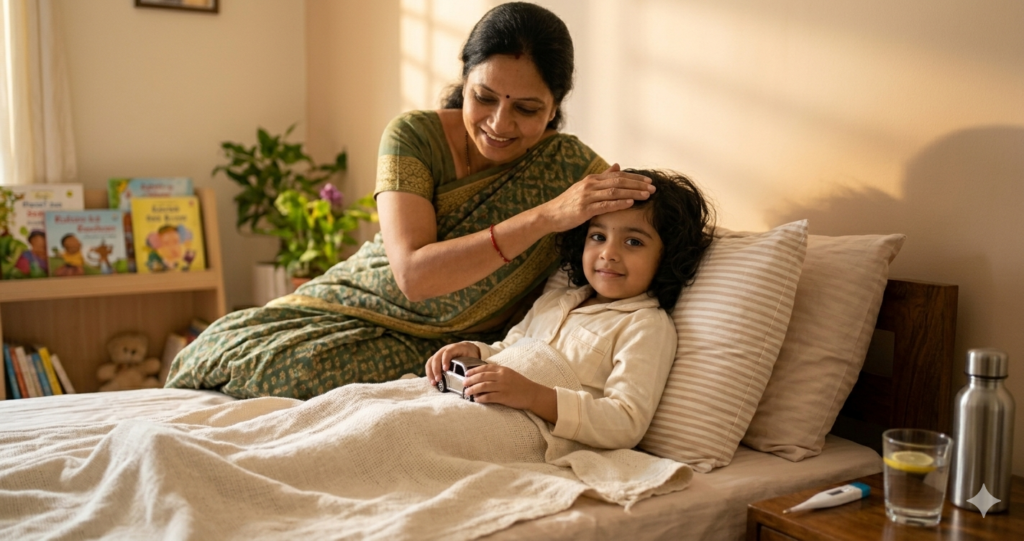
A fever is defined as a body temperature of 100.4°F or 38°C or higher. The exact reading that counts depends on where the temperature is measured. Rectal, ear, and forehead readings of 100.4°F or 38°C qualify as fever. Oral readings of 100°F or 37.8°C qualify. Underarm readings of 99°F or 37.2°C qualify. This distinction matters practically because many Indian parents use underarm thermometers and may get readings that seem lower than the true body temperature.
The most important thing to understand is that fever is not a disease. It is the immune system’s deliberate response to infection. Raising body temperature makes it harder for bacteria and viruses to survive and multiply. Reducing the fever does not cure the infection. It only relieves discomfort while the body continues its work.
The most common causes of fever in Indian children are viral respiratory infections, throat infections, ear infections, urinary tract infections, and post-vaccination reactions. A mild fever lasting about a day after vaccination is completely normal and expected. For older babies and children, the way the child is acting can often be more important than the number on the thermometer.
Most Fevers Resolve in 3 to 4 Days. Here Is How to Know When Yours Will Not.
Most viral fevers in children run their course within 3 to 4 days. If the fever is reduced with paracetamol, the child is drinking fluids, passing urine normally, and remaining reasonably alert, home monitoring is appropriate. However, if the fever has lasted more than 3 days and is showing no sign of reducing at all, a doctor must be consulted regardless of other symptoms.
- Watch for how fast the fever is rising. If the temperature is climbing rapidly within the first or second day, reaching high levels very quickly, this warrants early medical attention rather than waiting to see how it develops. Rapid escalation in the early days is a pattern worth taking seriously, not waiting out.
- Urine output is one of the most practical ways to monitor a child with fever. A child who is urinating normally with pale yellow urine is adequately hydrated. A child who has not urinated for 8 or more hours, or whose urine is very dark yellow, needs medical attention for dehydration. Dry lips and sunken eyes are other signs to watch for.
- Lethargy changes the picture entirely. A feverish child who is still somewhat alert, occasionally interested in surroundings, and responding to parents is very different from a child who is becoming progressively lethargic, difficult to wake, or unusually unresponsive. Lethargy alongside fever is always a reason to see a doctor promptly, not tomorrow, today.
Children who seem to be falling sick repeatedly with fever, cough, cold, or infections may also benefit from reading about frequent illness in children and when weak immunity may be a concern. And if anything feels unclear or wrong, call the clinic. Parents sometimes worry they are overreacting. A doctor can guide properly. Making decisions alone when something feels wrong is the only thing to genuinely avoid.
Age Changes Everything About Fever. The Younger the Child, the Faster You Should Act.
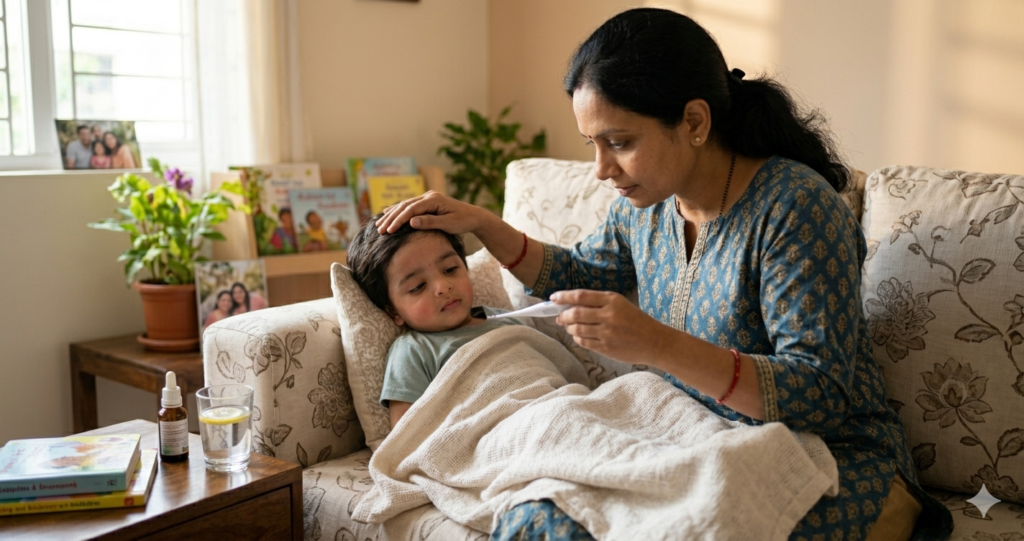
Age is the single most important factor in assessing how urgently a fever needs medical attention. A fever in a three-week-old baby and a fever in a seven-year-old are clinically very different situations, even if the thermometer reads the same number.
Any temperature of 100.4°F or 38°C or higher in a baby under 3 months is a medical emergency. Do not wait. Do not give medicine and watch at home. Go to the doctor or emergency room immediately. Young infants have immature immune systems and cannot fight serious infections the way older children can. What looks like a mild fever in this age group can escalate dangerously and quickly.
For babies aged 3 to 6 months, a temperature up to 102°F with the child appearing very lethargic or irritable warrants a call to the pediatrician without delay. For children aged 6 to 24 months, fever above 102°F lasting more than 24 hours should be evaluated by a doctor.
At any age, fever lasting more than 3 to 4 days, fever that does not respond to paracetamol or ibuprofen, or any fever in a child with a chronic health condition like sickle cell disease, cancer, or a heart condition requires prompt medical consultation without exception.
Warning Signs That Mean a Child Needs Medical Care Right Away
- Difficulty breathing, very fast breathing, or wheezing that does not improve can be a sign of a serious chest infection or pneumonia.
- Extreme sleepiness, unusual weakness, unresponsiveness, or difficulty waking the child is a serious warning sign.
- A stiff neck, severe headache, or strong sensitivity to light can point to meningitis.
- Purple or red spots on the skin that do not fade when pressed need emergency medical attention immediately.
- Blue lips, tongue, or fingernails can mean the child is not getting enough oxygen.
- A bulging or sunken soft spot on a baby’s head can be a sign of increased pressure or severe dehydration.
- Any seizure during a fever, even if it lasts only a short time, should be evaluated by a doctor the same day.
- Febrile seizures are more common in children between 6 months and 5 years, but they still need medical attention.
- Inconsolable crying that does not improve with feeding, holding, or comforting is another reason to seek care quickly.
What to Do When Your Child Has a Fever at Home?
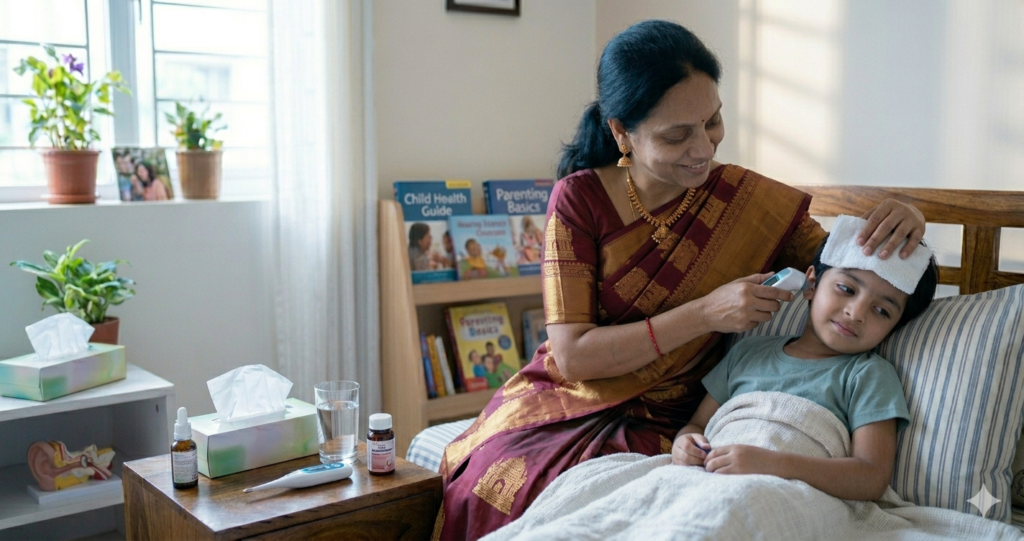
What actually helps: Paracetamol, also called acetaminophen, is the appropriate first-line medicine for fever in children and is safe from 3 months onwards. Always do it by the child’s weight, not by age. If unsure of the correct dose, call the clinic before giving any medicine. Ibuprofen is safe from 6 months onwards and can be used when paracetamol alone is not providing adequate comfort. Never give aspirin to children at any age. It is linked to a rare but serious condition called Reye syndrome.
Do not give any other medicines, cough preparations, or combination syrups without specific advice from a doctor. Many over-the-counter preparations are not appropriate for young children and some carry real risks that are not always obvious from the packaging.
Fluids are the most important home intervention. Offer breast milk, formula, water, diluted coconut water, or oral rehydration solution like Pedialyte regularly through the day. Avoid tea, cola, and caffeinated drinks. They worsen dehydration by increasing urination and should not be given to a child with fever for this reason.
Dress the child in light, breathable cotton clothing. A light sheet is fine if the child feels cold. Heavy blankets trap heat and worsen discomfort. A lukewarm sponge bath can help bring down temperature and provide comfort. Never use cold water, ice packs, or rubbing alcohol. Cold causes shivering which actually raises body temperature. Rubbing alcohol can be absorbed through the skin and is toxic in children.
What makes things worse: Giving double doses of medicine thinking it will work faster. Bundling the child tightly in heavy blankets to induce sweating. Giving adult medicine in reduced quantities. In many Mumbai households, home remedies including applying onion to the feet or giving concentrated tulsi-ginger decoctions are common practices. While these traditions come from genuine care, none of them replace appropriate medical treatment, and some delay it when time matters most.
Conclusion
Most fevers in children are caused by viral infections, resolve within 3 to 4 days, and do not require emergency treatment. The skill every parent needs is the ability to read how the child is doing alongside the thermometer reading. Fluid intake, urine output, alertness, and breathing matter as much as the number on the thermometer, sometimes more.
A child with a fever of 103°F who is still sipping water, looking around, and occasionally responding is in a very different situation from a child with a fever of 101°F who is completely unresponsive and has not urinated in ten hours. The number alone never tells the whole story.
Call the clinic when something feels wrong. A good pediatrician would always rather answer a call than have a parent wait too long at home with a child who needed care sooner.
Worried about your child’s fever or not sure whether to wait or visit? Call or book an appointment at Vivasvan Child Care Clinic, Mumbai. A quick consultation gives you the clarity and confidence every parent deserves when their child is unwell.
Frequently Asked Questions
Be concerned right away if a baby under 3 months has a fever of 38°C or higher. For older children, fever needs medical attention if it lasts more than 3 to 4 days, the child becomes very sleepy or hard to wake, urine becomes very dark, or warning signs like breathing difficulty, a rash, stiff neck, or seizure appear.
See a doctor if the child is under 3 months old, the fever lasts more than 3 days, does not improve with paracetamol, or the child is not drinking fluids well. Parents should also trust their instincts if something feels unusual or worrying.
Paracetamol is usually the safest first option for children over 3 months when given in the correct dose for weight. Ibuprofen can be used from 6 months onwards. Aspirin should never be given to children.
Go to the emergency room if a child has fever with breathing difficulty, extreme sleepiness, stiff neck, purple rash, blue lips, seizure, inconsolable crying, or a bulging or sunken soft spot on the head in babies.
Use Paracetamol in the right dose, offer plenty of fluids, dress the child in light clothing, and keep the room cool and comfortable. A lukewarm sponge bath can help. Avoid ice packs, cold baths, alcohol rubs, or heavy blankets.

Vivasvan Parekh
As a pediatrician and child specialist based in Mumbai, I bring over 15 years of experience in delivering comprehensive child healthcare. I hold an MD in Pediatrics and practice in Ghatkopar East and Chembur, where I focus on preventive and evidence-based pediatric care. My areas of expertise include vaccinations, newborn care, growth and development monitoring, and the treatment of common and complex childhood illnesses. I am committed to supporting parents with practical, reliable guidance on child health, nutrition, and overall well-being. Through my blog, I share trusted insights on pediatric health, helping parents make informed decisions about their child’s care and development.