
Quick Answer: Baby bottle tooth decay, also called early childhood caries, happens when milk, formula or other sugary liquids sit on a baby’s teeth for long periods, most often overnight, when saliva flow slows down. It usually starts on the upper front teeth as faint white lines near the gum. It’s common, preventable, and treatable when caught early.
- Milk and formula contain natural sugars that feed bacteria on the teeth, not just sweetened drinks.
- Saliva, which normally clears sugars away, flows far less during sleep, which is why night feeds carry more risk than daytime ones.
- The earliest sign is often chalky white lines near the gumline on the upper front teeth, easy to miss if not looked for.
- Very early white-spot decay can sometimes be strengthened with fluoride and better habits; an actual cavity needs dental treatment.
- Moving away from bottle-to-sleep habits around the first birthday is one of the single most protective steps a parent can take.
A Bottle at Bedtime, a Quiet Risk

A toddler settling to sleep with a bottle of milk propped in their mouth is one of the most common bedtime routines in Indian households, and one most parents have never thought to question. It’s soothing, it works, and for a long time it seems harmless. The trouble is what happens quietly afterward: that milk doesn’t just disappear once the baby falls asleep. It stays pooled around the teeth for hours, right when the mouth’s natural defences are at their lowest.
This is how baby bottle tooth decay gets started, not through neglect, but through a habit that feels completely ordinary. The reassuring part is that it’s both preventable and, if caught early, treatable, and understanding exactly how it happens makes the prevention steps much easier to follow.
What Is Baby Bottle Tooth Decay?
Baby bottle tooth decay, known clinically as early childhood caries, is tooth decay in infants and toddlers caused by repeated, prolonged contact between teeth and sugary liquids, including milk, formula, and juice. It typically affects the upper front teeth first, since these are the teeth that stay in contact with liquid longest during a feed, while the tongue tends to shield the lower front teeth.
Baby teeth matter more than their short lifespan suggests. They hold space for adult teeth to come in correctly, support clear speech development, and allow proper chewing during a period when nutrition is being established. Decay in baby teeth isn’t a problem that can simply be ignored until they fall out on their own.
How Night Feeds Cause Tooth Decay
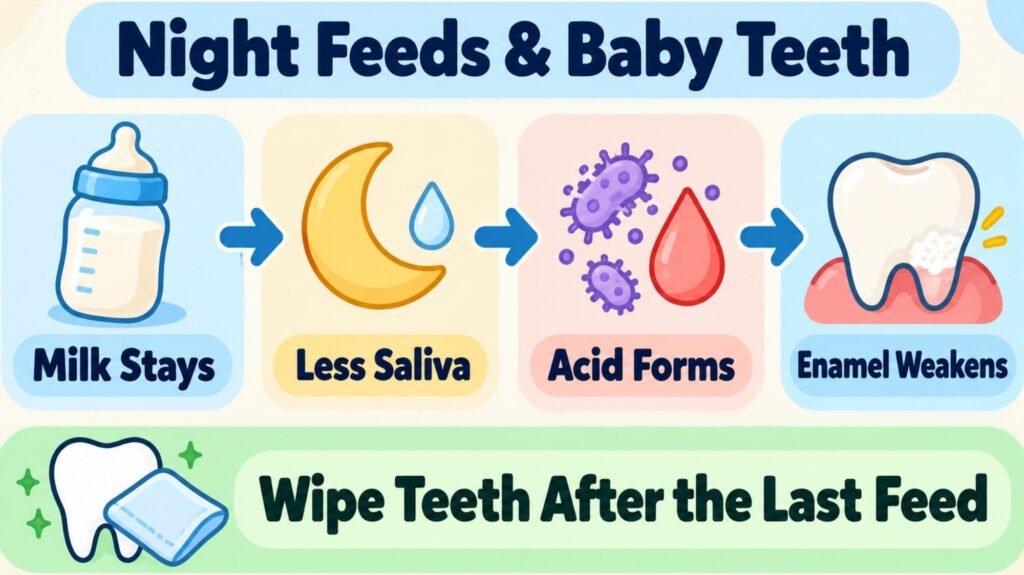
During sleep, saliva production drops significantly. Saliva normally does a lot of quiet work, washing away food particles and sugars, and neutralising the acid that bacteria produce. With far less saliva circulating overnight, any milk or formula left on the teeth sits there far longer than it would during the day, giving bacteria extended time to convert that sugar into acid that wears down enamel.
This applies across feeding methods, not just bottles. A baby who falls asleep bottle-feeding, breastfeeding frequently through the night once teeth have erupted, or sucking on a pacifier that’s been dipped in something sweet are all variations of the same mechanism.
It’s worth being clear on one point many parents worry about: breast milk remains the recommended feed for infants, and breastfeeding itself is not the problem. The risk rises specifically when frequent night feeds are combined with no tooth cleaning once teeth are present, not from breastfeeding as a practice.
Signs and Stages of Bottle Tooth Decay
Early childhood caries tend to progress in a recognisable pattern, and catching it at the earliest stage makes a real difference to how it’s treated.
| Stage | What it looks like | What it means |
| Early (white spot) | Chalky white lines or patches near the gumline on upper front teeth | Enamel is losing minerals; often reversible with fluoride and habit changes |
| Moderate | Yellow or light brown discoloration on the tooth surface | Decay has progressed into the enamel; needs a dentist’s evaluation |
| Advanced | Brown or black spots, visible pits, or chipped tooth edges | A cavity has formed; dental treatment is needed |
| Severe | Swelling of the gum, pus, or a broken tooth near the gumline | Possible infection; needs prompt dental attention |
The earliest stage is also the easiest one to miss, since white spots near the gumline don’t look dramatic and are easy to overlook during a quick morning routine.
How to Prevent It
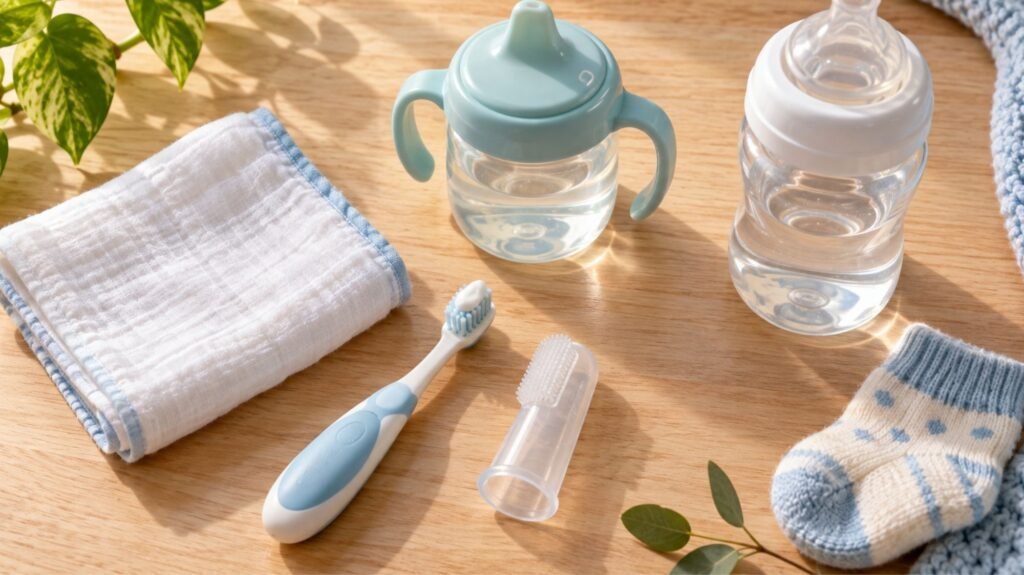
Most prevention here comes down to a handful of specific, manageable habits rather than any single dramatic change:
- Avoid putting a baby to sleep with a bottle of milk, formula, or juice
- Wipe the gums and teeth with a clean, damp cloth after the last feed of the day
- Brush from the first tooth onward, using a smear of fluoride toothpaste appropriate for the baby’s age
- Fill the bedtime or nap-time bottle with plain water only, once any other liquid habit needs breaking
- Move from a bottle to a cup around the first birthday
- Avoid routinely offering juice or other sweetened drinks in a bottle
- Keep up with regular dental visits, starting around the first tooth or first birthday
None of these require giving up night feeding altogether, they’re about what happens to the teeth immediately afterward.
Night Feeds: What to Do If Your Baby Still Wakes to Feed
Plenty of babies past one year still wake for a night feed, and that alone isn’t something to feel guilty about. A practical approach that works for many families: finish the feed as usual, then wipe or brush the teeth before settling the baby back to sleep, rather than letting them drift off with milk still in the mouth. From there, night feeds can be reduced gradually, with guidance from the paediatrician on a pace that suits the baby.
Treatment Options
Treatment depends entirely on the stage caught. Early white-spot decay can often be managed with fluoride varnish applications and the habit changes described above, no drilling or procedures needed at this stage. Once an actual cavity has formed, treatment typically involves fillings, and in more advanced cases, crowns or extraction of the affected tooth. For very young children needing more extensive work, a dentist may discuss sedation or general anaesthesia as an option to keep the child comfortable and still during treatment, this is a standard part of paediatric dental care, not a sign that anything has gone unusually wrong.
When to See a Pediatric Dentist
A dental visit is worth arranging for:
- Any white, yellow, brown, or black spots noticed on the teeth
- The first tooth’s appearance, or by the first birthday, whichever comes first
- Visible gum swelling or pus near a tooth
- A baby or toddler refusing food, which can sometimes point to tooth pain
Catching changes early keeps treatment simpler and less invasive.
Conclusion
Baby bottle tooth decay is common precisely because the habits behind it feel so ordinary, there’s no need for guilt, only a few adjustments to the bedtime routine. Wiping teeth after the last feed, moving toward water in the night bottle, and keeping up with early dental visits go a long way toward protecting those first teeth.
If white spots, discoloration, or any dental concern have already been noticed, it’s worth getting it looked at sooner rather than later. Book a dental check-up with Child Care Clinic Mumbai to have it properly assessed.
Frequently Asked Questions
Frequent or prolonged contact between teeth and milk, formula, juice, or other sugary liquids, especially overnight, allows bacteria to produce acid that damages enamel over time.
Breast milk is the recommended feed for infants. Cavities become more likely when frequent night feeds are combined with no tooth cleaning. Wiping or brushing teeth before sleep once they’ve erupted lowers that risk.
Chalky white lines or patches near the gums on the upper front teeth are usually the earliest sign, often followed by yellow or brown spots if left unaddressed.
Very early white-spot decay can sometimes be strengthened with fluoride treatment and improved habits. Once an actual cavity has formed, it needs dental treatment rather than home reversal.
Most dentists recommend moving to a cup around the first birthday and ending bottle-to-sleep habits as early as practical. A paediatrician can help plan a gradual transition.
Medically reviewed by Dr. Vivasvan Parekh, Child Care Clinic Mumbai.

Vivasvan Parekh
As a pediatrician and child specialist based in Mumbai, I bring over 15 years of experience in delivering comprehensive child healthcare. I hold an MD in Pediatrics and practice in Ghatkopar East and Chembur, where I focus on preventive and evidence-based pediatric care. My areas of expertise include vaccinations, newborn care, growth and development monitoring, and the treatment of common and complex childhood illnesses. I am committed to supporting parents with practical, reliable guidance on child health, nutrition, and overall well-being. Through my blog, I share trusted insights on pediatric health, helping parents make informed decisions about their child’s care and development.