
Quick Answer: Constipation in babies and toddlers usually shows up as hard, pellet like stools, visible straining, or fewer than three bowel movements a week. It’s often triggered by starting solids, switching to formula, dehydration, or a toddler holding back stool out of fear. Most cases settle within a few days using fluids and fiber at home. A doctor visit is needed if the problem lasts beyond two weeks or comes with vomiting, blood, or a swollen belly.
At a glance:
- Breastfed babies can go up to a week between stools and still be perfectly fine
- Formula fed babies and toddlers going fewer than three times a week is worth watching
- The fastest home fixes are extra fluids, fruit puree, tummy massage, and movement
- Get medical help if there’s no stool for three or more days along with vomiting, blood in the stool, or the baby is under two months old

A Familiar Scene in the Clinic
A mother once walked in holding her ten month old son, certain something was badly wrong. He’d gone red in the face, drawn his knees up, and cried through what looked like a painful, effortful attempt to pass stool. By the time she reached the clinic, she’d already convinced herself it was serious. It wasn’t. His stool was soft. He was simply learning to coordinate muscles that hadn’t fully matured yet.
This kind of worry is common, and it’s completely understandable. Up to 30 percent of children experience constipation at some point in early childhood, and for a first time parent, every strain or grunt can feel like an emergency. The good news is that true constipation in babies is usually easy to spot once a parent knows what to actually look for, and it responds well to a handful of simple changes at home. This guide walks through the real causes, what genuinely helps, and the specific signs that mean it’s time to see a pediatrician.
Is It Really Constipation, or Just a Normal Baby Thing?
Constipation means passing hard, dry stool with visible pain or straining, not simply going a few days without a bowel movement. That distinction matters more than most parents realize.
In the first month of life, babies tend to have a bowel movement roughly once a day. After that, things slow down naturally, especially in breastfed babies, who can go anywhere from a few days to a full week between stools without any problem at all. Straining, grunting, and going red in the face during a bowel movement is also normal for young infants, whose abdominal muscles are still weak. As long as the stool that eventually comes out is soft, there’s no cause for concern.
How Often Should a Baby Poop?
- Newborns (first month): about once a day
- Formula fed infants: anywhere from daily to every other day
- Breastfed infants: can range from several times a day to once a week
- Toddlers: fewer than three bowel movements a week is the point where a pediatrician would start paying closer attention
Constipation vs Colic: Don’t Confuse the Two
These two get mixed up often, and understandably so, since both involve a fussy, uncomfortable baby. Colic shows up as crying without a clear cause, typically worse in the evenings, and it isn’t tied to stool consistency at all. Constipation, on the other hand, is directly linked to hard stool and visible straining during an actual bowel movement attempt. A baby with colic can have perfectly normal stools. A baby with constipation usually can’t.
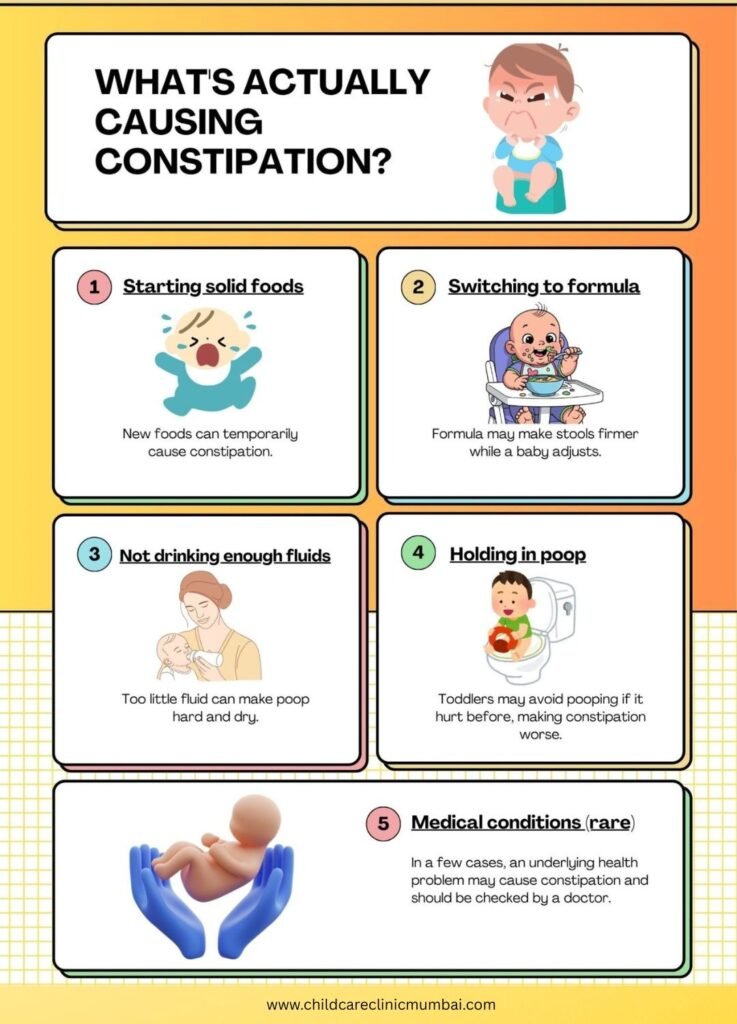
What’s Actually Causing Constipation?
- Starting solids or switching to formula is by far the most common trigger in the first year. A baby’s gut has to adjust to an entirely new set of proteins and fibers, and that adjustment period can slow things down for a week or two.
- Not drinking enough fluids is another major factor, and it deserves particular attention for families in Mumbai, where heat and humidity push up fluid loss far more than most parents expect. A baby who seems perfectly hydrated on a cooler day can still end up mildly dehydrated during a hot, humid spell, and dry stool is often the first sign.
- Toilet training and withholding tend to explain most cases in toddlers. Once a child experiences one painful bowel movement, a very natural but unhelpful pattern sets in: they hold back the next one out of fear, the stool sits longer and gets harder, and the next attempt hurts even more. Pediatric literature refers to this as a vicious cycle, and breaking it usually matters more than any single remedy.
- Rare medical causes do exist, including conditions like Hirschsprung disease or an underactive thyroid, but these are uncommon and usually come with other clear warning signs from very early infancy. A pediatrician can rule these out quickly during a physical exam, so there’s rarely a need to jump to the worst case scenario.
Safe Home Remedies That Actually Work
Extra fluids, fiber rich foods, and gentle movement, not laxatives, are the right first step for the vast majority of babies and toddlers.
| Age Group | Normal Pattern | Signs of Concern | First Step at Home |
| Newborn (0 to 2 months) | About once a day, though some variation is normal | No stool for more than 2 days along with vomiting, bloating, or unusual fussiness | Contact the pediatrician instead of trying home remedies |
| Breastfed Infant | Can go several days or even up to a week between bowel movements | Hard, pellet-like stools, blood in the stool, or visible pain while passing stool | If older than 2 months, discuss giving small amounts of extra fluids with the pediatrician |
| Formula Fed Infant | Usually once a day to every other day | No bowel movement for 3 or more days, especially if accompanied by discomfort | After medical guidance, small amounts of diluted prune or pear juice may help |
| Toddler | Typically at least 3 bowel movements per week | Stool withholding, significant straining, or fewer than 3 stools weekly for more than 2 weeks | Encourage fiber-rich foods, adequate hydration, physical activity, and a relaxed toilet routine |
- Hydration: For babies past two months old, cooled boiled water offered between feeds can help soften stool. Small amounts, around 2 to 4 ounces, of pear, prune, or apple juice are also commonly recommended, though it’s worth checking dosing with a pediatrician first rather than guessing.
- Fiber rich foods: Pureed pear, prune, and peach work well once solids have started. As a toddler grows, everyday Indian kitchen staples like oats, moong dal with vegetables, and soft cooked spinach all add useful fiber without needing anything unusual. Many households also reach for ghee in warm milk or jaggery based remedies, and while these are common traditions, they aren’t backed by strong clinical evidence, so they shouldn’t replace the basics of fluids and fiber. Licorice root in particular should be avoided in young children altogether, since it can affect blood pressure and potassium levels.
- Movement and massage: Gently cycling a baby’s legs, or massaging the tummy in a clockwise direction, can stimulate the gut and ease things along. For toddlers, simple active play throughout the day does much the same job.
- Warm baths and toilet posture: A warm bath just before attempting a bowel movement can relax tense abdominal muscles. For toddlers on the toilet, a stool or foot support that lifts the knees above hip level makes passing stool noticeably easier and less frightening.
What Home Remedy Helps Baby Constipation?
Extra fluids, a small amount of pureed prune or pear, and gentle tummy massage are usually enough to bring relief within a day or two. If nothing changes after that, it’s worth stepping back and looking at the bigger picture rather than trying remedy after remedy.
When to See a Doctor
- No bowel movement for three or more days along with vomiting or irritability
- Baby is younger than two months old
- Blood in the stool or visible cracks and fissures around the anus
- A firm, swollen belly with ongoing pain
- No real improvement after two weeks of home care
- A newborn who hasn’t passed their first stool within 48 hours of birth, which hospital staff usually flag before discharge
Any of these deserve a proper in person evaluation rather than another home remedy. At Vivasvan Child Care Clinic in Chembur, Mumbai, infants and children receive gentle, age appropriate assessments to identify the cause of constipation and ensure safe, effective treatment tailored to their needs.
The Takeaway
Most constipation in babies and toddlers is a passing phase tied to diet, hydration, or one bad experience on the toilet, not a sign of something seriously wrong, and it usually responds well to simple changes at home within a few days. Watching for the red flags above, rather than guessing, is what separates ordinary parental worry from a situation that genuinely needs medical attention.
If home remedies aren’t helping after two weeks, or if any warning sign shows up sooner, booking a consultation at Vivasvan Child Care Clinic is a straightforward next step, and often brings far more peace of mind than another late night search online.

Frequently Asked Questions
Newborns typically pass stool about once a day in the first month. After that, breastfed babies can range from several times a day to once a week, while formula fed babies tend to go daily or every other day. Toddlers going fewer than three times a week is generally the point worth watching.
Extra fluids, small amounts of pureed prune or pear, gentle leg cycling, and a clockwise tummy massage are the most reliable first steps, and they usually bring relief within a day or two.
Yes, switching to formula or changing formula brands can temporarily slow a baby’s digestion while the gut adjusts to different proteins. This usually settles within a week or two on its own.
A doctor visit is needed if there’s no stool for three or more days along with vomiting, if there’s blood in the stool, if the baby is under two months old, or if home remedies haven’t helped after two weeks.
Yes. Breastfed babies can go anywhere from a few days to a full week between bowel movements without it being a problem, as long as the stool is soft when it does come and the baby seems otherwise comfortable

Vivasvan Parekh
As a pediatrician and child specialist based in Mumbai, I bring over 15 years of experience in delivering comprehensive child healthcare. I hold an MD in Pediatrics and practice in Ghatkopar East and Chembur, where I focus on preventive and evidence-based pediatric care. My areas of expertise include vaccinations, newborn care, growth and development monitoring, and the treatment of common and complex childhood illnesses. I am committed to supporting parents with practical, reliable guidance on child health, nutrition, and overall well-being. Through my blog, I share trusted insights on pediatric health, helping parents make informed decisions about their child’s care and development.