
At a Glance
Ear infection in children happens when fluid builds up behind the eardrum after a cold, causing pain, fussiness, and sometimes fever, and most mild cases clear on their own within two to three days without antibiotics, though certain red-flag symptoms always need a pediatrician’s evaluation.
- Main cause: A blocked Eustachian tube, usually after a cold or blocked nose, traps fluid behind the eardrum.
- Most common age group: Babies and toddlers between 6 months and 2 years, due to shorter, more horizontal ear tubes.
- Top symptoms: Ear tugging, night-time crying, fever, reduced appetite, and trouble sleeping flat.
- First response: Pain relief and observation for 48–72 hours in most healthy children over 6 months.
- When antibiotics are needed: High fever above 102°F, symptoms lasting beyond 2–3 days, both ears involved in infants, or visible ear discharge.
- Prevention: Breastfeeding, upright feeding position, avoiding smoke exposure, and staying current on vaccinations.
Introduction
Nearly one in every two children will have had at least one ear infection by their first birthday, and by age three, close to 80% will have experienced one. For a parent standing in the clinic waiting room at 2 a.m. with a screaming toddler pulling at their ear, that statistic offers little comfort, what matters is knowing what’s actually happening inside that tiny ear canal, and whether antibiotics are the answer or an unnecessary detour. Ear infections are loud, dramatic, and genuinely painful for a child, yet the treatment path is often far calmer than parents expect. This guide walks through the real causes, the signs that separate a routine infection from an urgent one, and the honest answer to the question every parent eventually asks: does my child actually need antibiotics, or does this ear just need time?
What Exactly Is Happening Inside a Child’s Ear?
A middle ear infection, medically called acute otitis media, occurs when the narrow tube connecting the back of the throat to the middle ear, called the Eustachian tube, gets blocked. In children, this tube runs shorter, straighter, and more horizontal than in adults, which is precisely why toddlers get ear infections so often and adults rarely do. When a common cold, allergy, or blocked nose causes swelling, fluid that should normally drain away instead pools behind the eardrum. Bacteria or viruses already present in that trapped fluid multiply, pressure builds against the eardrum, and the result is the sharp, throbbing ear pain that sends a two-year-old into a full meltdown by evening.
Causes of Ear Infection in Children
A blocked or swollen Eustachian tube is the single biggest driver of childhood ear infections, and it almost always follows a respiratory illness. The most common contributors seen in clinic include:
- A recent cold, flu, or blocked nose that hasn’t fully cleared
- Enlarged adenoids pressing against the Eustachian tube opening
- Bottle-feeding while lying flat, which lets milk pool near the tube opening
- Exposure to household smoke or heavy dust, both common in dense Mumbai households
- Seasonal allergies and monsoon-related sinus congestion
- Daycare exposure, where cold viruses circulate constantly among young children
- A family history of frequent ear infections
Ear Infection Symptoms in Children: The Signs Parents Actually Notice First
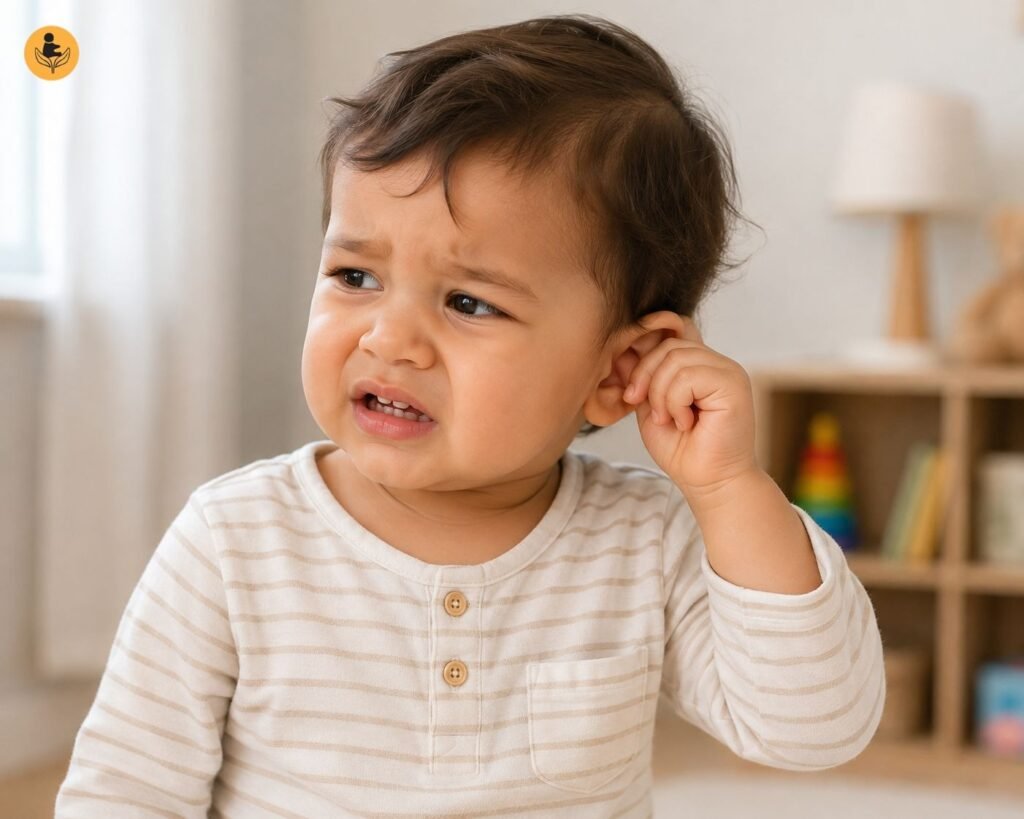
Ear pain, tugging at the ear, sudden fussiness, and disrupted sleep are the four earliest and most reliable signs of an ear infection in a child. Because toddlers and babies cannot say “my ear hurts,” parents usually notice a pattern of behaviour rather than a single symptom.
Signs of Ear Infection in Toddlers and Older Children
- Pulling, tugging, or rubbing at one ear repeatedly
- Sudden irritability, especially in the evening when lying flat increases pressure
- Trouble sleeping or waking up crying at night
- Reduced appetite, particularly reluctance to chew
- Mild to moderate fever
- Complaints of “my ear feels blocked” or reduced response to sound
- Yellowish or clear fluid draining from the ear (a sign the eardrum has released pressure)
Ear Infection in Babies: What Looks Different
In infants under one year, the signs are subtler and easy to miss during a rushed feed. Watch for a baby who suddenly turns away from the bottle or breast mid-feed (sucking changes pressure in the ear and can worsen pain), unexplained crying that intensifies when laid flat for a nappy change, low-grade fever, and general fussiness that doesn’t settle with the usual soothing routine.
Ear Infection vs. Common Cold: How To Tell Them Apart
A running nose alone rarely means an ear infection, it’s the combination of symptoms that matters. A child with only a cold will have a runny or blocked nose, mild cough, and normal sleep once the congestion is managed. A child developing a middle ear infection layers something extra on top: a very specific, one-sided pain response, tugging at one ear, tilting the head, or crying sharply when lying on one side, combined with a fever that climbs rather than settles after two to three days of a cold. That shift from “just a cold” to “cold plus focused ear pain” is usually the clearest clinical clue.
Ear Infection Treatment for Children: What Actually Happens at the Clinic
Most middle ear infections in healthy children over six months old improve on their own within 48 to 72 hours with pain control alone, without needing antibiotics. This surprises many parents, but it reflects strong pediatric evidence: a large share of ear infections are viral or resolve as the body’s own immune response clears the fluid.
The first line of treatment usually includes:
- Age-appropriate paracetamol or ibuprofen for pain and fever, dosed by the child’s weight
- Keeping the child upright during feeds and rest to ease ear pressure
- Warm compresses held gently against the outer ear
- Close observation for 48–72 hours, with a scheduled recheck if symptoms haven’t eased
Antibiotics for Ear Infection in Children: When They’re Actually Needed
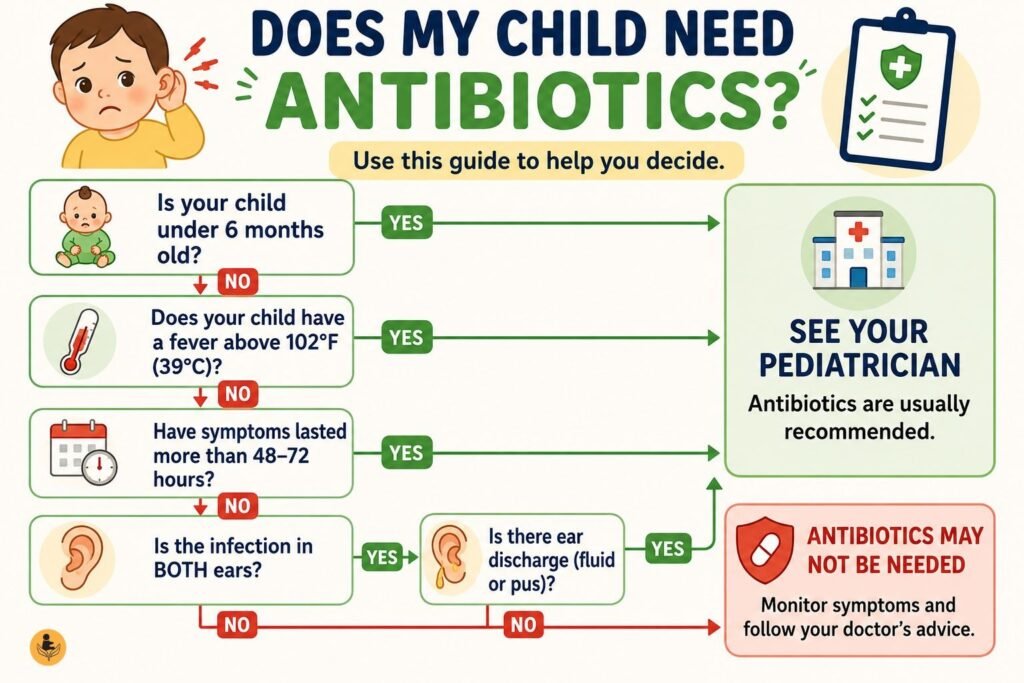
Antibiotics are recommended when a child is under six months old, has a fever above 102°F (39°C), has symptoms lasting more than 48–72 hours without improvement, has infection in both ears, or has visible fluid draining from the ear. Outside these situations, a “wait-and-watch” approach with pain relief is usually the more medically sound choice, not a shortcut, but the evidence-based standard of care. Overusing antibiotics for infections that would have resolved on their own contributes to antibiotic resistance and unnecessary side effects like diarrhoea and rash, without speeding up recovery. This is exactly why a pediatric evaluation, rather than a home guess or a pharmacist’s recommendation, should guide the decision.
A Word on Home Remedies
Instilling oil, garlic drops, or warm mustard oil into a child’s ear, a practice still common in many Indian households, should be avoided. If the eardrum has already ruptured to release pressure (visible as discharge), any liquid poured into the canal can worsen infection or cause lasting damage. Pain relief and a timely clinic visit remain the safest path.
Recurrent Ear Infections in Children: When Three Becomes a Pattern
A child who has three or more ear infections within six months, or four within a year, is considered to have recurrent otitis media. This pattern often points to persistently enlarged adenoids, chronic allergy-driven congestion, or fluid that never fully clears between episodes (known as glue ear). These children benefit from a focused ENT and pediatric assessment, since repeated fluid buildup, even without obvious pain, can quietly affect hearing and speech development during a critical stage of language learning.
Prevention: Reducing the Odds Before the Next Cold Hits
- Continue breastfeeding where possible; breastfed babies show lower rates of ear infection
- Feed babies in an upright position rather than lying flat with a bottle

- Keep vaccinations on schedule, the pneumococcal and flu vaccines both reduce ear infection risk (see the clinic’s vaccination and immunization guide for the current schedule)
- Limit exposure to household smoke and strong incense in enclosed rooms
- Wash hands frequently, especially during monsoon and winter cold season
- Avoid prolonged dummy/pacifier use past 12 months, which has been linked to higher recurrence
A Note on Safe Sleep and SIDS During Ear Infections
When a child is uncomfortable with ear pain, parents naturally want to comfort them through the night, but safe sleep practices should never be relaxed, even during illness. Infants under 12 months should always sleep on their back, on a firm, flat mattress, in a crib free of pillows, soft toys, and loose bedding, whether well or unwell. Propping a baby on their side or stomach to “ease ear pressure,” or letting an unwell infant sleep in a car seat or on a parent’s chest overnight, increases the risk of Sudden Infant Death Syndrome (SIDS) and should be avoided regardless of how fussy the night has been. If comfort is needed, holding the baby upright while awake and then returning them to a safe, flat crib position for sleep is the safer routine.
Quick Reference: Ear Infection at a Glance
| What Parents Want to Know | What To Expect |
| Common age affected | 6 months to 2 years, tapering after age 5 |
| Main early sign | Ear tugging, fussiness, disrupted sleep |
| Usual cause | Blocked Eustachian tube after a cold |
| Fever pattern | Mild to moderate; high fever needs review |
| First step at home | Paracetamol/ibuprofen, upright rest, observe 48–72 hrs |
| When antibiotics help | Age under 6 months, high fever, symptoms beyond 72 hrs, both ears, or discharge |
| Home oil drops | Not recommended, especially with any discharge |
| Recurrence pattern | 3+ infections in 6 months warrants ENT referral |
| Prevention | Vaccination, upright feeding, breastfeeding, reduced smoke exposure |
Conclusion
Ear infections are one of the most common reasons parents bring a child into a clinic, and they are almost always more frightening in the moment than they are dangerous in the outcome. Most cases, in most children, with simple pain relief and a short period of watchful waiting, antibiotics have their place, but that place is guided by clear clinical signs, not by an ear that merely looks red on one visit. What matters most is knowing which symptoms call for immediate attention and which call for a warm compress and a good night’s rest. If a child has been tugging at an ear, running a fever, or simply hasn’t seemed like themselves for more than a day or two, it’s always worth having it checked rather than guessing at home.
Book a consultation with Vivasvan Parekh Child Care Clinic in Chembur, Mumbai for a proper ear examination and a treatment plan built around your child, not a generic prescription.
Frequently Asked Questions
Look for repeated ear tugging, sudden fussiness that worsens when lying flat, crying that spikes during feeds, low-grade fever, and disturbed sleep. These combined signs are more reliable in babies than any single symptom alone.
No. Most healthy children over six months old improve within 48–72 hours using pain relief alone. Antibiotics are generally reserved for infants under six months, high fever, symptoms lasting beyond two to three days, both ears affected, or visible ear discharge.
Yes, and there’s a clear reason: lying flat increases pressure on the already inflamed middle ear, which is why children often seem fine in the morning and miserable by bedtime.
Air travel can be uncomfortable during an active infection due to pressure changes, and swimming should be avoided if there is any ear discharge or a known eardrum perforation. A quick check with the pediatrician before travel or swimming is the safest approach.
Seek urgent care if there is high fever with stiff neck, swelling or redness behind the ear, severe unrelenting pain, or if the child appears unusually drowsy or difficult to wake, these can signal a rarer but serious complication that needs immediate evaluation.

Vivasvan Parekh
As a pediatrician and child specialist based in Mumbai, I bring over 15 years of experience in delivering comprehensive child healthcare. I hold an MD in Pediatrics and practice in Ghatkopar East and Chembur, where I focus on preventive and evidence-based pediatric care. My areas of expertise include vaccinations, newborn care, growth and development monitoring, and the treatment of common and complex childhood illnesses. I am committed to supporting parents with practical, reliable guidance on child health, nutrition, and overall well-being. Through my blog, I share trusted insights on pediatric health, helping parents make informed decisions about their child’s care and development.