
Quick answer:
Early signs of autism or developmental delay often show up before speech does in eye contact, response to name, shared enjoyment, play patterns, and reactions to sound or touch. Watching these areas alongside speech gives a fuller picture and helps parents raise concerns early rather than waiting to see how things go.
- Many early signs of autism appear in social connection and play, not only in delayed talking
- Not responding consistently to their name by 12 months is worth mentioning at the next visit
- Reduced pointing, showing, or sharing enjoyment with a caregiver by 15–18 months is a meaningful cue
- Unusual reactions to sound, light, or touch, or repetitive movements, can appear alongside or before speech delay
- A developmental screening conversation with a paediatrician does not mean a diagnosis it means getting clarity
A common moment in the clinic: a parent brings in a bright, active two-year-old, worried mainly that he isn’t talking as much as his cousin. Speech gets noticed first because it’s easy to compare and count words. But some of the earliest, most useful signs of autism or developmental delay show up well before or alongside speech in how a child looks at a caregiver’s face, responds to their name, plays with toys, or reacts to a loud mixer grinder in the kitchen. The World Health Organization estimates that autism affects roughly 1 in 100 children worldwide, and the Indian Academy of Pediatrics recommends universal screening at 18 and 24–30 months precisely because these non-speech signs are so often the first ones to appear. This piece walks through what those signs look like, what counts as normal variation, and when a conversation with a paediatrician is worth having.
What Counts as an Early Sign of Autism, Beyond Speech?
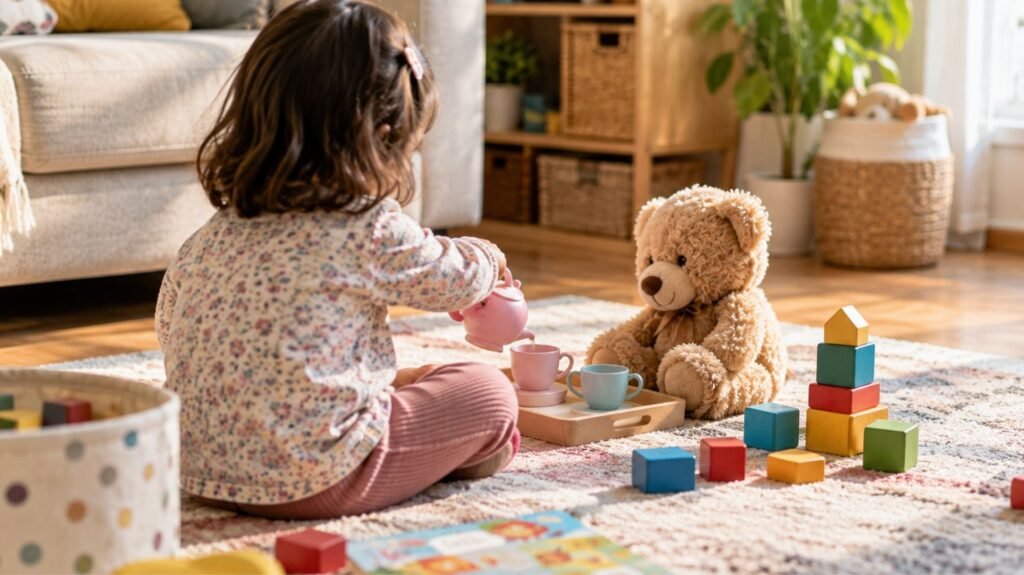
Long before a toddler is expected to string words together, most babies are already doing something quietly remarkable: checking a parent’s face to see if a new sound or sight is safe or exciting, lifting their arms to be picked up, or turning toward their name across a noisy room. These small behaviours are called joint attention and social referencing, and they typically show up well before first words. When they’re consistently missing or delayed, it’s worth noting not panicking about, just noting, the way a good check-up notices anything worth a second look.
The earliest signs of autism usually involve this kind of social connection and play, rather than vocabulary alone. A toddler can have very few words and still be developing typically if they consistently make eye contact, share enjoyment with a caregiver, and engage in imaginative play. The reverse is also true, and less commonly discussed: a toddler can have an impressive vocabulary and still show signs worth exploring, if the social and play patterns look different from what’s expected.
Signs by Age: 12, 18, and 24 Months
Different social and play skills are expected at each stage, and a single missed milestone at one check-up is far less concerning than a pattern that repeats across several visits.
By 12 months, most babies respond to their name most of the time, babble with changing tones as if trying out a conversation, and point or reach to show interest rather than only to get something they want. By 18 months, toddlers typically use a few gestures alongside their words waving, or bringing a toy over just to share the moment rather than to hand it off and start imitating simple actions like clapping or feeding a doll. By 24 months, simple pretend play usually appears (feeding a toy, “talking” on a toy phone), along with combining two words together and showing curiosity about other children, even before they’re ready to properly play together.
A toddler who is quieter than others but still consistently makes eye contact, shares enjoyment, and engages in pretend play is often well within the range of normal variation; some children are simply more reserved talkers. A toddler who has strong vocabulary for their age but rarely makes eye contact, doesn’t show interest, or shows little interest in other children represents a different pattern worth discussing, even in the complete absence of a speech delay.
Social and Communication Cues Parents Often Overlook
A few subtle behaviours are commonly missed because, day to day, they don’t look dramatic:
- Rarely making eye contact during feeding, play, or being held
- Not pointing to show a parent something interesting, as opposed to pointing to request something
- Limited response to their name being called, especially when it happens consistently rather than only during distraction
- Little interest in sharing enjoyment with a caregiver for instance, not looking back at a parent after doing something fun, the way most toddlers instinctively do
None of these on its own is unusual once in a while. What matters is whether it’s the pattern across most days, most settings, and most people the child interacts with.
Sensory Signs Parents Often Miss

Unusual reactions to sound, touch, light, or textures either heightened sensitivity or an apparent lack of reaction can be an early sign, quite separate from any speech concern. Some toddlers cover their ears at ordinary household sounds like a mixer or a pressure cooker whistle; others seem not to react at all to loud noises that startle everyone else in the room. Some resist certain clothing textures, socks, or hair oiling far more intensely than typical toddler fussiness would suggest. Others actively seek out repetitive sensory input spinning objects, staring at ceiling fans, or flapping their hands when excited.
On its own, any single one of these behaviours is common in typically developing toddlers too. The pattern and intensity across several areas at once is what tends to matter more than any one behaviour in isolation.
Motor and Play-Based Signs
Lining up cars or blocks in the same way every time, focusing intensely on spinning parts of toys rather than how they’re meant to be used, or becoming distressed by small changes to a play sequence or daily routine are patterns worth noting especially alongside the social and sensory cues above. Motor delays, such as not sitting, crawling, or walking within the expected windows, are a separate but related reason for a developmental conversation, since they fall under the same broad umbrella of developmental screening.
A Real Pattern Seen in Clinic
A common scenario in general paediatric practice: parents bring in a toddler around twenty months, mainly worried that he isn’t saying many words yet, while an older relative reassures them that “boys talk late” or that his father spoke late too and turned out fine. On closer conversation, it often turns out the toddler does respond to his name, points to show his mother a passing dog, and enjoys peekaboo reassuring social signs that matter more than word count alone.
A different, anonymised pattern seen across many clinics looks quite different on the surface: a toddler with an unusually large vocabulary for pictures and numbers shows little interest in pointing things out to a parent, rarely makes eye contact during play, and becomes intensely upset by small changes to a daily routine. Despite completely normal, even advanced speech, this pattern looks less like “just quiet” and more worth a structured screening conversation.
A common misconception in Indian households is that a child who is otherwise “smart” good with rhymes, numbers, or gadgets cannot also have a developmental concern. Strong memory or number skills and social-communication differences can exist side by side; one doesn’t rule out the other. Another frequent belief is that head-massage oils, particular diets, or “he’ll catch up once he starts school” are a substitute for a developmental conversation. None of these replace a proper screening when a pattern of signs is present; they can sit alongside good medical care, but not instead of it.
Normal Variation vs. Signs Worth Discussing
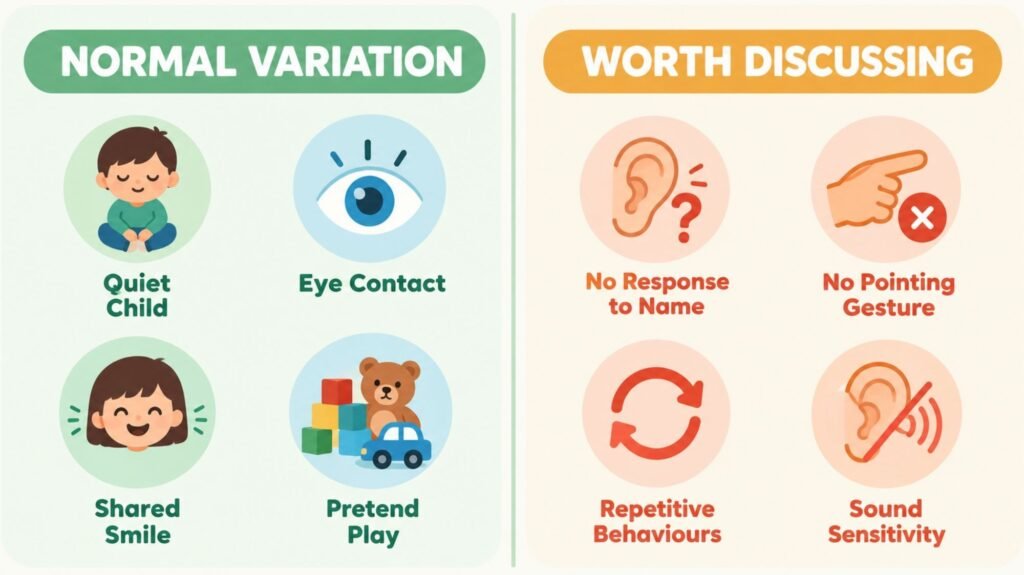
| Area | Normal Variation | Worth a Developmental Conversation |
| Eye contact | Looks away sometimes, especially when shy with strangers | Rarely makes eye contact even with familiar caregivers during play or feeding |
| Response to name | Occasionally ignores name when deeply focused on an activity | Consistently doesn’t respond to name across several settings and check-ups |
| Pointing/showing | Points mainly to request things (“give me that”) | Rarely or never points to share interest (“look at that!”) by 15–18 months |
| Play | Prefers certain toys but plays in varied ways | Repetitive play only (lining up, spinning parts), with little pretend play by 24 months |
| Sensory response | Mild reactions to loud noise or new textures | Strong, frequent distress or a complete lack of reaction to sound, light, or touch across settings |
| Speech | Fewer words than peers but uses gestures and engages socially | Speech delay combined with reduced social engagement or unusual play patterns |
What Parents Can Do
A simple diary noting what is and isn’t observed name response, pointing, and pretending play is genuinely useful to bring to the next visit; it’s easy to forget the details of a Tuesday afternoon by the time a check-up happens weeks later. Getting down to floor level for daily back-and-forth play helps too, with attention on whether the child shares enjoyment, not just whether they comply with a request. Narrating daily routines out loud describing what’s happening while making tea, folding clothes, or getting ready to leave the house supports language naturally, without pressuring a child to repeat words on demand.
A few things are worth avoiding. Comparing a child to siblings or cousins is a natural instinct but isn’t a substitute for an actual screening conversation. Waiting for a certain age “just to be sure,” when several signs across categories are already present together, tends to delay rather than clarify things. And home remedies, particular diets, or supplements should never stand in for a paediatric evaluation, however well-meaning the advice behind them.
The most common mistakes are assuming only speech delay matters and overlooking social or sensory signs; believing a child can’t have a developmental concern if they’re advanced in another area like numbers or screen-based skills; and treating a paediatrician’s screening as an autism diagnosis rather than what it actually is a first step toward clarity.
For a toddler meeting most social and play milestones, with only mild speech delay and normal eye contact and engagement, continued monitoring alongside simple home language stimulation, discussed at routine visits, is often entirely reasonable. Evaluation sooner rather than later makes more sense when there’s a loss of previously acquired skills, words or gestures a child used to have and no longer responds to name by 12 months, no pointing to shared interest by 18 months, or a combination of signs spanning social, sensory, and play areas together.
Regular well-child visits that include developmental screening, not only growth and vaccination checks, remain the most reliable way to catch these signs early. Even attentive parents and experienced relatives can miss subtle patterns that a structured screening tool is specifically designed to pick up.
A developmental screening conversation is a normal part of paediatric care, not a last resort. Book a consultation with a paediatrician in Chembur to talk through what’s been observed.
Frequently Asked Questions
Yes. Some children have age-appropriate or even advanced vocabulary but show differences in eye contact, shared interest, or play patterns. Speech alone doesn’t rule a concern in or out.
Most children respond to their name consistently by around 12 months. Occasional lapses during deep focus are normal; a consistent lack of response across settings is worth discussing.
No. Many toddlers enjoy ordering objects as part of normal play. It becomes more relevant when it’s the dominant play style, paired with limited pretend play and other social or sensory signs.
No this is exactly the window the Indian Academy of Pediatrics recommends for autism-specific screening, alongside routine developmental checks. Raising it early opens up more options, not fewer.
No. A screening tool identifies children who would benefit from a fuller developmental evaluation. It’s a first step, not a final answer, and many children screened this way don’t go on to receive a diagnosis.

Vivasvan Parekh
As a pediatrician and child specialist based in Mumbai, I bring over 15 years of experience in delivering comprehensive child healthcare. I hold an MD in Pediatrics and practice in Ghatkopar East and Chembur, where I focus on preventive and evidence-based pediatric care. My areas of expertise include vaccinations, newborn care, growth and development monitoring, and the treatment of common and complex childhood illnesses. I am committed to supporting parents with practical, reliable guidance on child health, nutrition, and overall well-being. Through my blog, I share trusted insights on pediatric health, helping parents make informed decisions about their child’s care and development.