
At a Glance
A febrile seizure is a brief, fever-triggered convulsion in a child aged 6 months to 5 years, and while it looks terrifying, most episodes last under two minutes and cause no lasting harm, the key is staying calm, keeping the child safe, and timing the seizure from the very first second.
- What it is: A convulsion triggered by a rapid rise in body temperature, not by fever severity or infection type.
- Who gets them: Roughly 2–5% of children between 6 months and 5 years, peaking around 12–18 months.
- First step: Note the exact start time and gently lay the child on their side on a flat, clear surface.
- Never do: Never restrain the child, put anything in the mouth, or try to stop the shaking.
- Call emergency services if: The seizure lasts longer than 5 minutes, breathing looks abnormal, or it’s the child’s first-ever seizure.
- After it stops: The child will likely be drowsy or confused for several minutes, this is normal and expected.
Introduction
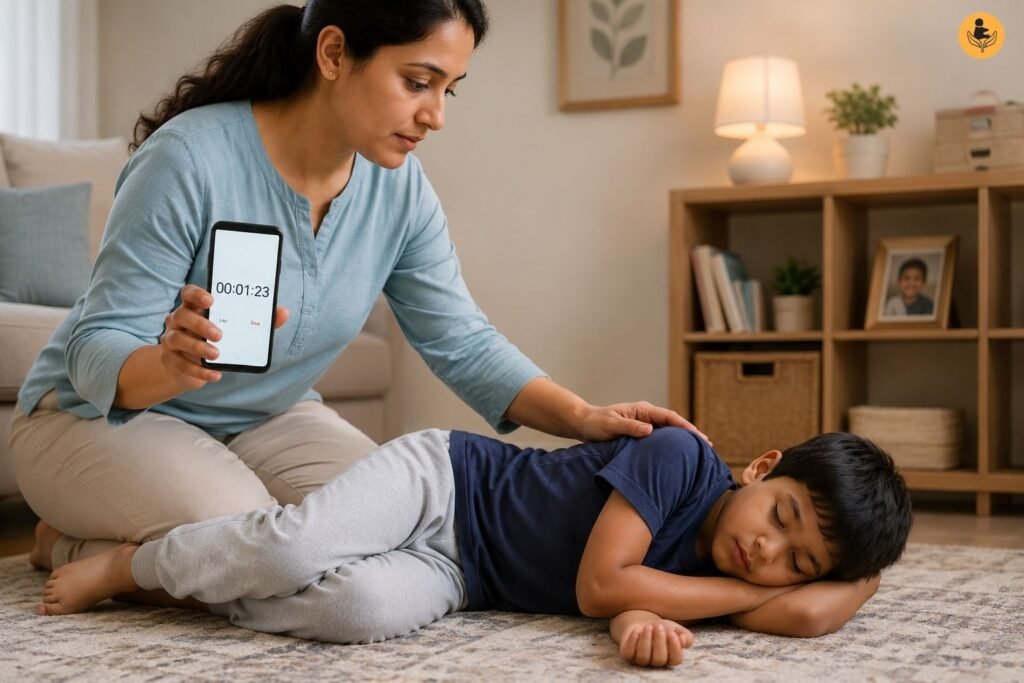
Roughly 1 in every 25 children will experience a febrile seizure at some point before their fifth birthday, and for the parent standing in that moment, no statistic in the world feels reassuring while their child’s body is shaking on the living room floor. It is, without exaggeration, one of the most frightening things a parent can witness, the stiffening, the jerking limbs, the eyes rolling back, all while a fever climbs in the background. Yet febrile seizures, despite how alarming they look, are almost always short, self-limiting, and free of any lasting effect on a child’s brain or development. What separates a calm, controlled response from a chaotic one usually comes down to knowing exactly what to do, and what not to do, in the first five minutes.
What Is a Febrile Seizure, Really?
A febrile seizure is a convulsion caused by a rapid rise in body temperature in a child between six months and five years old, most often occurring within the first 24 hours of a fever rather than at its peak. It is not caused by the fever being “too high”, a child can seize at 101°F just as another child tolerates 104°F without one. What triggers it is the speed of the temperature climb and the child’s individual neurological sensitivity at that age, when the developing brain is more reactive to sudden thermal shifts. Common triggers include viral infections, the aftermath of certain vaccinations, tonsillitis, ear infections, and the seasonal viral fevers so common during Mumbai’s monsoon and post-monsoon months.
Simple Febrile Seizure vs. Complex Febrile Seizure
Not all febrile seizures are the same, and the distinction matters for follow-up care.
- Simple febrile seizure: Lasts under 15 minutes, involves the whole body shaking symmetrically, and does not recur within 24 hours. This accounts for the vast majority of cases and carries an excellent outlook.
- Complex febrile seizure: Lasts longer than 15 minutes, affects only one part or side of the body, or recurs within the same 24-hour period. These need a more thorough pediatric evaluation, though even these are rarely dangerous in the long run.
Febrile Seizure Symptoms: What It Actually Looks Like
The hallmark signs of a febrile seizure are sudden stiffening of the body, rhythmic jerking of the arms and legs, rolled-back eyes, and brief loss of consciousness, all occurring alongside a fever. Parents often describe the moment as their child “going stiff, then shaking all over,” sometimes with a brief cry right before it starts. Other signs include:
- Clenched jaw or teeth
- Skin appearing slightly bluish around the lips during the episode
- Loss of bladder control in some cases
- Deep, heavy breathing or brief breath-holding
- Complete unresponsiveness for the duration of the seizure
Most episodes last between 30 seconds and two minutes, though to a parent watching it happen, it can feel like an eternity.
What To Do During a Febrile Seizure: The First 5 Minutes, Step by Step
The correct first-aid response is to stay calm, start timing immediately, lay the child on their side on a flat surface, and clear the area of anything hard or sharp, never restrain the child or place anything in their mouth.
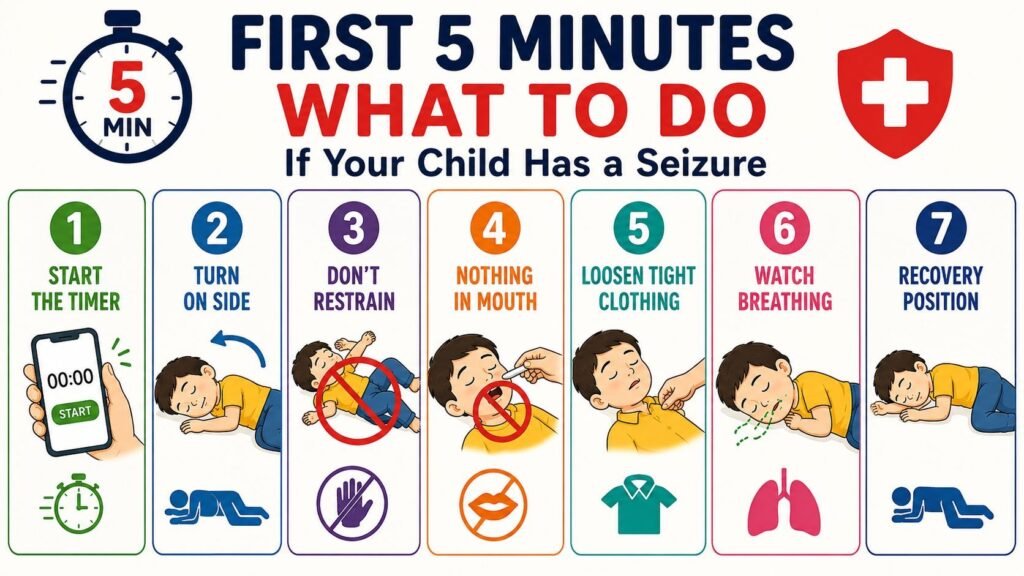
- Start a timer the moment it begins. This single detail matters more than almost anything else parents do, because duration decides whether this stays a routine event or becomes a medical emergency.
- Lay the child gently on their side (the recovery position), on the floor or another flat surface, away from furniture edges or hard objects.

- Do not hold the child down or try to stop the movements. Restraining a seizing body does not help and can cause injury.
- Do not put anything in the mouth, not a spoon, not a finger, not water. Children do not swallow their tongues, and this old household advice can cause choking or injury.
- Loosen tight clothing around the neck if present.
- Stay beside the child and watch the breathing and colour, without trying to intervene physically beyond keeping the space safe.
- Once the shaking stops, keep the child in the side-lying recovery position until they are fully alert, since drowsiness and confusion for 10–20 minutes afterward is entirely normal.
When To Call Emergency Services Immediately
- The seizure lasts longer than 5 minutes
- Breathing looks laboured, irregular, or the child turns significantly blue
- This is the child’s very first seizure of any kind
- The child does not regain awareness within 20–30 minutes after it stops
- A second seizure starts before full recovery from the first
Febrile Seizure Treatment: What Happens After the Emergency Passes
Once a febrile seizure has stopped and the child is breathing normally, the next step is a pediatric evaluation to identify and treat the underlying fever cause, not to prevent future seizures with routine medication, since febrile seizures themselves are not treated with anti-seizure drugs in most cases. At the clinic, the focus shifts to finding what triggered the fever, whether it’s a viral infection, ear infection, throat infection, or something needing further testing. Fever-reducing medication like paracetamol may be given for comfort, but it does not reliably prevent a repeat seizure during the same illness, this is a common myth worth correcting directly, since many parents blame themselves for “not bringing the fever down fast enough.”
Febrile Seizure Prevention: What Actually Helps (and What Doesn’t)
There is no guaranteed way to prevent a first febrile seizure, since it depends on individual neurological sensitivity rather than fever management alone. However, some practical steps reduce overall fever burden and support recovery:
- Treating fevers promptly with weight-appropriate paracetamol or ibuprofen once a child feels unwell, rather than waiting for a spike
- Keeping the child in light, breathable clothing during a fever rather than heavily bundled, a common well-meaning mistake in many Indian households during a cold or fever
- Staying current with vaccinations, since several common vaccine-preventable illnesses (like flu and certain bacterial infections) are known fever triggers
- Ensuring adequate fluids to avoid dehydration compounding illness
- Avoiding tepid sponging with cold water or ice, which can cause shivering and paradoxically raise core temperature
Roughly one in three children who have one febrile seizure will have another during a future fever, so prevention here is really about preparation, knowing the steps, rather than trying to eliminate every fever.
Safe Sleep After a Febrile Seizure: Getting the Positioning Right
There’s an important distinction parents often miss: the side-lying recovery position used during and immediately after a seizure is different from normal sleep positioning, and the two should not be confused once the child has fully recovered. During an active seizure and for the drowsy recovery period right after, lying on the side helps keep the airway clear. But once an infant under 12 months is fully alert and settling back to actual sleep, standard safe sleep guidance returns: back-sleeping on a firm, flat mattress, free of pillows, blankets, or soft toys, to reduce the risk of Sudden Infant Death Syndrome (SIDS). Parents should never leave an unwell infant sleeping face-down or side-lying unsupervised overnight out of a fear the seizure will recur, supervised recovery positioning is for the acute event only, not for the night’s sleep that follows.
Quick Reference: Febrile Seizures at a Glance
| What Parents Want to Know | What To Expect |
| Age range affected | 6 months to 5 years, peak around 12–18 months |
| Typical duration | 30 seconds to 2 minutes |
| Main trigger | Rapid rise in body temperature, not fever severity |
| Simple vs. complex | Simple: under 15 min, whole body, no recurrence in 24 hrs |
| First response | Time it, side-lying position, clear the area |
| Never do | Restrain the child, put anything in the mouth |
| Call emergency services | Seizure over 5 minutes, breathing trouble, first-ever episode |
| After it stops | Drowsiness for 10–20 minutes is normal |
| Recurrence risk | About 1 in 3 children will have another with a future fever |
| Long-term outlook | Excellent; no impact on intelligence or development in simple cases |
Conclusion
Watching a child have a febrile seizure is frightening in a way that few other parenting moments compare to, but the medical reality is genuinely reassuring: most febrile seizures are brief, self-limiting, and leave no lasting mark on a child’s development. What makes the biggest difference isn’t stopping the seizure, that isn’t something a parent can do, but responding with a clear head: timing it, positioning the child safely, and knowing exactly which signs mean it’s time to call for emergency help versus which signs mean it’s time to simply comfort a drowsy, recovering child. Every child who has had a febrile seizure deserves a proper follow-up evaluation to identify the fever’s cause and to walk through a clear action plan for next time.
Book a consultation with Vivasvan Parekh Child Care Clinic in Chembur, Mumbai to get a personalised febrile seizure action plan and peace of mind for the next fever that comes along.
Frequently Asked Questions
No. Simple febrile seizures do not cause brain damage, epilepsy, or developmental delays. They are frightening to witness but are considered a benign, age-related response to rapid temperature change.
No medication should be given by mouth while a child is seizing, since this risks choking. Fever-reducing medicine can be given once the child is fully alert afterward.
Not typically. Febrile seizures are fever-triggered and distinct from epilepsy, which involves recurring seizures unrelated to fever. Only a small percentage of children with febrile seizures go on to develop epilepsy, usually those with other risk factors identified during evaluation.
There’s no fixed threshold, some children have a mild fever around 100–101°F, while others tolerate much higher temperatures without one. It’s the speed of the rise, not the number on the thermometer, that matters most.
Usually not. For a straightforward, brief, whole-body seizure with quick recovery, most pediatric guidelines don’t recommend routine brain imaging or EEG. Further testing is reserved for complex seizures or specific red-flag findings during examination.

Vivasvan Parekh
As a pediatrician and child specialist based in Mumbai, I bring over 15 years of experience in delivering comprehensive child healthcare. I hold an MD in Pediatrics and practice in Ghatkopar East and Chembur, where I focus on preventive and evidence-based pediatric care. My areas of expertise include vaccinations, newborn care, growth and development monitoring, and the treatment of common and complex childhood illnesses. I am committed to supporting parents with practical, reliable guidance on child health, nutrition, and overall well-being. Through my blog, I share trusted insights on pediatric health, helping parents make informed decisions about their child’s care and development.