
Quick Answer: Twins and multiples are usually tracked on the same WHO growth charts used for all children, but each baby should be plotted on their own curve rather than compared directly to their co-twin. It’s common for twins to start smaller, especially if born early, and many catch up over the first two years.
- Shared womb space and earlier delivery are the main reasons twins often weigh less at birth than single babies
- No separate “twin growth chart” is needed for routine tracking, standard WHO charts work for each baby individually
- Premature twins are usually assessed using corrected (adjusted) age, not birth age, until around two years
- A consistent, widening gap between twins, rather than a one-time difference, is what actually warrants a closer look
- Growth trend over several visits matters far more than any single weight reading
Two Babies, Two Curves

A set of parents once sat through a vaccination visit watching the nurse weigh Twin A, then Twin B, and immediately start comparing the two numbers out loud, “why is she 400 grams lighter than her brother?” It’s one of the most natural questions a parent of twins can ask, and also one of the easiest to misread. Twins are two individual children who happened to share a pregnancy, and their growth is best understood that way too.
Twin and multiple births are increasingly common, including in India, often linked to assisted conception and to mothers having children a little later. Most twins grow up perfectly healthy, but their early growth pattern genuinely does look different from single babies, and understanding why makes those early percentile numbers far less worrying.
Why Twins and Multiples Grow Differently
Twins typically share limited space and placental resources during pregnancy, which means they’re often born a few weeks earlier and a bit lighter than single babies carried to full term. This isn’t a sign of a problem with either baby, it’s simply a feature of sharing a womb.
What reassures most parents is this: a large proportion of twins show real catch-up growth over the first two years, gradually closing the gap with single-born peers of the same age. The pace of that catch-up varies from baby to baby, and a paediatrician tracking both twins over time is in the best position to say whether a particular pair is following that expected pattern.
Which Growth Charts to Use
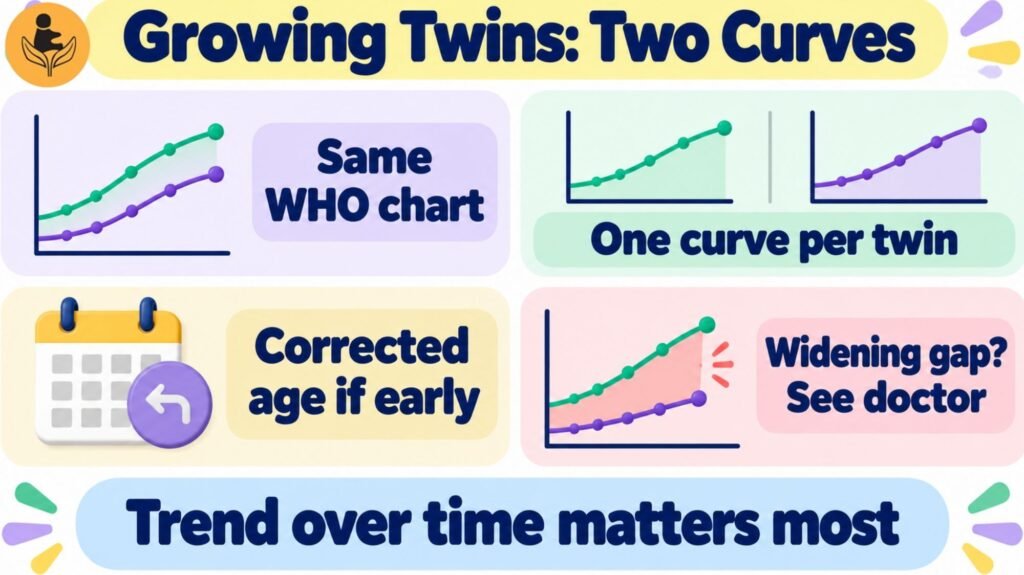
The WHO growth standards, used for children aged 0 to 5 in India, are the standard reference for twins as well; there’s no separate “twins growth chart” required for routine tracking. For older children, Indian Academy of Pediatrics (IAP) charts are commonly used.
Percentiles simply describe where a baby’s measurement sits compared to other children of the same age and sex. A baby on the 25th percentile for weight is lighter than 75 out of 100 typical babies their age, it does not mean “underweight” on its own. What a paediatrician watches for is the baby’s own curve over time, not a single number compared against an abstract average.
This is also the honest answer to the most direct version of this question: twins do not need a different growth chart from singletons. What’s different is how the chart should be read, each twin plotted and followed on their own line. Follow our Growth chart Monitoring page for further details.
Corrected Age for Premature Twins
For babies born early, “corrected age” (also called adjusted age) is the age counted from the original due date rather than the actual birth date. A twin born eight weeks early, now four months old by birth date, would have a corrected age of two months, and growth and developmental milestones are usually judged against that corrected age, not the calendar age.
This matters because comparing a premature twin’s weight to the standard chart using their actual birth date can make perfectly normal growth look like it’s lagging, when it’s really right on track for how early they arrived. Corrected age is typically used until around two years, after which the gap becomes less clinically significant. A paediatrician can confirm when it’s appropriate to stop adjusting for a specific baby.
How to Track Each Twin Correctly

At every routine visit, weight, length (or height) and head circumference should be measured and plotted separately for each twin, never averaged or recorded as a single combined figure. A few practical habits make this tracking more useful:
- Look at the trend across several visits, not any one reading in isolation
- Plot each twin on their own line on the chart, even if it feels repetitive
- Bring both twins to the same visits where possible, so comparisons are made on the same day under the same conditions
Comparing Twin A’s single reading to Twin B’s single reading, especially a one-off weigh-in at home, can be misleading, small day-to-day differences (a feed just before weighing, a slightly damp nappy) can shift the number without meaning anything about actual growth.
When a Size Difference Is Normal, and When to Flag It
| Situation | Usually normal | Worth discussing with the paediatrician |
| One twin consistently a bit smaller | Yes, if the gap stays roughly steady | — |
| Gap between twins keeps widening over visits | — | Yes |
| One twin crosses down through percentile lines | — | Yes |
| Either twin loses weight between visits | — | Yes |
| Poor feeding or low energy in one twin | — | Yes |
| No catch-up by the age the doctor advised watching for | — | Yes |
Small, stable differences between twins are common and usually not a concern. What matters clinically is a pattern, a gap that keeps growing, or a baby whose own curve is dropping across percentile lines, rather than the existence of any difference at all.
Feeding Twins for Healthy Growth
Feeding on demand, rather than a strict shared schedule, generally supports steady growth for each twin individually, some babies simply feed more frequently than their co-twin, and that’s fine. Keeping a simple log of feeds in the early weeks can help a paediatrician spot a feeding-related growth concern early, if one comes up.
Solids are usually introduced around six months of age, using corrected age rather than birth age for babies born premature.
Conclusion
Growth in twins is best understood as two separate stories unfolding side by side, not a competition between siblings. A stable, modest gap is rarely a reason for concern; a widening one, or a twin crossing down through percentile lines, is what’s actually worth a closer look.
If there’s any uncertainty about how either twin is tracking, a growth assessment can offer real clarity. Book a growth check-up with Dr. Vivasvan Parekh at Child Care Clinic Mumbai to see exactly where each baby stands.
Frequently Asked Questions
No. Twins are usually plotted on the same WHO growth charts as other children, with each twin tracked on their own curve and the trend watched over time rather than compared against each other.
Yes, small differences are common. It’s worth seeing a doctor if the gap keeps widening or one twin keeps falling to lower percentile lines over successive visits.
Many twins catch up in the first two years, though the timing varies from pair to pair. Premature twins may take a little longer, and the paediatrician will track the pattern at each visit.
Yes. For babies born early, growth and milestones are usually judged by corrected age, commonly until around two years. Confirm the exact cut-off for your babies with the paediatrician.
Usually at each routine and vaccination visit, with closer monitoring if the doctor is following up on a specific concern. Daily weighing at home isn’t necessary and can create unnecessary worry over normal day-to-day fluctuation.
Medically reviewed by Dr. Vivasvan Parekh, Child Care Clinic Mumbai.

Vivasvan Parekh
As a pediatrician and child specialist based in Mumbai, I bring over 15 years of experience in delivering comprehensive child healthcare. I hold an MD in Pediatrics and practice in Ghatkopar East and Chembur, where I focus on preventive and evidence-based pediatric care. My areas of expertise include vaccinations, newborn care, growth and development monitoring, and the treatment of common and complex childhood illnesses. I am committed to supporting parents with practical, reliable guidance on child health, nutrition, and overall well-being. Through my blog, I share trusted insights on pediatric health, helping parents make informed decisions about their child’s care and development.