
Quick Overview:
Picky eating in toddlers between 1 and 5 years is a normal developmental phase driven by slowing growth, a natural wariness of new foods, and a growing need for independence at mealtimes not usually a sign that something is wrong. Most toddlers eat enough across a week even when individual meals look inconsistent, and pushing, bribing, or forcing food tends to backfire.
- Picky eating typically peaks between 18 months and 3 years and often eases with age.
- Growth slows sharply after the first birthday, which naturally reduces appetite.
- Toddlers often need 8–15 exposures to a new food before accepting it.
- Weekly intake matters more than what’s eaten at any single meal.
- Persistent food refusal paired with poor weight gain or gagging warrants a pediatric evaluation.
The Mealtime Standoff Every Parent Recognises

A plate of dal-chawal sits untouched while a toddler pushes it away, arms crossed, absolutely certain that today is not a rice day. Ten minutes later, spoon-feeding attempts, distraction with a phone, and a hopeful offer of curd have all failed. This scene repeats itself in homes across the country every single day, and it’s one of the most common concerns raised in a pediatric consultation right up there with fevers and vaccination questions.
Picky eating is common enough that it’s considered a typical part of toddler development rather than a red flag, and it’s worth saying plainly: a toddler who eats inconsistently but is otherwise growing, active, and hitting developmental milestones is very unlikely to be malnourished, even if mealtimes feel like a daily battle. What tends to make the difference between a phase that resolves and one that drags on is less about the food itself and more about how mealtimes are handled around it.
This piece looks at why picky eating happens, how to tell ordinary fussiness from something that needs medical attention, and what actually helps without turning every meal into a negotiation.
Why Do Toddlers Suddenly Become Picky Eaters?
Toddler picky eating usually shows up between 18 months and 3 years because growth rate drops sharply after the first birthday, appetite naturally decreases, and toddlers begin asserting independence over one of the few things fully within their control that goes into their own mouth.
The Growth Slowdown Nobody Warns Parents About
An infant roughly triples their birth weight in the first year, which requires a substantial calorie intake relative to their size. That growth rate slows dramatically after age one, and appetite adjusts accordingly. This is exactly why routine growth monitoring matters more than daily calorie-counting a toddler eating noticeably less than they did as a one-year-old isn’t regressing, their body simply doesn’t need as much fuel as it did during that first, rapid growth spurt.
Neophobia: The Built-In Wariness of New Foods
Many toddlers go through a phase called food neophobia, an instinctive caution around unfamiliar foods which is thought to be an evolutionary safeguard from a time when trying an unknown item carried real risk. This is why a toddler might refuse a food outright the first, second, or even the tenth time it’s offered, only to eventually accept it once it stops feeling unfamiliar.
Asserting Independence at the Table
Between one and three years, toddlers are working out how much control they have over their world, and mealtimes are one of the most immediate places to test that. Refusing food, insisting on a particular bowl, or wanting to feed themselves messily rather than be fed are less about the food and more about establishing autonomy, a normal and, frankly, healthy part of development.
Is This Normal Picky Eating or Something to Worry About?
Most toddler food refusal is developmentally normal and doesn’t require medical intervention, provided the child is otherwise growing well, gaining weight appropriately, and meeting developmental milestones. Concern is warranted when food refusal is paired with poor weight gain, gagging or choking on multiple food textures, extreme distress around mealtimes, or a diet so restricted it covers only a handful of foods across every food group.
When to Worry About Picky Eating: Warning Signs
- Poor or stalled weight gain over several months
- Gagging, choking, or vomiting with a wide range of textures, not just occasional foods
- A diet limited to fewer than 10–15 total foods across all categories
- Visible distress, crying, or mealtime battles lasting well beyond a typical toddler tantrum
- Signs of fatigue, low energy, or reduced activity alongside poor eating
If several of these apply, it’s worth raising with a pediatrician rather than waiting to see if it resolves on its own; sometimes there’s an underlying sensory sensitivity, an oral-motor issue, or a medical cause worth ruling out.
How Long Does the Picky Eating Phase Usually Last?
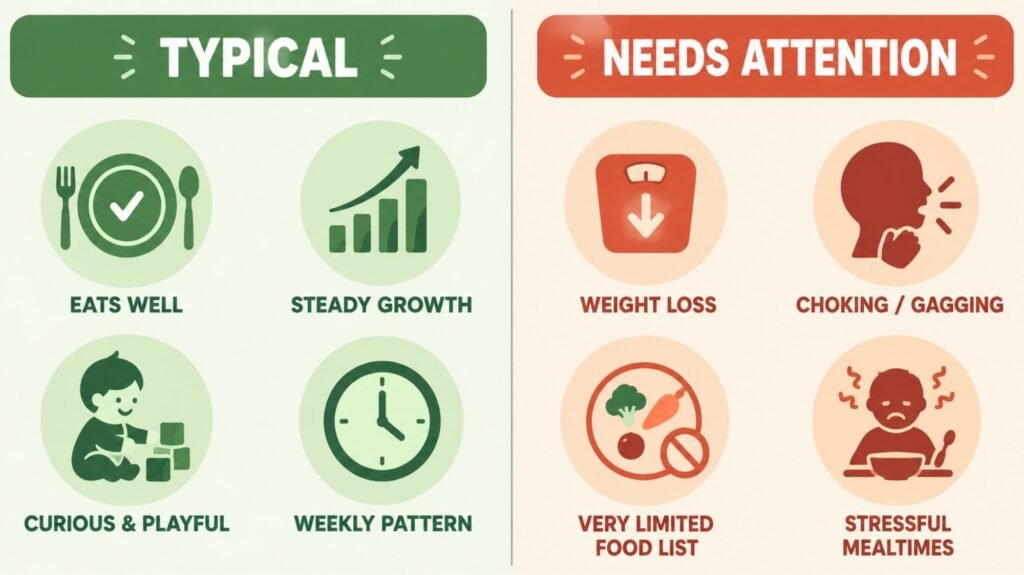
For most toddlers, picky eating is most intense between 18 months and 3 years, gradually easing as the child approaches 4 to 5 years and becomes more comfortable with a wider range of foods, textures, and family meals. It doesn’t disappear on a fixed schedule, and some pickiness around specific foods can persist into the school years, but the daily mealtime standoffs typically become less frequent well before that point.
Picky Eating in Toddlers: What’s Typical vs What Needs Attention
| Situation | Typically Normal | Worth a Pediatric Check |
| Refuses a food repeatedly before accepting it | Yes — often needs 8–15 exposures | — |
| Eats inconsistently day to day but fine over a week | Yes | — |
| Suddenly dislikes a food they used to eat | Yes — common toddler behaviour | — |
| Poor weight gain over 2–3 months | — | Yes |
| Gags or chokes on many different textures | — | Yes |
| Eats fewer than 10–15 foods total, long-term | — | Yes |
| Extreme mealtime meltdowns, most meals | — | Worth discussing |
| Low energy, reduced activity alongside poor eating | — | Yes |
What Actually Helps With a Picky Eater Child
Offer, Don’t Force
Repeated, pressure-free exposure works better than insistence. Placing a new food on the plate alongside familiar ones without demanding it be eaten allows a toddler to get used to how it looks and smells before ever tasting it, which is often the real first step toward acceptance.
Keep One Familiar Food on the Table
Pairing something new with something the toddler already eats comfortably a familiar dal alongside a new vegetable, for instance reduces the pressure of a meal feeling entirely unfamiliar and gives them something safe to fall back on.
Let Mealtime Independence Happen, Even If It’s Messy
Allowing a toddler to serve themselves a small amount, use their own spoon, or pick between two acceptable options hands back some of the control they’re instinctively seeking, which often reduces the urge to refuse food just to make a point.
Watch the Weekly Pattern, Not the Daily One
A single meal of just rice and curd looks alarming in isolation, but toddlers are often remarkably good at balancing their intake across several days if left to their own appetite cues rather than pressured at every sitting. Tracking intake over a week, rather than reacting to one poor meal, usually paints a more reassuring picture.
Avoid Turning Meals Into a Negotiation
Bribing with dessert, offering screen time as a reward, or pleading for “just one more bite” tends to increase resistance over time rather than resolve it, since it teaches a toddler that refusal gets attention and negotiation both of which are, from a toddler’s point of view, quite rewarding.
Healthy Food Ideas for Picky Eaters

Building meals around a few reliably accepted foods, then introducing new ones alongside them, tends to work better than replacing an entire plate at once. Familiar Indian staples like idli, khichdi, dal, curd, and roti can be paired with small, low-pressure additions a spoon of mashed vegetable folded into khichdi, grated carrot mixed into paratha dough, or fruit offered as a separate, no-pressure option after the main meal. None of this needs to happen overnight; small, repeated additions matter more than dramatic changes to the plate. For a more tailored plan, personalized nutrition counselling can help build a plate that fits a specific child’s accepted foods and growth needs.
Practical Guidance for Parents Handling a Fussy Eater
Worth doing: Sticking to regular meal and snack times, offering new foods repeatedly without pressure, and involving toddlers in simple food preparation, which often increases their willingness to try what they’ve helped make.
Worth avoiding: Force-feeding, offering separate “backup” meals every time a food is refused, and using dessert or screen time as a bribe to finish a plate.
When to see a pediatrician: Poor weight gain over several months, persistent gagging across many textures, a diet limited to a very small number of foods, or visible fatigue alongside poor intake.
Realistic expectations: Picky eating rarely resolves overnight, and most toddlers need dozens of low-pressure exposures to a new food before accepting it. Patience, not persistence through conflict, is what tends to move things along.
Conclusion
Picky eating between 1 and 5 years is, in the overwhelming majority of cases, a normal developmental stage rather than a nutritional emergency driven by slowing growth, a natural caution around new foods, and a toddler’s growing need to assert control. What helps most isn’t more pressure at the table, but consistency, repeated low-stakes exposure to new foods, and paying attention to intake across the week rather than any single meal.
For parents watching weight gain stall, noticing gagging across many foods, or simply feeling unsure whether their toddler’s eating falls within a normal range, a conversation with a pediatrician can offer real clarity rather than guesswork. A visit to Vivasvan Child Care Clinic can help assess growth, rule out underlying causes, and build a realistic plan that fits the child rather than a generic one.
FAQ
Some fluctuation in appetite over a few days is common and usually not a cause for concern, provided the toddler remains active, hydrated, and otherwise well. Sustained refusal over a week or more, or refusal paired with lethargy, warrants a pediatric check.
Toddlers often need 8 to 15 exposures to a new food before accepting it, so offering it repeatedly without pressure to eat it each time tends to work better than giving up after just a few tries.
It’s uncommon for typical toddler pickiness to cause deficiencies, since most toddlers balance their intake across the week even when individual meals look limited. A very restricted diet of fewer than 10 to 15 total foods is worth discussing with a pediatrician.
This depends on the child’s overall diet and growth pattern, and it’s best assessed by a pediatrician rather than started independently, since supplementation isn’t automatically necessary for every fussy eater.
It’s worth a pediatric evaluation if weight gain has stalled, if the child gags or chokes across many food textures, if the accepted food list is very limited, or if mealtimes involve extreme distress on a regular basis.

Vivasvan Parekh
As a pediatrician and child specialist based in Mumbai, I bring over 15 years of experience in delivering comprehensive child healthcare. I hold an MD in Pediatrics and practice in Ghatkopar East and Chembur, where I focus on preventive and evidence-based pediatric care. My areas of expertise include vaccinations, newborn care, growth and development monitoring, and the treatment of common and complex childhood illnesses. I am committed to supporting parents with practical, reliable guidance on child health, nutrition, and overall well-being. Through my blog, I share trusted insights on pediatric health, helping parents make informed decisions about their child’s care and development.