Quick Answer: A 6 month old baby is ready for solids once they can sit with support, hold their head steady, and show real interest in food. The first foods should be iron rich, think ragi, moong dal, or fortified cereal, rather than just fruit purees, since a baby’s iron stores from birth start running low right around this age. Texture moves from smooth purees to soft lumps by 8 months and finger foods by 9, with breast milk or formula continuing alongside solids until at least 12 months.
At a glance:
- Start solids at 6 months, not earlier, alongside continued breast milk or formula
- First foods should be iron rich, ragi, dal, and fortified cereal, not fruit purees alone
- Texture moves from smooth purees to soft lumps by 8 months to finger foods by 9 months
- Avoid honey, added salt, added sugar, and whole cow’s milk as a main drink before 12 months
- Vitamin D drops are recommended daily from birth for breastfed babies, regardless of how sunny the city is
One Chart, Too Many Opinions
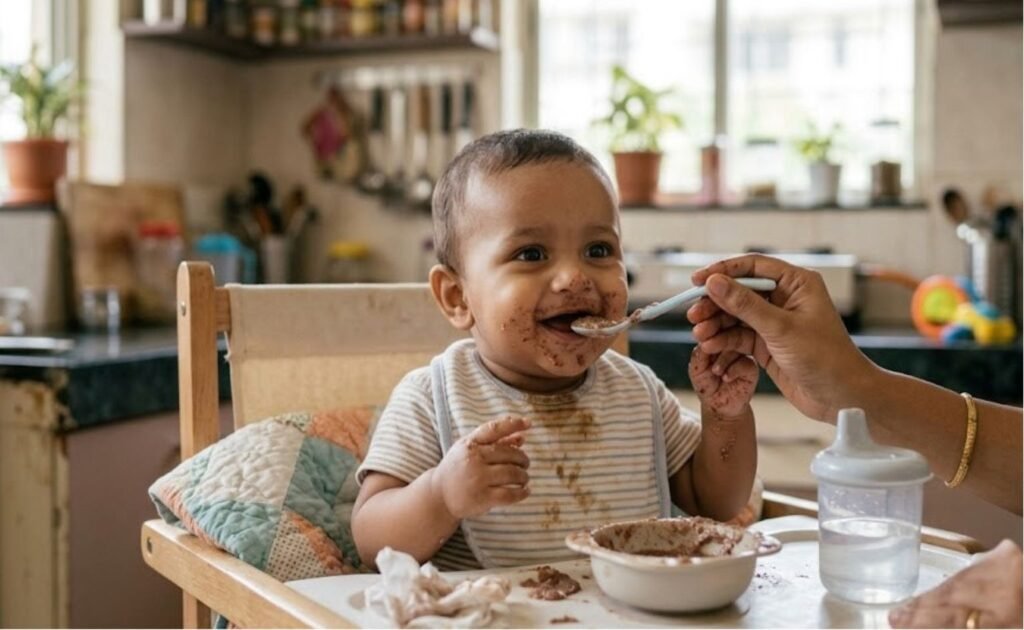
Few parenting topics attract as much advice as feeding a baby. Grandparents, friends, parenting groups, and online articles often have different opinions on what should come first and what should wait. It’s no surprise that many parents feel uncertain about whether they are introducing foods in the right way or at the right time.
Here’s the part worth knowing early. National health surveys consistently find that a large share of Indian children under two carry some degree of iron deficiency, which is exactly why this chart leads with iron rich foods rather than the fruit first approach many parents default to. What follows is a straightforward, month by month path from the first spoonful of porridge to a full seat at the family table, along with the specific signs that mean it’s worth checking in with a pediatrician along the way.
Is the Baby Actually Ready for Solids?
Readiness isn’t just about turning 6 months old on the calendar. It shows up as a specific set of physical signs, and they tend to appear together rather than one at a time.
The Real Readiness Checklist
- Steady head control while sitting upright in a high chair
- Sitting with little or no support
- Genuine interest in food, watching closely or reaching for the plate during family meals
- Loss of the tongue thrust reflex, the automatic reflex that used to push anything solid straight back out
If most of these are showing up together, the timing is right, regardless of what the calendar says down to the day.
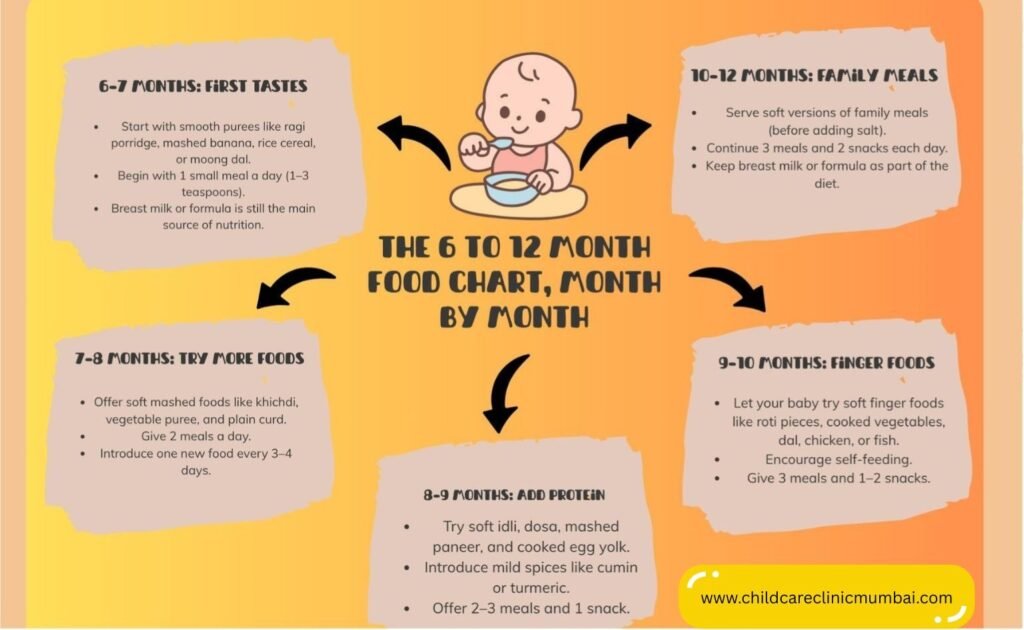
The 6 to 12 Month Food Chart, Month by Month
Solids move through three broad texture stages, smooth purees, soft mashes with small lumps, and finger foods, and each stage tends to last roughly two to three months.
6 to 7 Months: The Tasting Phase
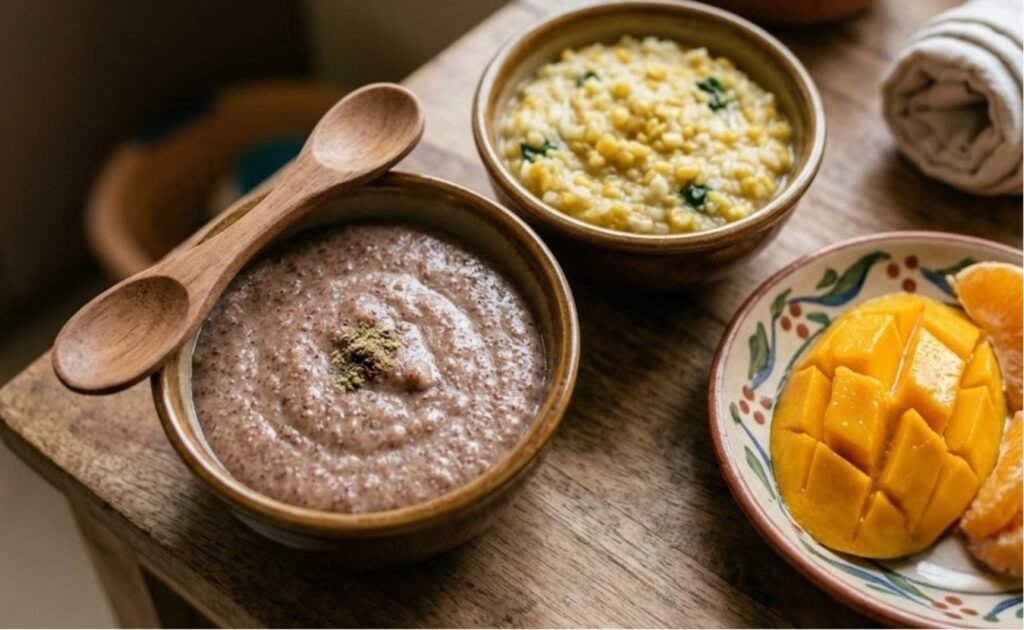
This stage is about exploration far more than nutrition, since breast milk or formula is still doing most of the heavy lifting. Ragi porridge, moong dal water, rice cereal, and mashed banana all work well as first foods. Start with a single meal a day, 1 to 3 teaspoons, building toward 2 to 3 tablespoons and a second meal by week three or four. Introducing solids around this age also lines up with a burst of physical development, and parents tracking sitting, crawling, and other early motor skills alongside feeding might find this guide to crawling and walking milestones useful for the fuller picture.
7 to 8 Months: Building Variety
Textures thicken into soft mashes with small lumps. Khichdi, vegetable purees, plain curd, and a small amount of ghee stirred in for extra calories all fit naturally here. Two solid meals a day is typical, and introducing one new ingredient every 3 to 4 days makes it far easier to spot a reaction if one shows up.
8 to 9 Months: Texture and Protein
Soft idli and dosa, mashed paneer, and well cooked egg yolk are all good additions once a baby is handling lumps comfortably. Mild spices like cumin, coriander, or turmeric can be introduced in small amounts too. Two to three meals plus a snack is a reasonable rhythm at this stage.
9 to 10 Months: Finger Foods and Family Flavors
This is usually when self feeding starts in earnest. Soft roti torn into small strips, dal without salt, soft cooked vegetables, and small pieces of well cooked chicken or fish all work. Three meals plus one or two snacks, with plenty of room for a baby to practice picking up food independently.
10 to 12 Months: Joining the Family Table
By now most babies can manage soft, chewable versions of regular family meals. The easiest approach is setting aside the baby’s portion before salt goes into the rest of the pot, rather than cooking a separate meal entirely. Three meals plus two snacks, with breast milk or formula continuing alongside.
Why Iron Deserves First Place on the Plate
A baby’s iron stores from birth begin running low right around the 6 month mark, which is exactly why the very first foods matter more than parents often realize. Ragi, dal, and fortified cereal deserve a place on the plate well before fruit purees, not instead of them, but alongside them from day one.
Plant based iron doesn’t absorb nearly as efficiently as iron from animal sources, but pairing it with Vitamin C can triple how much the body actually takes in.
| Iron Rich Food | Pair It With | Why It Works |
| Ragi porridge | A few pieces of orange, sweet lime, or mango | Vitamin C helps the body absorb non heme (plant based) iron much more effectively. |
| Dal (masoor or moong) | Tomato puree, chopped tomatoes, or a small amount of amla | Combining iron rich lentils with Vitamin C rich foods improves iron absorption and makes for an easy everyday meal. |
| Cooked spinach | A squeeze of fresh lemon juice | Cooking reduces some natural compounds that limit iron absorption, while lemon provides Vitamin C to further enhance iron uptake. |
Worth knowing too, cow’s milk and tea both reduce iron absorption when eaten at the same meal, so it helps to space them apart from iron rich foods rather than serving them together.
The One Supplement Most Parents Miss
Iron and multivitamins tend to get all the attention, but Vitamin D drops are the one supplement recommended for nearly every breastfed baby in India, starting from birth, regardless of how sunny the city is or how much time the baby spends outdoors. Breast milk simply doesn’t carry enough Vitamin D on its own, and this gap catches even attentive parents off guard. A single daily drop, in whatever form a pediatrician recommends, closes it completely.
For families weighing broader nutrition questions beyond this one supplement, particularly given how common undernutrition still is among young children in Mumbai, this practical nutrition guide for under 5s covers the wider picture in more depth.
Foods to Avoid Before the First Birthday
- Honey, and jaggery in any real quantity, due to the risk of infant botulism
- Added salt, since a baby’s kidneys can’t yet handle the extra sodium load
- Added sugar, which builds an early preference for sweet foods over everything else
- Whole cow’s milk as a main drink, fine only in small cooked amounts before 12 months
- Whole nuts, whole grapes, popcorn, and raw hard vegetable chunks, all genuine choking hazards
What If the Baby Just Won’t Eat?
Refusal in the early weeks is close to universal, and it rarely means anything is wrong. It can take 10 to 15 tries before a new food gets accepted, sometimes more. The simplest way to think about it: the parent decides what food is offered, when, and where, while the baby decides whether to eat it and how much. Holding that line, without pressure, bribery, or a backup snack every time something gets rejected, is what actually expands a picky eater’s palate over time.
When Feeding Patterns Are Worth Mentioning to a Doctor
- Weight gain that’s slow or has stalled
- Refusing solids entirely for several days in a row
- Repeated vomiting or diarrhea after meals
- Signs of an allergic reaction, rash, swelling, or breathing trouble within two hours of eating
- Choking, gagging, or visible difficulty swallowing at nearly every meal
A quick safety note that matters more than any chart: difficulty breathing, facial or tongue swelling, widespread hives, or a baby who goes limp or unresponsive are genuine emergencies. These need immediate medical attention, not a routine appointment scheduled for later in the week.
Quick Reference Table
| Age | Texture | Meals per Day | What’s New |
| 6 to 7 months | Smooth purees and thin porridges | Start with 1 meal, gradually increase to 2 | Introduction of iron rich first foods such as ragi, dal, and pureed vegetables |
| 7 to 8 months | Soft mashed foods with small lumps | 2 meals | New foods like khichdi, curd, and small amounts of ghee can be introduced |
| 8 to 9 months | Mashed foods along with soft finger foods | 2 to 3 meals | Introduction of more protein sources and mild family spices |
| 9 to 10 months | Soft, lumpy, bite sized foods | 3 meals plus healthy snacks | Encouraging self feeding and exposing babies to familiar family flavors |
| 10 to 12 months | Texture similar to family foods, appropriately softened | 3 meals plus 2 snacks | Transitioning toward eating at the family table with a wider variety of foods |
The Conclusion
Feeding a baby through this stretch has less to do with following a chart down to the tablespoon and far more to do with steady exposure to real, iron rich, home cooked food, offered without pressure or panic on the days it doesn’t go to plan. A pediatrician visit is worth booking whenever there’s genuine uncertainty about weight gain, persistent refusal, or a possible allergic reaction, not treated as a last resort.
For a feeding plan built around a specific baby rather than a generic chart, it’s easy to book a consultation at Vivasvan Child Care Clinic.
Frequently Asked Questions
Iron rich options like ragi porridge, moong dal water, or a fortified rice cereal make excellent first foods, since a baby’s natural iron stores begin declining around this age. Simple fruit purees like mashed banana or stewed apple work well alongside them.
Most babies start with one small meal a day in the first week or two, building up to two meals by weeks three and four. Milk remains the primary source of nutrition throughout this stage.
Yes. Well cooked egg yolk, and eventually whole egg, can be introduced from 6 months, and current evidence suggests early introduction may actually lower the risk of egg allergy rather than raise it. Eggs should always be served fully cooked, never raw or runny.
Whole cow’s milk as a main drink is best held off until after 12 months, since it’s harder on a baby’s kidneys and lower in iron than breast milk or formula. Small amounts used in cooking from around 8 months are perfectly fine.
Keep offering the food without pressure or force, since it can take 10 to 15 exposures before a baby accepts something new. Avoid turning mealtimes into a battle. If refusal continues for several days alongside poor weight gain, it’s worth mentioning to a pediatrician.

Vivasvan Parekh
As a pediatrician and child specialist based in Mumbai, I bring over 15 years of experience in delivering comprehensive child healthcare. I hold an MD in Pediatrics and practice in Ghatkopar East and Chembur, where I focus on preventive and evidence-based pediatric care. My areas of expertise include vaccinations, newborn care, growth and development monitoring, and the treatment of common and complex childhood illnesses. I am committed to supporting parents with practical, reliable guidance on child health, nutrition, and overall well-being. Through my blog, I share trusted insights on pediatric health, helping parents make informed decisions about their child’s care and development.