
Every baby develops at their own pace, and that’s exactly what makes parenting both exciting and stressful. This guide helps parents understand what’s truly normal when it comes to crawling, standing, and walking during the first two years. From tummy time and cruising to first wobbly steps, it explains developmental milestones in a simple, reassuring way without turning them into a race. You’ll learn what signs to celebrate, what delays may need attention, and how to gently support your baby’s growth at home. Because in the end, every small step, early or late, is still a beautiful milestone worth celebrating.
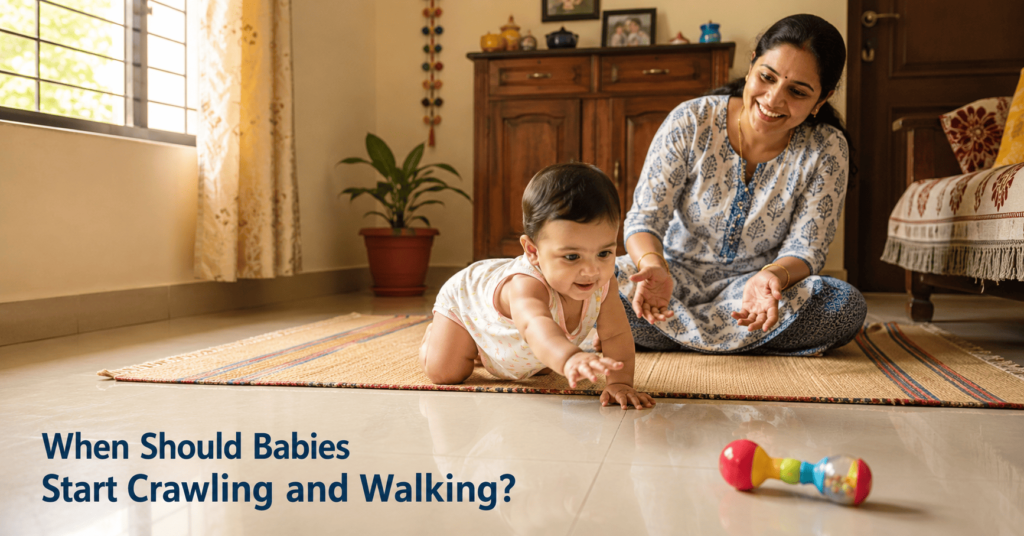
Every Baby Has Their Own Clock
Picture this: a group of Mumbai moms are sitting together at a kitty party, and one of them says, “Mera bacha 11 mahine ka ho gaya, abhi tak theek se crawl nahi kiya!” (My child turned 11 months old and still hasn’t crawled properly!) The room immediately fills with opinions, comparisons, and well-meaning but often confusing advice.
Sound familiar? This is one of the most common conversations that happen in pediatric clinics across India every single day.
Here is the truth that every parent deserves to hear early: developmental milestones are guidelines, not rules. Not every child hits all the milestones. Not every child crawls. Some babies walk at 10 months. Others take until 16 or 17 months. And both of them are perfectly, completely normal.
Most babies start crawling somewhere between 7 and 10 months, but the healthy window stretches from 6 to 12 months. Walking typically begins between 12 and 15 months, with 18 months still considered well within the normal range. These are ranges, not deadlines.
So take a breath, and let’s walk through what is actually happening inside your baby’s growing body, month by month.
Want to know if your baby is hitting the right milestones at the right time? Watch the reel below:
The Crawling Journey: What Is Actually Happening Month by Month
Before the Crawling Begins (4 to 6 Months)
Babies do not wake up one day and decide to crawl. The whole process starts much earlier, with small, quiet preparations happening every time your baby does tummy time.
Around 4 months, babies start rolling from tummy to back. By 6 months, most can roll in both directions. At the same time, something important is happening when you lay your baby face-down: the neck, shoulders and core muscles are getting stronger with every little push-up they manage.
Around 6 months, watch for your baby rocking back and forth on their hands and knees. This adorable motion is not random. It is the single most important building block for crawling. The rocking trains the muscles they will need to actually move forward.
Active Crawling: The Baby Crawling Age in Months (7 to 10 Months)
Once the rocking starts, crawling usually follows within a few weeks. Most babies begin crawling between 7 and 10 months, though anything from 6 to 12 months is considered normal.
And here is something that surprises many parents: crawling does not look the same for every baby. Some babies do the classic hands-and-knees crawl that we picture. Others do an army crawl, pulling themselves forward on their belly with their arms. Some scoot on their bottoms. Some do a funny one-leg-forward drag. All of these count as crawling, and all of them are getting your baby to where they need to go.
Many babies also crawl backward before moving forward. Parents sometimes worry about this, but it is simply because the pushing muscles are stronger than the pulling ones at this stage. Forward movement follows soon after.
At the clinic, parents often come in concerned when their 9-month-old is only army crawling. The reassurance is always the same: as long as the baby is moving, exploring and using both sides of the body, the style does not matter.
When Babies Skip Crawling Entirely
Yes, this happens, and yes, it is okay. Some babies go from sitting to pulling themselves up to standing, and then straight to walking, completely bypassing crawling. What matters is whether the baby is developing overall strength, balance, and coordination, not whether they followed a specific sequence.
If a baby is not moving at all, or is consistently favouring one side of the body, that is when a conversation with the pediatrician becomes important.
Walking Milestones: From Sofa-Surfing to First Steps
1. The Cruising Phase (9 to 12 Months)
Before babies walk, they cruise. Cruising means holding onto furniture and side-stepping along it. In Indian homes, this often happens along the edge of a low divan, a wooden chowki, or even the living room wall.
This phase builds the leg strength and balance that independent walking requires. Babies also get into and out of a sitting position more easily during this time, and by 12 months most can do so completely on their own.
2. The First Independent Steps (11 to 13 Months)
This is the moment parents wait for. Most babies take their first independent steps somewhere between 11 and 13 months. Those steps will be wobbly, wide-legged and short. That is exactly how they should look.
The balance system is still calibrating. Falls are part of the process. A baby who takes three steps and then sits down hard on the floor has not failed at walking. They have just completed a very successful walking session.
A common scenario at pediatric clinics: parents rush in with a video of their 11-month-old taking four shaky steps, excited but also slightly anxious. The answer is always to celebrate. Four steps at 11 months is a milestone worth cheering for.
3. Walking Unassisted: When Do Babies Start Walking on Their Own? (12 to 18 Months)
Most babies are walking with growing confidence between 12 and 15 months. However, walking by 18 months is still completely within the normal range. Some children walk steadily at 10 months. Others are not fully walking until 17 months. Both are normal.
The key is not the exact age, but the overall development picture. Is the baby gaining strength? Are they interested in moving around? Are they pulling up to stand and experimenting with balance? If yes, things are progressing as they should.
Baby Developmental Milestones by Month: A Quick Reference for Parents
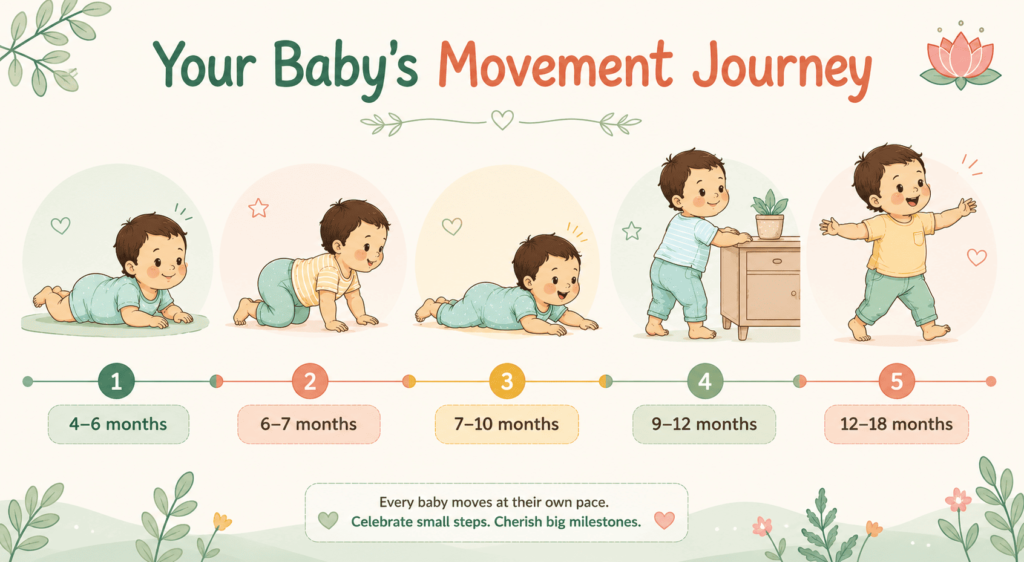
This table is a guide, not a checklist. Every baby may arrive at these milestones a little earlier or later, and that is perfectly fine.
| Age | Milestone | What It Looks Like | Parent Tip |
| 2 months | Holds head up briefly | Pushes up with arms during tummy time | Start tummy time from day one |
| 4 months | Rolls tummy to back; head steady | Rocks side to side, may roll one way | Place a toy to one side to encourage rolling |
| 6 months | Sits with help; rocks on hands and knees | Crawling foundation is forming | Support with pillows while sitting |
| 7-10 months | Crawling begins | Army crawl, bottom scoot, or classic crawl | Place favourite toy just out of reach |
| 9-12 months | Cruising along furniture | Holding sofa or table edge and side-stepping | Baby-proof your home now |
| 11-13 months | First independent steps | Wobbly, wide-legged walk | Cheer every step, even the falls |
| 12-18 months | Walking unassisted | Gaining confidence and speed | 18 months is still perfectly normal |
Note: The last row is highlighted as a reminder that 18 months is still within the normal walking range.
How to Encourage Your Baby: Simple Things That Actually Work
1. Tummy Time is the Foundation of Everything
Tummy time is the single most effective thing parents can do to support their baby’s motor development. It strengthens the neck, shoulders, and core, and it lays the groundwork for rolling, crawling, and eventually walking.
Start from birth, even if it is just a few minutes at a time. As the baby gets stronger, increase the duration gradually. Make it fun by getting down on the floor yourself, making faces, or placing a colourful toy just slightly out of reach.
2. The Out-of-Reach Toy Trick
This is one of the oldest and most effective tricks in child development. Place a favourite rattle, ball, or toy just beyond what the baby can comfortably reach. The desire to get to it is exactly what motivates movement. Let the baby work for it a little.
3. Floor Time Over Everything
Babies learn to move by moving. The more time a baby spends on a clean, safe floor, the more opportunities they have to practice. In Indian homes, a soft cotton dari (floor mat) in a safe, gated room works beautifully for this.
4. Say No to Baby Walkers
Baby walkers are extremely popular across India, but they are not recommended by pediatric organisations. They can actually delay natural walking development by reducing the baby’s motivation to pull up and balance on their own. They also pose a serious safety risk near stairs. Floor play and cruising along furniture are the safest path to independent walking.
5. Go Barefoot Whenever Possible
Bare feet help babies feel the ground, develop balance, and strengthen the small muscles in the foot. Socks on smooth floors can actually make learning harder because they slip. Keep shoes outdoors.
When to Visit the Pediatrician: Red Flags Worth Knowing
Milestones being guidelines does not mean every delay should be ignored. There are specific signs that warrant a visit to the clinic, not out of panic, but because early identification always leads to better outcomes.

It is a good idea to consult a pediatrician if the baby is not sitting without support by 9 months, or is not crawling by 12 months, or is dragging one side of the body consistently while crawling. Similarly, if the baby cannot stand even with support at 12 months, is not using gestures like waving or pointing by 12 months, or is not walking independently by 18 months, a clinical check is a good idea.
Skill regression is also worth flagging. If a baby loses a motor skill they previously had, such as no longer being able to sit up after being able to do so comfortably, that is always something to bring up with the doctor.
At Vivasvan Child Care Clinic, the approach is always the same: trust your instincts. Parents know their babies better than anyone. If something feels off, come in. There is no such thing as an unnecessary check-up when it comes to child development.
Every Step is Worth Celebrating
Baby development is not a race, and it has never been one. Whether a baby crawls at 7 months or walks at 17 months, whether they army-crawl across the floor or skip crawling altogether and go straight to standing, every path is valid.
What matters most is that the baby is growing, exploring, gaining strength and curiosity, and that parents feel supported along the way. Milestones are tools to help, not standards to stress over.
If there is ever any doubt, the best thing to do is simply come in for a conversation. At Vivasvan Child Care Clinic in Mumbai, every parent who walks through the door with a question gets a real answer, not a generic chart.
Frequently Asked Questions
No. Most babies begin crawling between 7 and 10 months, but anything up to 12 months can still fall within the normal developmental range. Some babies skip crawling completely and move directly toward standing and walking.
Common milestones include:
Around 2 months: better head control
Around 4 months: rolling begins
Around 6 months: sitting with support and rocking movements
Between 7 and 10 months: crawling or other forms of movement
Between 9 and 12 months: pulling up and cruising along furniture
Around 11 to 13 months: first independent steps
These milestones are approximate ranges, not strict deadlines.
Not necessarily. Some healthy babies take longer to develop movement skills. However, if a baby shows very little interest in movement or is not standing with support by 12 months, discussing it with a pediatrician is a good idea for reassurance and guidance.
Most babies take their first independent steps between 11 and 13 months, while confident walking often develops between 12 and 15 months. Walking anytime up to 18 months can still be completely normal.
No. Baby walkers do not teach balance or natural movement patterns effectively and may even delay walking skills. They also increase the risk of household injuries. Supervised floor play and furniture cruising are safer and more beneficial alternatives.

Vivasvan Parekh
As a pediatrician and child specialist based in Mumbai, I bring over 15 years of experience in delivering comprehensive child healthcare. I hold an MD in Pediatrics and practice in Ghatkopar East and Chembur, where I focus on preventive and evidence-based pediatric care. My areas of expertise include vaccinations, newborn care, growth and development monitoring, and the treatment of common and complex childhood illnesses. I am committed to supporting parents with practical, reliable guidance on child health, nutrition, and overall well-being. Through my blog, I share trusted insights on pediatric health, helping parents make informed decisions about their child’s care and development.