
Most children show toilet training readiness somewhere between 18 and 36 months, and the readiness signs matter far more than the age on the calendar. Starting before roughly 27 months often takes longer, not shorter. Training itself typically takes weeks to months, not days. Accidents and setbacks are a normal part of the process, and a previously trained child who suddenly starts having accidents should be checked for a physical cause before assuming it’s behavioral.
At a glance:
- Watch for readiness signs, not a birthday, most children show them somewhere between 18 and 36 months
- Daytime and nighttime dryness are separate skills running on completely different timelines
- Punishment for accidents is linked to worse outcomes, not faster progress
- Sudden regression in a trained child is worth a pediatrician visit before assuming it’s just behavior
The Comparison Every Parent Falls Into
A parent once sat down at a checkup, genuinely worried, because her nearly three year old “still wasn’t trained” while her sister’s child of the same age had finished months earlier. That quiet comparison is one of the most common sources of anxiety around this milestone, and it’s almost never fair to the child at the center of it.
Here’s the part worth knowing upfront, even solid evidence based reviews find that only about 40 to 60 percent of children are fully trained by 36 months. A child who’s “still working on it” at three isn’t behind. They’re squarely within a wide, genuinely normal range. This guide walks through what readiness actually looks like at each age, the approach that helps most, and how to handle the accidents and setbacks along the way without turning any of it into a battle.
What Does “Ready” Actually Look Like?
Readiness isn’t one single sign. It’s a cluster of physical, cognitive, and emotional signals showing up together, and most children display it somewhere between 18 and 36 months.
The Readiness Checklist
Body
- Stays dry for two or more hours at a stretch, or wakes up dry from a nap
- Has regular, soft, predictable bowel movements
- Can walk to the bathroom, sit down, and pull pants up and down with a little help
Brain
- Follows simple two step instructions
- Uses words or gestures for pee and poop
- Shows awareness while it’s happening, pausing, squatting, or hiding in a corner
Emotional
- Curious about the toilet or interested in watching others use it
- Bothered by a wet or dirty diaper
- Wants to do things “by myself” and takes pride in small wins
Not every sign needs to show up at once. Seeing several of them together is usually enough to know it’s time to start.
Toilet Training by Age: What’s Typical at Each Stage
There’s no single correct age to begin, but a fairly consistent pattern does show up across most children.
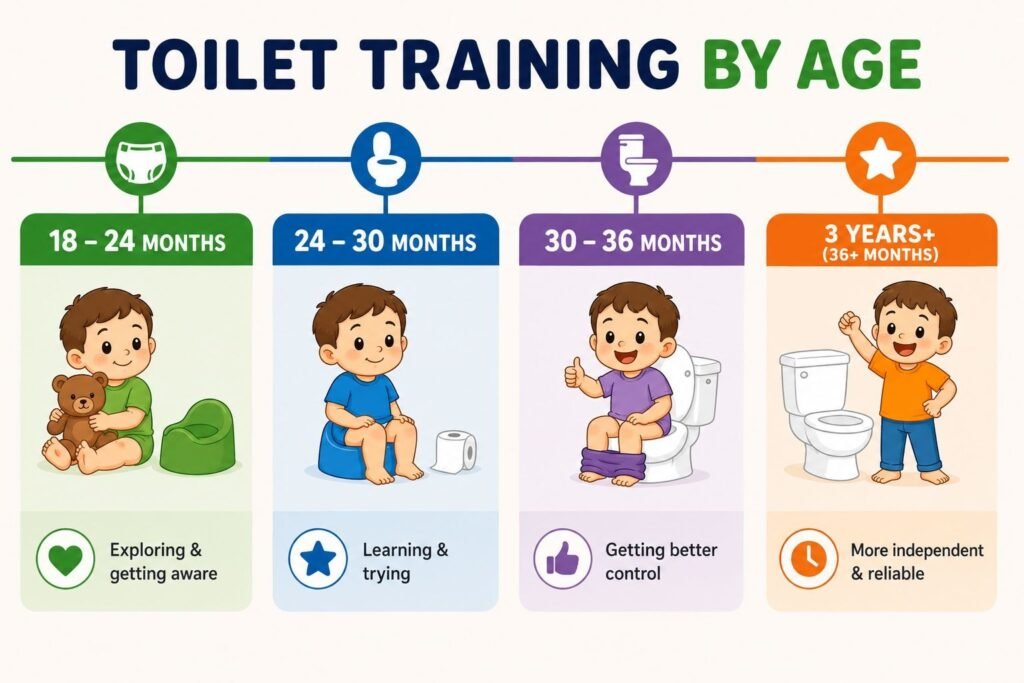
18 to 24 Months
Early bladder and bowel awareness starts to build during this window. Some toddlers manage short dry stretches and begin following simple instructions, but true readiness is still developing for most children at this stage, and that’s completely expected.
24 to 30 Months
Muscle control and communication typically catch up enough for many toddlers to begin active training somewhere in this range. It’s also worth knowing that starting meaningfully earlier than about 27 months tends to make the whole process take longer rather than shorter, one of the more counterintuitive but well supported findings on this topic.
30 to 36 Months and Beyond
Most children who begin training around this window complete daytime training within a matter of months. Nighttime dryness lags well behind and runs on an entirely separate timeline, one that has little to do with how well daytime training went.
How to Actually Start: A Step by Step Approach
The idea underlying every approach that actually works is simple: hand control to the child rather than managing the process for them.
- Equipment: start with a floor level potty chair rather than the big toilet, since feet planted flat on the ground genuinely help with pushing during bowel movements. Move to a toilet seat insert and step stool once the child is ready for that transition.
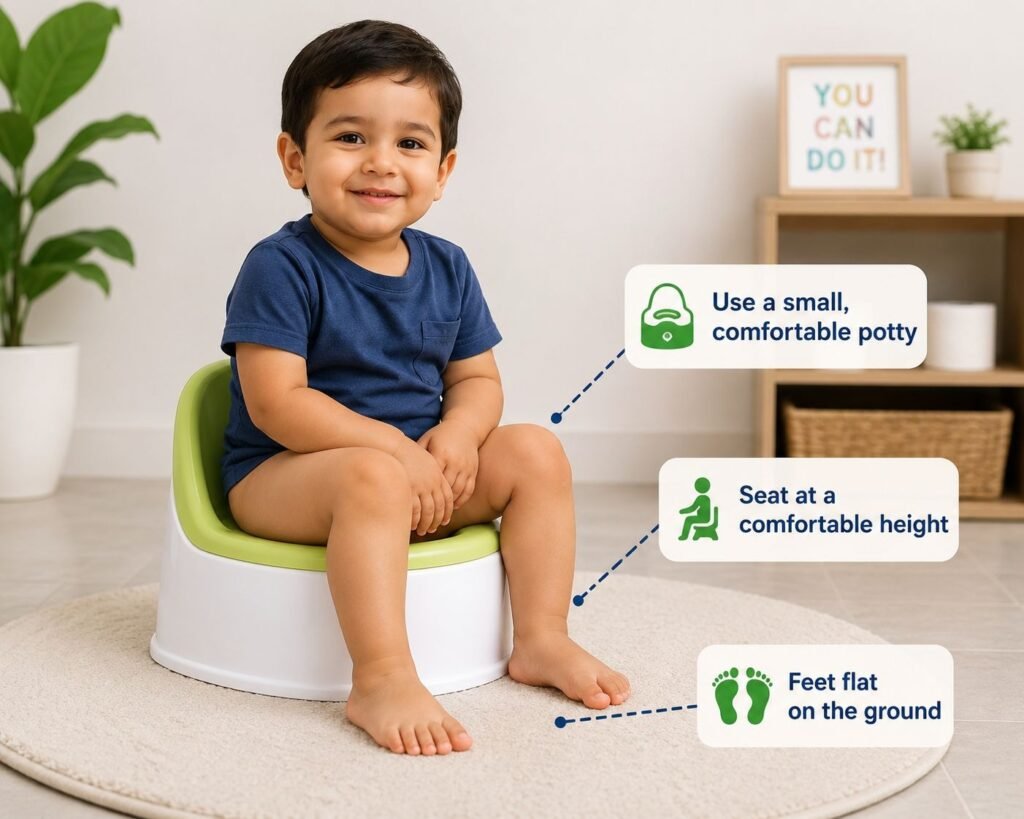
- Routine: try the potty after waking, roughly 15 to 30 minutes after meals, and before bath time, building it into the rhythm of the day rather than treating it as a separate event.
- Timing: keep each sitting for about 3 to 5 minutes. A longer wait can start to feel like punishment rather than practice.
- Praise: offer specific, warm praise for trying, not just for success, and keep any rewards small and fading over time rather than escalating into a bigger and bigger system.
- Underwear transition: switching fully to underwear once daytime training begins works well for many families, while others prefer a gradual shift, starting with underwear at home before expanding to outings. Both are reasonable paths, and the right one depends on the child.
Which Method Actually Works Best?
No single method has been shown to be clearly superior to the others, and the strongest evidence review available on this topic found that the major approaches have never actually been compared head to head in a real trial.
- Child led: follows the child’s own pace and readiness signals, tends to be lower stress for everyone involved, and usually takes weeks to months.
- Three day intensive: can work quickly in an older toddler with strong, clear readiness signs, but starting this kind of intensive approach before around 27 months tends to backfire and stretch the process out longer instead.
- Elimination communication: begins in infancy, is genuinely time and attention intensive for a caregiver, and has limited supporting evidence. Most families who try it still use diapers as a backup.
Accidents, Setbacks, and Regression
Accidents are a normal part of learning this skill, not a sign that anything has gone wrong, and how a parent responds tends to matter more than the accident itself.
What genuinely helps:

- Staying calm and neutral, cleaning up without comment or visible frustration
- Taking a short pause, a week or two, if resistance is strong, then trying again later
- Treating a sudden run of accidents in a previously trained child as a reason to check in with a pediatrician first, rather than assuming it’s purely behavioral
What tends to backfire:
- Punishment or shaming, which research links to higher rates of incontinence issues later on, not faster training
- Forcing a resistant or frightened child to sit longer or try harder
- Pressuring bowel training specifically, which can trigger stool withholding, a genuinely common and self reinforcing cycle worth understanding on its own. This overlaps closely with constipation in babies and toddlers, since a single painful, hard stool is often exactly what starts the withholding pattern in the first place.
Nighttime Dryness Runs on a Completely Different Timeline
Staying dry overnight depends on the body physically maturing, not on anything a child can be taught, which is exactly why it often takes months to years longer than daytime training does.
- About 1 in 5 children still wet the bed at age 5, and about 1 in 10 still do at age 7, both comfortably within a wide range of normal
- A consistently dry morning nappy is the real readiness sign for stopping night nappies, not a fixed age
- Waking a child overnight to use the toilet may reduce wet nights in the short term, but it doesn’t actually speed up the body’s natural physical maturity
When to Talk to a Pediatrician
- Little to no progress by around age 3
- Pain while peeing or pooping
- Blood on the stool or on toilet paper
- A weak or dribbling urine stream in a boy, or constant small leaking in a girl
- Sudden daily accidents alongside increased thirst or unexplained weight loss
- A previously trained child who suddenly regresses, especially with soft, diarrhea like leaking, which can be a sign of a backed up bowel rather than a simple setback
Quick Reference by Age
| Age Range | What’s Typical | Best Approach |
| 18 to 24 months | Early awareness building, true readiness still developing | Introduce toilet words, let the child observe |
| 24 to 30 months | Muscle control and communication often catch up | Begin active training if several signs cluster together |
| 30 to 36 months | Daytime training often completes within a few months | Consistent routine, warm praise, patience through setbacks |
| 3 years and beyond | Nighttime dryness still developing on its own timeline | Wait for a dry morning nappy before starting night training |
Practical Guidance for Parents
- Safe to do at home: build a consistent daily routine, offer warm and specific praise, allow a temporary diaper for bowel movements if a child resists pooping on the potty, and pause training entirely during major life changes like a new sibling or a house move.
- Best avoided: punishment or shaming for accidents, forcing a scared or resistant child onto the potty, restricting fluids to try to reduce accidents, and comparing one child’s timeline to another’s.
- A common misconception worth clearing up: that a resistant child “isn’t trying.” Most resistance actually traces back to fear, pain from a previous hard stool, or simply not being developmentally ready yet, not defiance.
The Takeaway
Toilet training has a genuinely wide, normal range, and a child who takes longer than a cousin or classmate isn’t behind, they’re simply on their own timeline. The approach that works best stays calm, consistent, and led by the child’s own readiness rather than a deadline. A pediatrician visit is worth booking for real red flags, pain, blood, no progress by three, or sudden regression, not for the ordinary bumps along the way.
For personalized guidance through this stage, or to explore the full range of services available at the clinic, booking a consultation at Child Care Clinic Mumbai is a straightforward next step.
Frequently Asked Questions
Most children show readiness signs somewhere between 18 and 36 months, and there’s no single correct starting age. What matters more than the calendar is whether the child is showing several physical, cognitive, and emotional readiness signs together.
Usually weeks to months, though the exact timeline varies widely from child to child. Starting before a child is genuinely ready, particularly before about 27 months, tends to stretch the process out longer rather than speeding it up.
This is a common pattern called stool toileting refusal, affecting roughly one in five children. It’s best not to force it, allowing a diaper for bowel movements if the child asks usually resolves within a few months, especially alongside a diet that keeps stools soft.
Yes. Occasional accidents can continue for months even after training seems complete, and they typically taper off over the following six months or so. Frequent accidents that aren’t improving over time are worth mentioning to a pediatrician.
Bedwetting is common and usually resolves on its own with time, since nighttime dryness depends on the body maturing rather than a skill being learned. It’s worth a conversation with a pediatrician if a child is 5 or older and bedwetting is causing real distress, or routinely by age 7 if it’s still happening.

Vivasvan Parekh
As a pediatrician and child specialist based in Mumbai, I bring over 15 years of experience in delivering comprehensive child healthcare. I hold an MD in Pediatrics and practice in Ghatkopar East and Chembur, where I focus on preventive and evidence-based pediatric care. My areas of expertise include vaccinations, newborn care, growth and development monitoring, and the treatment of common and complex childhood illnesses. I am committed to supporting parents with practical, reliable guidance on child health, nutrition, and overall well-being. Through my blog, I share trusted insights on pediatric health, helping parents make informed decisions about their child’s care and development.