
Key takeaways
- Mild fever, soreness, and fussiness after vaccination are normal signs the immune system is working, not signs of harm.
- Inactivated vaccines (DTaP, IPV, Hepatitis B, PCV) cause reactions within 24–48 hours; live vaccines (MMR, Varicella) can cause fever 14–42 days later.
- Breastfeed after the shot, use a cool compress on the injection site, and avoid oil, ghee, or heat on the area.
- Give paracetamol only if the baby is genuinely uncomfortable, never before the shot, as it can blunt the vaccine’s effectiveness.
- Call the paediatrician for fever of 38.5°C or higher, fever lasting beyond 24 hours, or any fever in a baby under 3 months.
- Go to emergency care immediately for breathing difficulty, facial swelling, seizures, or a limp, unresponsive baby.
The vaccination is done. The baby is crying. One parent is carrying a screaming infant out of the clinic while the other is already searching “fever after baby injection what to do” on their phone. And somewhere in the background, a well-meaning grandmother is suggesting coconut oil on the injection site.
This scene plays out in paediatric clinics across Mumbai every single day. Mild fever, soreness at the injection site, and fussiness after vaccination are completely normal. They are not signs that something went wrong. They are signs that the immune system is doing exactly what the vaccine asked it to do. Before their second birthday, babies may receive up to 20 injections across their vaccination schedule. Knowing how to manage the aftermath of each one makes the experience less frightening for parents and more comfortable for the baby.
This guide covers everything: what to expect hour by hour, how to treat baby fever after vaccination at home, how to reduce pain after vaccination, when a bath is safe, whether feeding should continue, and the specific signs that mean it is time to call the clinic.
Why Babies Have Reactions After Vaccination, And Why That Is Actually Good News
Before getting into management, it helps to understand why reactions happen at all. Parents who understand biology make calmer decisions, reach for medication less often than necessary, and feel genuinely less anxious when the expected symptoms appear.
Fever after vaccination happens because the immune system has recognised the vaccine components and launched a response. Raising the body temperature makes the body a less hospitable environment for germs and activates the signalling chemicals that guide immune activity. The localised redness and swelling at the injection site is the same immune response playing out in a smaller, more concentrated area. The temporary fatigue many babies show after vaccination happens because energy is being redirected toward immune work.
None of this is the vaccine causing harm. All of it is the vaccine working.
It is also worth saying clearly: a baby who does not develop any visible reaction after vaccination is not responding poorly. Not every baby who builds strong, effective immunity develops a fever or swelling. Absence of symptoms does not mean the vaccine failed. The immune response is happening whether or not there are visible signs of it.
Normal body temperature sits at approximately 37°C. A fever is anything above this, but the level of the fever and how the baby is behaving alongside it matter far more than the number on the thermometer.
What to Expect After Vaccination: An Honest Timeline
One of the most helpful things a parent can have is a realistic picture of when reactions appear, how long they last, and when the window for concern genuinely opens. Most post-vaccination anxiety comes from not knowing what is normal at each stage.
In the First Few Hours
The injection site may appear red, feel slightly warm to touch, and look a little swollen. The baby may be fussier than usual, may feed a little less eagerly, or may sleep more than expected. A mild fever can begin within a few hours of the shot. All of this is expected and does not need medical attention.
Day 1 to Day 2
Most reactions from inactivated vaccines, which include DTaP, IPV, Hepatitis B, and PCV, peak in the first 24 to 48 hours. Injection site soreness and redness typically resolve within 24 hours. If the pain, swelling, or redness at the injection site is worsening rather than improving, or has not resolved after 24 hours, that is the time to contact the paediatrician.
The MMR and Varicella Exception: Reactions That Appear Much Later
This is the timing detail that catches most parents off guard, and it is worth reading carefully because not knowing it causes significant unnecessary panic.
MMR and Varicella are live attenuated vaccines, meaning they contain weakened versions of the actual virus. Because of this, the immune response plays out over a much longer window than inactivated vaccines.
MMR can cause a mild fever anywhere from the day of vaccination up to 14 days afterward, in roughly 2 in every 100 recipients. Varicella is even more extended: fever can appear anywhere from the day of vaccination to 42 days afterward, with most reactions occurring between day 14 and day 27 after the shot.
A baby who develops a mild fever or a faint rash three weeks after the MMR or Varicella vaccine is having a completely normal, expected immune response. Parents who are not warned about this timeline frequently arrive at the clinic in a panic, not connecting the current fever to a vaccination given a fortnight earlier. Every parent receiving the 9-month MMR or 15-month Varicella vaccine should be told this at the time of the visit.
How to Reduce Pain After Vaccination: What Actually Helps
At the Clinic: Before and During the Shot
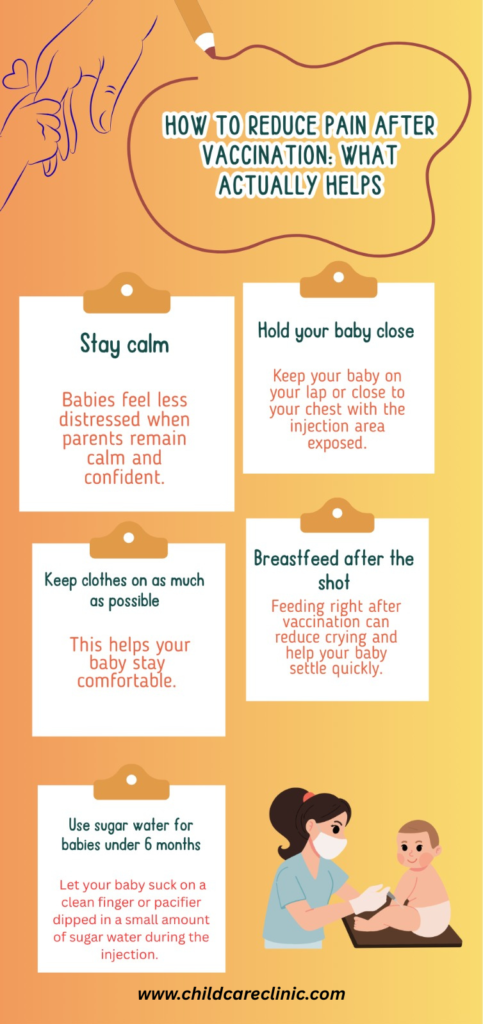
- Stay calm. This is not a platitude. Research shows that parent anxiety significantly affects how much distress a baby experiences during vaccination. A parent who holds the baby firmly, confidently, and calmly produces a measurably calmer baby. The pain of the injection lasts seconds. The protection lasts years.
- Hold the baby close with the injection arm or thigh exposed. Older babies can sit on the parent’s lap facing them, which provides both physical security and a distraction. Keeping the baby as clothed as possible makes for a quick, comfortable exit afterward.
- Breastfeed after the shot, not immediately before. Studies consistently show that babies who are breastfed during or shortly after vaccination cry significantly less and settle more quickly. However, feeding immediately before the injection carries a small risk of vomiting during the procedure. The right approach is to feed right after.
- Sugar water for babies under 6 months is a well-studied, safe comfort measure. Dipping a clean pacifier or finger in a small amount of sugar water and letting the baby suck during the injection measurably reduces the pain response. It is simple, costs nothing, and works.
- Ask about combination vaccines. A single Pentavalent injection covers Diphtheria, Tetanus, Pertussis, Hib, and Hepatitis B in one poke rather than five separate injections. The Indian Academy of Pediatrics (IAP) and the American Academy of Pediatrics (AAP) both recommend combination vaccines whenever possible to reduce the total number of injections per visit.
- Ask about numbing cream (EMLA). A topical anaesthetic applied to the injection site approximately one hour before the appointment reduces pain significantly. This is worth discussing with the paediatrician, particularly for older babies or for children who had a very distressing experience at a previous vaccination visit.
- Distract older babies with a favourite toy, bubbles, a noisemaker, or a short video at the right moment. Redirecting attention away from the injection is one of the most effective pain-reduction strategies available, endorsed by the CDC.
At Home: Managing Injection Site Pain and Swelling
- Cool compress first. Place a cool damp cloth or cold wet towel on the injection site for a few minutes. This reduces localised inflammation and soothes the soreness. Repeat a few times during the day if the baby seems uncomfortable.
- Gently move the limb. Carefully moving the arm or leg where the injection was given several times throughout the day prevents stiffness and helps with circulation at the site.
- What not to do at the injection site. Do not massage directly over the injection spot. Do not apply oils, including coconut oil. Do not use hot towels, heat packs, or any herbal or home remedy in the area. All of these can worsen local irritation and increase swelling. This point is worth emphasising for Indian households where applying oil or herbal pastes to sore areas is a deeply instinctive response. The intention is kind, but the effect at an injection site is the opposite of helpful.
- Paracetamol only if clearly needed and only on paediatrician’s advice. If the baby is genuinely uncomfortable from the injection site pain, a paediatrician-recommended dose of syrup paracetamol can be given. Do not give it prophylactically before the shot or immediately afterward as a precaution, as this has been shown to reduce the vaccine’s effectiveness by blunting the antibody response.
How to Treat Baby Fever After Vaccination: The Temperature Action Ladder
This is the most searched question in the hours after a vaccination visit, and it deserves a precise, actionable answer that parents can actually use at home with a thermometer in hand.
The consistent clinical message across all guidance: most post-vaccination fevers are mild, self-limiting, and do not need medication. How the baby is behaving matters as much as the number on the thermometer. A baby with a temperature of 37.8°C who is feeding well and is generally settled needs monitoring, not medication. A baby with a temperature of 38°C who is very distressed and not settling needs paracetamol and possibly a call to the clinic.
Temperature Action Table
| Baby’s Temperature | What to Do |
| Below 37.5°C | Monitor your baby, keep them comfortable, and offer extra feeds to maintain hydration. |
| 37.5°C and above | Give age appropriate paracetamol only at the dose recommended by your paediatrician. |
| 38°C and above | Continue paracetamol and begin lukewarm water sponging. Avoid using cold water. |
| 38.5°C and above | Contact your paediatrician promptly rather than waiting for the next scheduled visit. |
| Any fever in a baby under 3 months | Seek immediate medical advice, regardless of the thermometer reading. |
| Fever lasting more than 24 hours | Contact your paediatrician even if the temperature remains below 38.5°C. |
Paracetamol at Home: What Parents Need to Know
Syrup paracetamol is the correct first-line medication for post-vaccination fever in babies. Ibuprofen can be considered for babies over 6 months if paracetamol alone is not providing sufficient relief, but always confirm this with the paediatrician before switching.
Dosing rules to follow at home:
- Give every 4 to 6 hours when genuinely needed
- Do not exceed 4 doses in any 24 hour period
- Can be given with or without food
- Shake the bottle well before each use
- Refrigerate after opening and never freeze
- Discard 6 months after first opening regardless of how much remains
Do not give paracetamol before the vaccination to prevent fever. Multiple studies show this reduces the antibody response and makes the vaccine less effective. It feels like a proactive, caring thing to do. Clinically, it works against the purpose of the vaccination. If the baby is comfortable after the shot without medication, there is no reason to give any.
Dressing and Comfort During Fever
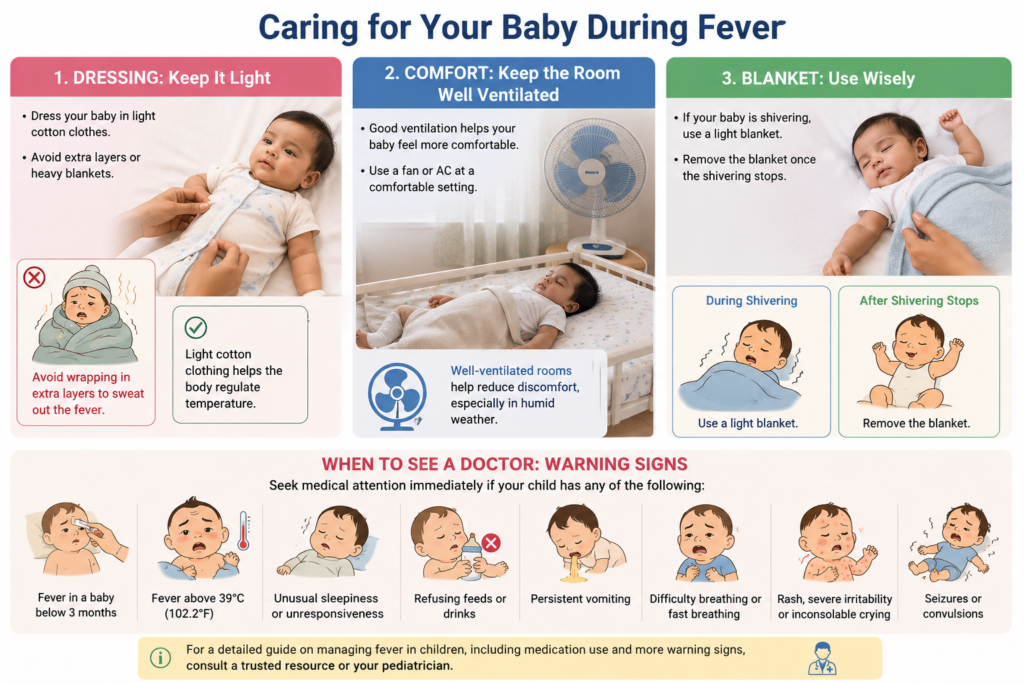
Keep the baby lightly dressed. The instinct in many Indian households to wrap a feverish baby in extra layers to sweat out the fever actively makes things worse by trapping heat and preventing the body from regulating its own temperature. Light cotton clothing is the right approach. A light blanket is appropriate if the baby is shivering, but should be removed once the shivering stops.
Keep the room well ventilated. In Mumbai’s humidity during the monsoon months, a poorly ventilated room can make a mild fever feel much worse for a baby. A fan or air conditioning at a comfortable setting is completely appropriate.
For a detailed guide on managing fever in children beyond the vaccination context, including when to use different medications and what warning signs to watch for, this resource on child fever: when to see a doctor, warning signs, and safe medicines for kids covers everything parents need to know.
When Post-Vaccination Symptoms Are Not Normal: Signs That Need Immediate Attention
After all the reassurance above, here is the section that needs to be read equally carefully. Most post-vaccination reactions are mild and self-resolving. A small number are not.
Call the Paediatrician If:
- Fever reaches 38.5°C or above
- Fever persists beyond 24 hours regardless of how high it is
- There is any fever at all in a baby under 3 months old
- The baby has a persistent high-pitched cry lasting more than one hour. This is distinctly different from the normal fussy crying after a vaccination and parents who have heard it usually describe it as unusual
- The baby is excessively sleepy, difficult to rouse, or unusually limp in a way that is not typical for them
- The injection site swelling is growing larger, spreading up the limb, or has not improved after 24 hours
Go to Emergency Immediately If:
- The baby has difficulty breathing or any tightness in the throat
- There is swelling of the face, lips, or tongue
- Hives or a widespread rash appears rapidly across the body
- The baby becomes limp, pale, or unresponsive
- A seizure or convulsion of any kind occurs
Severe allergic reactions to vaccines are extremely rare. When they do occur, they typically happen within 15 to 30 minutes of the injection, which is why paediatric clinics ask parents to remain in the waiting area after vaccination. This is not a formality. It is a genuine clinical safety measure, and parents should always stay for the observation period rather than leaving immediately after the shot.
Common Advice That Is Better Left Aside
A post-vaccination care guide for Indian parents would not be complete without addressing the specific home remedies and well-meaning suggestions that circulate in family WhatsApp groups and that parents bring up at almost every post-vaccination consultation.
- Applying oil, ghee, or herbal pastes to the injection site does not reduce swelling and can introduce bacteria to a site where the skin barrier has just been broken by a needle. A cool damp cloth is what the evidence supports.
- Wrapping the baby in extra blankets during fever traps heat and makes it harder for the body to regulate its own temperature. Light clothing and good ventilation are the right approach, even if the instinct to keep a feverish baby warm is a strong one.
- Giving gripe water or herbal remedies for fussiness after vaccination has no evidence behind it for this specific use, and some preparations contain ingredients that are not appropriate for young infants. Breastfeeding, holding, gentle rocking, and skin to skin contact are the comfort measures that actually work.
- Pre-medicating with paracetamol before the shot feels proactive and caring. Clinically, as discussed above, it reduces vaccine effectiveness. The better approach is to manage discomfort if and when it appears, not to anticipate it with medication beforehand.
For a broader look at the vaccine-related claims that circulate among Indian parents and how to assess them, this guide on vaccination myths vs facts for Mumbai parents addresses them one by one with clear evidence-based answers.
For parents curious about why some vaccines are given by mouth while others are injected, this resource on oral vs injectable vaccines explains the science behind the delivery method.
The Discomfort Is Temporary. The Protection Is Not.
Every injection a baby receives is a disease that the baby will almost certainly never have to face. The crying stops within minutes. The redness at the injection site fades within a day. The fever breaks within 24 hours for most vaccines. What remains is immunity that will protect that child through childhood, through school, through the years when they are no longer under the same roof.
Watching a baby be uncomfortable is genuinely hard, even when the parent knows it is for the best. The goal of this guide is not to tell parents they should not care about their baby’s discomfort. It is to give them the knowledge to manage it confidently, calmly, and correctly, and to know the clear difference between normal discomfort that simply needs time and the rare sign that genuinely needs a doctor.
If there are concerns about a baby’s reaction after vaccination, if a dose has been missed, or if there are questions about the right vaccination schedule, book a consultation with Dr. Vivasvan Parekh at Vivasvan Child Care Clinic in Mumbai. Bring the vaccination card to every visit.
Frequently asked questions about baby care after vaccination
For most inactivated vaccines such as DTaP, PCV, and Hepatitis B, fever usually appears within 24 to 48 hours and settles within a day. Live vaccines like MMR and Varicella can cause fever much later. MMR reactions may occur up to 14 days after vaccination, while Varicella-related fever can appear up to 42 days later, most commonly between days 14 and 27. If fever lasts beyond 24 hours or reaches 38.5°C or higher, contact your paediatrician.
Yes. Bathing is completely safe after vaccination. A lukewarm bath may even help soothe a baby with a mild fever or discomfort. Avoid hot water, handle the injection site gently, and pat it dry rather than rubbing. Normal bathing routines can continue as usual.
Yes, and it is encouraged. Breastfeeding during or shortly after vaccination helps babies settle faster and may reduce crying. It also provides immune support and helps maintain hydration. Vaccines do not interfere with breast milk, so feeding can continue normally and even more frequently if the baby wants.
A mild fever is a common and expected reaction. Contact your paediatrician if the temperature reaches 38.5°C or higher, lasts longer than 24 hours, or if your baby is under 3 months old and develops any fever. Seek emergency care immediately if your baby has difficulty breathing, facial or throat swelling, seizures, becomes limp or unresponsive, or develops hives or a rapidly spreading rash.
No. Giving paracetamol before vaccination is not recommended because it may reduce the body’s antibody response. If your baby develops a fever afterward and is uncomfortable, paracetamol can be given in the dose recommended by your paediatrician. If the baby is comfortable, medication is usually unnecessary. When in doubt, contact your clinic for advice.

Vivasvan Parekh
As a pediatrician and child specialist based in Mumbai, I bring over 15 years of experience in delivering comprehensive child healthcare. I hold an MD in Pediatrics and practice in Ghatkopar East and Chembur, where I focus on preventive and evidence-based pediatric care. My areas of expertise include vaccinations, newborn care, growth and development monitoring, and the treatment of common and complex childhood illnesses. I am committed to supporting parents with practical, reliable guidance on child health, nutrition, and overall well-being. Through my blog, I share trusted insights on pediatric health, helping parents make informed decisions about their child’s care and development.