
Quick Answer: Babies need 12 to 17 total hours of sleep a day across the first year, gradually consolidating from scattered newborn bursts into longer night stretches and two structured naps by 6 months. Night waking is usually driven by hunger, an overheated room, or a developmental leap, not a sign that anything has gone wrong. Safe sleep position remains the single biggest factor in preventing SIDS, and it matters more than any schedule.
At a glance:
- Newborns (0 to 3 months): 14 to 17 hours total, in short, unpredictable bursts
- 4 to 6 months: 14 to 15 hours, longer night stretches begin
- 6 to 12 months: 12 to 14 hours, usually 2 naps plus 10 to 12 hours at night
- Back sleeping, a firm flat surface, and an empty crib remain the most protective steps against SIDS
- Night waking is most often hunger, room temperature, or a developmental leap, not a reason to worry

The 4 Month Checkup That Isn’t Actually a Problem
Few parenting experiences are as confusing as a baby who suddenly stops sleeping the way they used to. Just when parents feel they have settled into a routine, nighttime wakings increase, naps become unpredictable, and a once easy sleeper seems to change overnight. It’s a pattern so common that many parents assume something must be wrong.
Nothing had broken. His brain had simply matured, and his sleep cycles had shifted to look more like an adult’s, which sounds like good news until it means far more natural waking between cycles. A newborn’s sleep cycle runs at roughly half the length of an adult’s, which is exactly why frequent waking in the early months is biology doing its job, not a parenting failure. What follows is a clear, age by age look at how much sleep is actually normal, why babies wake when they do, and the safe sleep basics that matter more than any schedule ever could.
How Much Sleep Does a Baby Actually Need?
Total daily sleep drops steadily across the first year, from around 14 to 17 hours as a newborn down to 12 to 14 hours by the first birthday. These are ranges, not targets to hit exactly, and a baby sleeping slightly outside them, while otherwise happy, growing, and alert, is not behind.
| Age | Total Sleep | Night Sleep | Naps |
| 0 to 3 months | 14 to 17 hours | Short, fragmented stretches with frequent feeds | 4 to 8 naps with no predictable schedule |
| 4 to 6 months | 14 to 15 hours | Longer sleep stretches begin to emerge | Usually 2 to 3 naps per day |
| 6 to 12 months | 12 to 14 hours | Around 10 to 12 hours at night, though some wakings remain normal | Typically 2 naps, with the third nap gradually disappearing |
Why Newborns Wake So Often, and Why That’s Normal
A newborn’s sleep cycle runs about 45 to 50 minutes, compared with roughly 90 minutes in an adult, which means far more natural surfacing between cycles throughout the night. A tiny stomach that empties in as little as 1.5 to 3 hours means genuine hunger drives most of that waking, not habit and not a sleep problem to fix.
What’s Normal at This Age
- Waking every 1.5 to 3 hours to feed
- Needing to be held or fed back to sleep
- Short, 20 to 45 minute naps
- No predictable schedule at all in the first weeks
Building a Routine That Actually Works
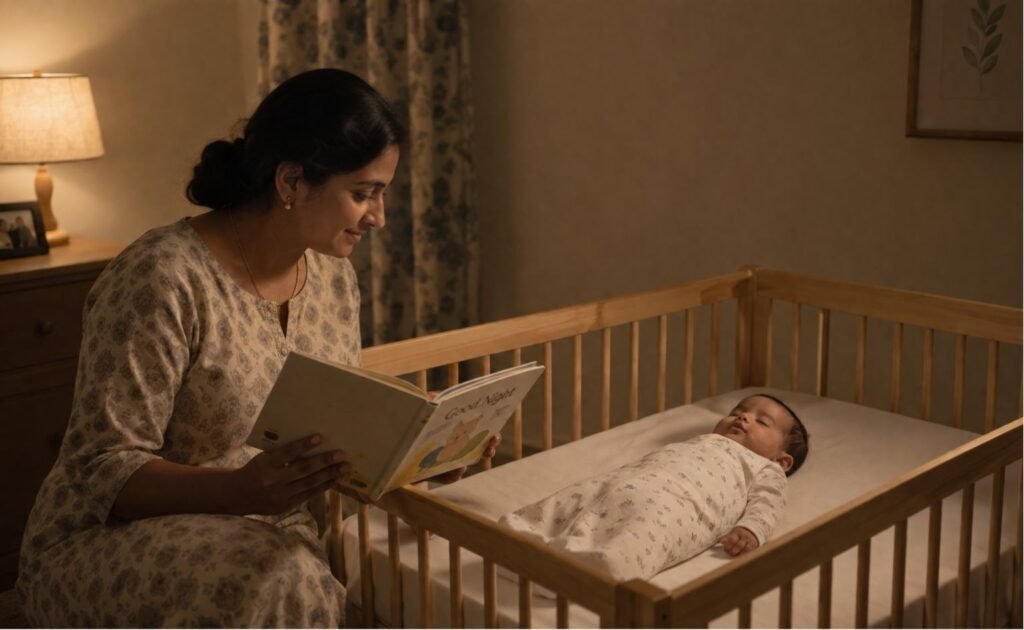
Consistency, far more than complexity, is what teaches a baby’s brain that it’s time to wind down. Daytime naps can happen in a bright, ordinarily noisy environment, normal household sounds are perfectly fine and even helpful. Nighttime is where the shift matters: dimming the lights and stepping away from screens roughly an hour before bed, then following the same calm sequence every night, a bath, a change, a sleep sack, a short book, sends a clear, repeated signal.
Self settling deserves a mention here too. Placing a baby down drowsy but still awake, rather than fully asleep, helps build the skill of settling back down independently between cycles, which pays off enormously by 6 months and beyond.
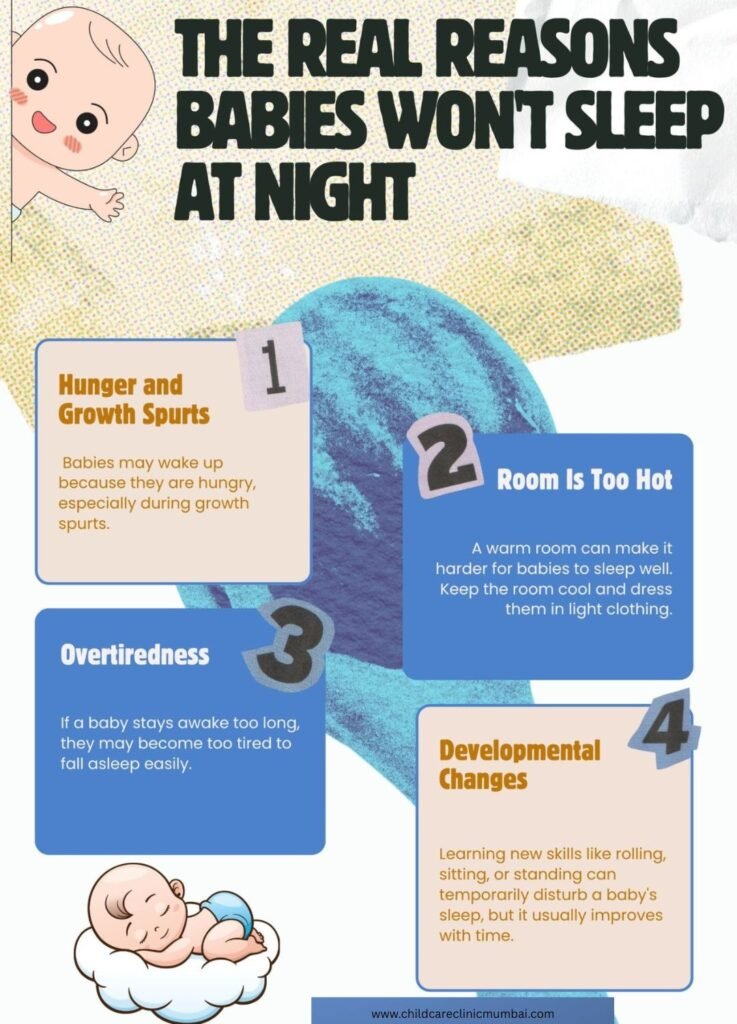
The Real Reasons Babies Won’t Sleep at Night
1. Hunger and Growth Spurts
Genuine nighttime hunger is common, especially under 6 months, and growth spurts can temporarily push a baby to feed more often at night. One pattern worth flagging to a pediatrician is a baby eating noticeably more at night than during the day, since gently shifting calories toward daytime feeds usually helps more than trying to cut night feeds outright. For parents wondering whether daytime intake itself needs a closer look, this nutrition guide for under 5s in Mumbai is a useful companion read.
2. An Overheated Room
This one gets overlooked constantly, and it matters more in Mumbai’s climate than most parenting advice accounts for. A room that’s too warm blocks the natural drop in core body temperature that deep sleep depends on. Somewhere around 18 to 22°C tends to be comfortable for most babies, and on genuinely hot nights, light cotton sleepwear plus a fan does far more good than an extra blanket ever will.
3. Overtiredness
Missing a baby’s natural sleep window, even by as little as 20 minutes, can trigger a small surge of stress hormones that leaves an overtired baby looking wired and wide eyed rather than sleepy. Watching for the early tired cues, yawning, rubbing the eyes, staring off into space, and acting on them before that window closes makes falling asleep noticeably smoother.
4. Developmental Leaps
Rolling, sitting, standing, and separation anxiety all disrupt sleep temporarily, and all of them pass on their own, usually within 2 to 6 weeks. Plenty of daytime floor time to practice new physical skills, paired with brief, calm nighttime interactions rather than long engagement, tends to speed the whole phase along. Parents keeping an eye on these physical milestones alongside sleep changes may find this guide to crawling and walking milestones useful for spotting the connection between the two.
Safe Sleep: The Section That Matters Most
Back sleeping, a firm flat surface, and an empty crib are the three most protective steps against Sudden Infant Death Syndrome, and none of them are optional extras or nice to haves.
- Always place the baby on their back to sleep, for every single sleep, naps included
- Use a firm, flat mattress with nothing but a snugly fitted sheet
- Keep the crib completely empty, no pillows, blankets, bumper pads, or soft toys
- Room share without bed sharing for at least the first 6 months, ideally through the first birthday
- Dress for room temperature and never cover the head, since overheating is a genuine risk
- Keep the sleep space entirely smoke free
- A pacifier at sleep time is fine once breastfeeding is well established, but it shouldn’t be forced
One honest note worth including here. Co-sleeping is common across many Indian households, for cultural reasons, joint family living, and sheer exhaustion during breastfeeding. Pretending it never happens helps no one. Families who do share a bed should, at an absolute minimum, avoid soft mattresses, sofas, and recliners, keep heavy bedding and pillows well away from the baby’s face, and never share a bed after alcohol, sedating medication, or extreme exhaustion. Harm reduction genuinely matters more here than an all or nothing message that gets quietly ignored.
When to Call a Doctor About Sleep
- A newborn sleeping more than 4 to 5 hours between feeds in the first 2 weeks without having regained birth weight
- Noisy or labored breathing during sleep, distinct from the normal grunting and snuffling newborns make
- Loud snoring most nights, or visible pauses in breathing
- Any fever of 100.4°F (38°C) or higher in a baby under 3 months
- Sleep problems lasting several weeks with no improvement despite a genuinely consistent routine
Quick Comparison
| Age | Typical Sleep Pattern | Common Cause of Waking | What Helps |
| 0 to 3 months | Fragmented sleep in 1.5 to 3 hour stretches throughout the day and night | Hunger, frequent feeding needs, and immature sleep cycles | Feed based on cues, maintain a calm environment, and keep nighttime interactions quiet and dimly lit |
| 4 to 6 months | Longer nighttime stretches begin, though wakings are still common | Developmental milestones, sleep regressions, and becoming overtired | Establish a consistent bedtime routine and pay attention to early sleepy cues |
| 6 to 12 months | Around 10 to 12 hours of nighttime sleep with 2 regular naps | Habit waking, separation anxiety, teething, or an uncomfortable sleep environment | Encourage self settling when appropriate and maintain a comfortable, sleep friendly room temperature |
The Final Thought
Baby sleep during the first year is rarely linear. A baby who suddenly starts waking more often, especially around 4 months, is usually experiencing normal developmental changes rather than a sleep problem. As sleep cycles mature, frequent night wakings, shorter naps, and changes in bedtime routines become common parts of infancy.
The most important steps are often the simplest ones: following safe sleep practices, creating a calm and predictable bedtime routine, and paying attention to a baby’s sleep cues instead of chasing a perfect schedule. Every baby develops differently, and occasional regressions are usually temporary.
At the same time, parents should watch for genuine concerns such as breathing difficulties during sleep, poor weight gain, persistent irritability, or sleep problems that significantly affect feeding and daily functioning.
In most cases, reassurance, consistency, and time are all that is needed. However, if sleep concerns persist or leave parents feeling uncertain, a consultation at Vivasvan Child Care Clinic can provide personalized advice and much needed peace of mind
.Frequently Asked Questions
Newborns need roughly 14 to 17 hours a day, dropping to about 14 to 15 hours between 4 and 6 months, and settling around 12 to 14 hours by their first birthday. These are ranges, not exact targets.
This is most often genuine hunger, especially under 6 months, since a young baby’s stomach empties quickly and their sleep cycles are naturally shorter than an adult’s. It’s a normal stage, not a sign of a sleep problem.
Always on the back, for every sleep, both naps and nighttime, on a firm flat surface with nothing else in the crib. This remains the single most protective step against SIDS.
Many babies begin sleeping longer stretches somewhere between 4 and 6 months, though a full 10 to 12 hour night without any waking often doesn’t settle in fully until closer to the first birthday, and the range of normal is genuinely wide.
Yes, and it’s one of the most common concerns brought to a pediatrician. Sleep cycles mature permanently around this age, which temporarily increases night waking. It typically resolves within 2 to 6 weeks.

Vivasvan Parekh
As a pediatrician and child specialist based in Mumbai, I bring over 15 years of experience in delivering comprehensive child healthcare. I hold an MD in Pediatrics and practice in Ghatkopar East and Chembur, where I focus on preventive and evidence-based pediatric care. My areas of expertise include vaccinations, newborn care, growth and development monitoring, and the treatment of common and complex childhood illnesses. I am committed to supporting parents with practical, reliable guidance on child health, nutrition, and overall well-being. Through my blog, I share trusted insights on pediatric health, helping parents make informed decisions about their child’s care and development.