
Key takeaways
- India has two vaccination pathways: the free government NIS schedule and the expanded IAP schedule followed by most private paediatricians.
- At birth, every baby should receive BCG, OPV-0, and the Hepatitis B birth dose within 24–72 hours of delivery.
- The Rotavirus vaccine cannot be started after 16 weeks of age, this window cannot be reopened once it closes.
- MMR-1 must be given only after exactly 270 completed days of life, not simply “at 9 months.”
- Almost every other vaccine can be caught up later if a dose is missed, delay is not the same as losing the opportunity.
- IAP additions worth prioritising for Mumbai families include Typhoid Conjugate Vaccine and Hepatitis A, given local food, water, and monsoon risk.
Every parent wants to protect their baby, but keeping track of the vaccination schedule can quickly become confusing. Questions like Which vaccines are due next?, Are government and private schedules the same?, and What if a dose is delayed? are among the most common concerns during a child’s first year.
The answer is simpler than it seems. India follows two vaccination pathways. The government’s National Immunisation Schedule (NIS) provides essential vaccines free of cost through BMC health posts, government hospitals, and primary health centres. Alongside this, the Indian Academy of Pediatrics (IAP) recommends an expanded schedule followed by many private paediatricians, offering additional protection against several preventable diseases. This guide explains both schedules side by side, helping parents understand what vaccines are due, when they should be given, and where they can be accessed.
Government NIS- free
BCG, OPV, Hepatitis B, Pentavalent, IPV, Rotavirus, PCV, MR, DPT boosters, Td, Vitamin A. Available at BMC health posts and government hospitals.
IAP private additions
Everything in the NIS plus Varicella, Hepatitis A, Typhoid Conjugate Vaccine, full MMR, annual Influenza, and HPV from age 9.
Why the Vaccination Schedule Is Designed the Way It Is
The timing of vaccines is not arbitrary. Every dose on the schedule is placed at a specific age for two reasons: the immune system is developmentally ready to mount the strongest possible protective response at that point, and the baby is at the highest risk of exposure to that particular disease around that age.
A newborn in Mumbai who has not received BCG is genuinely at risk in a densely populated city where tuberculosis continues to circulate. A baby who misses the rotavirus vaccine window loses the opportunity entirely, because the first dose cannot be given after 16 weeks of age under any circumstances. These are not bureaucratic rules. They are biological realities.
It is also worth naming what these vaccines actually prevent, in concrete terms. Polio can cause permanent paralysis. Measles can cause brain damage and death. Whooping cough is fatal in babies under 6 months. Tetanus has no cure. None of these are historical diseases confined to textbooks. Polio still circulates in Pakistan and Afghanistan. Measles outbreaks have occurred in India within the last decade. Typhoid spreads through contaminated water and food in Mumbai’s monsoon months every single year.
And then there is herd immunity. When enough children in a community are vaccinated, diseases cannot spread efficiently. This protects babies who are too young to be vaccinated yet, children who are immunocompromised, and elderly grandparents living in the same household. In a joint family setting, vaccination is never just a personal decision. It protects everyone under the same roof.
For parents curious about why some vaccines are swallowed rather than injected, this guide on oral vs injectable vaccines explains the reasoning behind the delivery method for each type.
Government (NIS) vs IAP Schedule: What Is the Difference?
This is the question that creates the most confusion in the clinic, and it deserves a clear answer without jargon.
What the Government NIS Provides Free of Charge
The National Immunisation Schedule (NIS) covers the essential baseline and every vaccine listed below is available at no cost at BMC health posts and government hospitals across Mumbai.
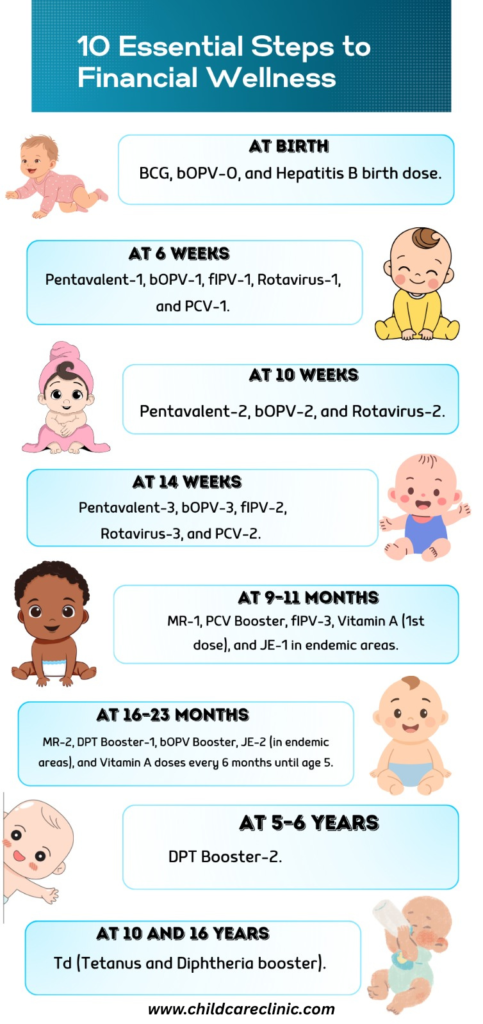
- At birth: BCG, bOPV-0 (oral polio zero dose), and the Hepatitis B birth dose. All three should be given within 24 to 72 hours of delivery, before leaving the maternity ward.
- At 6 weeks: Pentavalent-1 (a single combined injection covering Diphtheria, Tetanus, Pertussis, Hib, and Hepatitis B), bOPV-1, fIPV-1 (fractional inactivated polio), Rotavirus-1, and PCV-1.
- At 10 weeks: Pentavalent-2, bOPV-2, and Rotavirus-2.
- At 14 weeks: Pentavalent-3, bOPV-3, fIPV-2, Rotavirus-3, and PCV-2.
- At 9 to 11 months: MR-1 (Measles and Rubella), PCV Booster, fIPV-3, Vitamin A first dose, and JE-1 in Japanese Encephalitis endemic areas.
- At 16 to 23 months: MR-2, DPT Booster-1, bOPV Booster, JE-2 in endemic areas, and Vitamin A doses 2 through 9 (given every 6 months until age 5).
- At 5 to 6 years: DPT Booster-2.
- At 10 years and 16 years: Td (Tetanus and Diphtheria booster).
What the IAP Private Schedule Adds
The IAP schedule includes everything in the NIS and adds vaccines that provide meaningful extra protection, particularly relevant for urban families in Mumbai.
- Varicella (Chickenpox): 2 doses, at 15 months and again at 4 to 6 years. Chickenpox spreads rapidly in schools and playgroups and can cause serious complications in some children.
- Hepatitis A: 2 doses of the killed vaccine at 12 months and 18 months, or a single dose of the live vaccine at 12 months. Hepatitis A spreads through contaminated food and water, a real concern during Mumbai’s monsoon season.
- Typhoid Conjugate Vaccine (TCV): first dose at 6 to 9 months, booster at 2 years. Typhoid is endemic in Mumbai and this vaccine offers significantly longer protection than older typhoid vaccines.
- Full MMR (Measles, Mumps, and Rubella) instead of MR only: given at 9 months (after 270 completed days), 15 months, and 4 to 6 years. The government MR vaccine does not include the Mumps component.
- Influenza: annually from 6 months onward, with the first two doses given one month apart.
- HPV (Human Papillomavirus): from age 9 onwards, 2 doses if started before the 15th birthday, 3 doses if started at 15 or after.
Tdap was preferred over plain Td at the age 10 booster, offering additional Pertussis protection.
The IAP additions come at a cost and not every family can access private clinics for all of them. The NIS provides strong core protection. Where possible, filling in the IAP additions is a worthwhile conversation to have with a paediatrician, particularly TCV and Hepatitis A for Mumbai’s urban environment.
Complete Vaccination Schedule Chart: IAP and NIS Combined (0 to 10 Years)
| Age | Government NIS (Free) | IAP Private Clinic Additions |
| Birth (within 24 to 72 hours) | BCG, bOPV-0, Hepatitis B | — |
| 6 weeks | Pentavalent-1, bOPV-1, fIPV-1, RVV-1, PCV-1 | DTwP or DTaP-1, Hib-1, IPV-1, Hepatitis B, Rotavirus-1 |
| 10 weeks | Pentavalent-2, bOPV-2, RVV-2 | DTwP or DTaP-2, Hib-2, IPV-2, Hepatitis B, PCV-2, Rotavirus-2 |
| 14 weeks | Pentavalent-3, bOPV-3, fIPV-2, RVV-3, PCV-2 | DTwP or DTaP-3, Hib-3, IPV-3, Hepatitis B, PCV-3, Rotavirus-3 |
| 6 months | — | Hepatitis B (if following the 0,1,6 schedule), Influenza-1 |
| 7 months | — | Influenza-2 |
| 6 to 9 months | — | Typhoid Conjugate Vaccine (TCV)-1 |
| 9 to 11 months | MR-1, PCV Booster, fIPV-3, Vitamin A | MMR-1 (after 270 completed days) |
| 10 months | — | TCV-1 (at least 1 month after MMR) |
| 12 months | — | Hepatitis A-1, Varicella-1 |
| 15 months | — | MMR-2, Varicella-1 (if not already given), PCV Booster |
| 15 to 18 months | — | DTwP or DTaP Booster, IPV Booster, Hib Booster |
| 16 to 23 months | MR-2, DPT Booster-1, bOPV Booster, Vitamin A | Hepatitis A-2 (killed vaccine only) |
| 2 years | — | TCV Booster or Typhoid Polysaccharide Vaccine |
| 4 to 6 years | DPT Booster-2 | DTwP or DTaP Booster-2, MMR-3, Varicella-2, OPV Booster |
| 9 years onwards | HPV (2 doses if given before age 15) | — |
| 10 years | Td | Tdap preferred over Td |
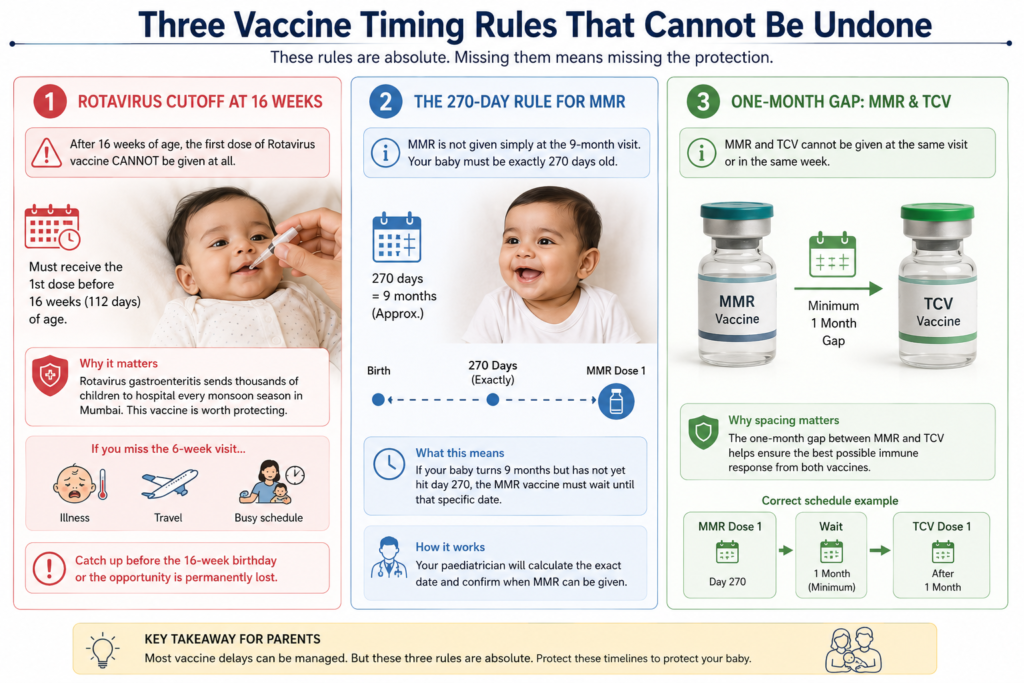
Three timing rules parents must not miss: MMR-1 must be given after exactly 270 completed days of life, not simply “at 9 months.” The Rotavirus first dose cannot be started after 16 weeks of age under any circumstances. The Typhoid Conjugate Vaccine must be given at least one month after MMR. These are the three rules most commonly missed and none of them can be reversed once the window closes.
Three Vaccine Timing Rules That Cannot Be Undone
Most of the vaccination schedule for babies has flexibility built in. Catch-up is possible, doses can be rescheduled, and the series does not restart from zero if a visit is missed. But three rules are absolute.
- The Rotavirus cutoff at 16 weeks is the most critical. After 16 weeks of age, the first dose of the Rotavirus vaccine cannot be given at all. This is not a guideline that bends for convenience. A baby who misses the 6-week appointment for any reason, whether illness, travel, or simply a busy household, must catch up on Rotavirus before the 16-week birthday or the opportunity is permanently lost. In Mumbai, where rotavirus gastroenteritis sends thousands of children to hospital every monsoon season, this is a vaccine worth protecting.
- The 270-day rule for MMR catches many parents off guard. The paediatrician does not simply schedule MMR at the 9-month visit. The baby must have completed exactly 270 days of life. A baby who turns 9 months but has not yet hit day 270 waits until that specific date. The paediatrician will calculate this and confirm.
- The one-month gap between MMR and TCV matters for the quality of the immune response. These two vaccines cannot be given at the same visit or in the same week. The spacing is part of what makes each vaccine work effectively.
In Mumbai, where rotavirus gastroenteritis sends thousands of children to hospital every monsoon season, the Rotavirus cutoff in particular is a vaccine worth protecting carefully.
What Happens If a Vaccine Is Delayed?
This question comes up constantly in the clinic, usually from parents who missed a visit during illness, a family emergency, or simply the chaos of managing a newborn. The reassuring answer is that for almost every vaccine, delay does not mean starting over.
A baby who missed the 10-week dose does not go back to the 6-week starting point. The paediatrician reviews what has been given and maps the fastest, safest catch-up path from there. Partial vaccination is meaningfully better than no vaccination, and starting late is always better than not starting at all.
The single exception is the Rotavirus vaccine. Once the 16-week window closes, it is closed permanently. Everything else can be caught up on.
Families who have moved between cities, changed clinics, or lost their vaccination card should not assume the window has passed. Bring whatever records exist to the new paediatrician. Even a rough timeline of what was given and when is enough to build a catch-up plan.
A practical note for Mumbai families: BMC health posts in many areas now maintain digital immunisation records. Private clinics should provide a physical vaccination card at every visit. That card is a medical document. It will be required for school admissions, travel visas, and future healthcare, so it is worth keeping somewhere safe and bringing to every appointment without fail.
For a clear breakdown of common vaccine concerns and misconceptions that circulate among Indian parents, this guide on vaccination myths vs facts for Mumbai parents is worth reading alongside this schedule.
Every Dose on Time Is a Disease the Child Will Never Face
The vaccination schedule is not a checklist to be endured. It is one of the most effective tools medicine has ever produced, and following it from birth through childhood is one of the most meaningful things a parent can do for a child’s long-term health.
Side effects like mild fever, fussiness, or soreness at the injection site after a vaccine are normal and short-lived. They are the immune system doing exactly what the vaccine asked it to do. Serious reactions are rare, and paediatricians are trained to recognise and manage them if they ever occur.
Mumbai parents have access to both a strong government immunisation programme and excellent private paediatric care. Using both wisely, knowing what each provides, and never missing the windows that cannot be reopened, is the clearest path to a fully protected child.
To check whether any doses have been missed, get a personalised catch-up plan, or discuss the difference between the government and IAP schedules, book a consultation with Dr. Vivasvan Parekh at Vivasvan Child Care Clinic in Mumbai. Bring the vaccination card to every visit.
Book a Consultation with Dr. Vivasvan Parekh
Frequently asked questions about baby vaccination in India
The IAP (Indian Academy of Pediatrics) vaccination schedule is a comprehensive immunisation plan covering birth through 18 years of age. It includes all vaccines in the government’s National Immunisation Schedule (NIS) plus additional protection through vaccines such as Varicella, Hepatitis A, Typhoid Conjugate Vaccine, MMR, annual Influenza, and HPV. It is the schedule commonly followed by private paediatric clinics across Mumbai.
The Government of India’s National Immunisation Schedule provides essential vaccines free of cost at government hospitals, BMC health posts, and primary health centres. These include BCG, OPV, Hepatitis B, Pentavalent, IPV, Rotavirus, PCV, MR, DPT boosters, Td, and Vitamin A supplementation. Vaccines such as Varicella, Hepatitis A, Typhoid Conjugate Vaccine, MMR, Influenza, and HPV are generally available only through private clinics.
Most vaccines can be delayed and given later through a catch-up schedule without restarting the series. However, the Rotavirus vaccine has a strict age limit, with the first dose not recommended after 16 weeks of age. Delaying vaccination leaves a child unprotected for longer, so catch-up plans should be discussed with a paediatrician as soon as possible.
At birth, ideally within 24 to 72 hours, babies receive three vaccines: BCG, OPV-0 (oral polio vaccine), and the Hepatitis B birth dose. These are usually administered before hospital discharge and should be recorded in the baby’s vaccination card.
Yes. Government hospitals and BMC centres follow the National Immunisation Schedule and provide core vaccines free of charge. Private clinics generally follow the IAP schedule, which includes additional recommended vaccines beyond the government programme. The two schedules complement each other, and parents can discuss adding IAP-recommended vaccines with their paediatrician if needed.

Vivasvan Parekh
As a pediatrician and child specialist based in Mumbai, I bring over 15 years of experience in delivering comprehensive child healthcare. I hold an MD in Pediatrics and practice in Ghatkopar East and Chembur, where I focus on preventive and evidence-based pediatric care. My areas of expertise include vaccinations, newborn care, growth and development monitoring, and the treatment of common and complex childhood illnesses. I am committed to supporting parents with practical, reliable guidance on child health, nutrition, and overall well-being. Through my blog, I share trusted insights on pediatric health, helping parents make informed decisions about their child’s care and development.