
For many Indian parents, Cerelac feels like the obvious “healthy baby food” choice, but the full story is more complicated. This guide takes an honest, balanced look at packaged baby cereals, including the added sugar concerns in some Indian variants and what that means for your baby’s taste preferences and long-term health. It explains when products like Cerelac can be useful, when homemade food is the better option, and how to read labels more carefully. Most importantly, it reminds parents that simple homemade foods like khichdi, ragi, dal, and fruit have nourished babies beautifully for generations, and still remain one of the best choices today.
Cerelac is one of those brand names that has quietly become a generic word in Indian households, much like Xerox or Band-Aid. Parents say Cerelac when they mean any packaged baby cereal. They buy it with confidence, mix it with water or milk, and feed it to their six-month-old with the genuine belief that they are doing something nutritious and responsible.
Most of them have never been told what is actually inside.
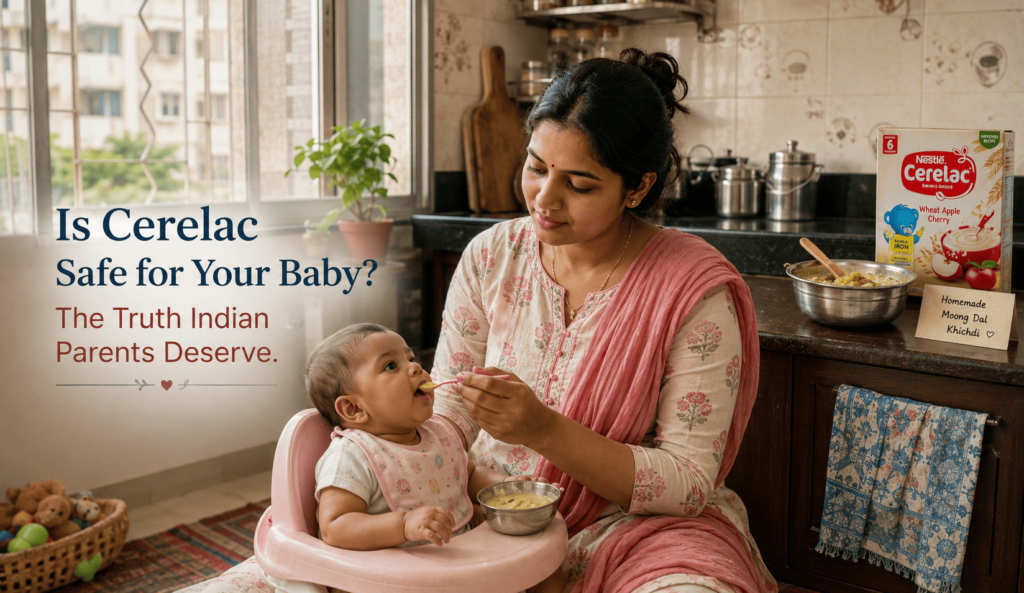
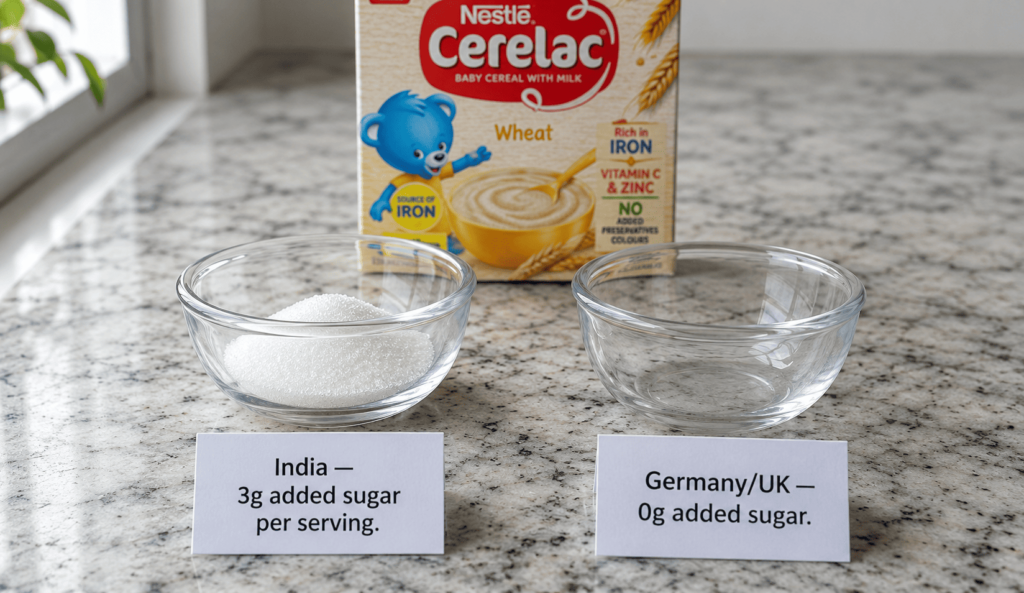
A 2024 investigation by Public Eye, an independent research organization, found that all 15 Cerelac baby products sold in India contain an average of nearly 3 grams of added sugar per serving. The same products sold in Germany and the United Kingdom contain zero added sugar. The same brand. The same packaging design. Two completely different formulas, one for European babies and one for Indian babies.
The most common question in the clinic about this topic is simple: Doctor, is Cerelac safe for my baby? Should I use it or avoid it completely? The honest answer is more nuanced than a simple yes or no, and Indian parents deserve to hear the full picture.
Want the honest truth about what is really inside that packet? Watch the reel below:
Cerelac Is a Brand, Not a Food Group. That Distinction Matters.
Cerelac is a Nestle product. There are many other brands producing similar packaged infant cereals for babies above 6 months of age. When parents say Cerelac, they usually mean any packaged baby cereal, and the quality, ingredients, and sugar content vary significantly across brands and even across the same brand’s products in different countries.
What these products are designed to do is provide a convenient, shelf-stable, fortified cereal that can be mixed with water or milk and given to a baby during the complementary feeding stage, which begins at 6 months. They are not designed to replace breast milk or formula. They are not designed to replace home-cooked meals. They are designed for convenience, and convenience always has a nutritional cost that parents should understand before making it a daily habit.
The fortification is real. These products do contain added vitamins and minerals that are important during the complementary feeding stage. But fortification does not cancel out the added sugar. And the sugar is the part of the story that rarely gets told clearly to parents sitting in supermarket aisles reading the front of the packet.
The Sugar Problem Indian Parents Were Never Told About
This is the part of the Cerelac conversation that deserves to be stated plainly, without softening.
All 15 Cerelac baby products sold in India contain an average of nearly 3 grams of added sugar per serving. Zero added sugar in Germany. Zero in the UK. In Ethiopia and Thailand, the same product contains nearly 6 grams per serving. This is a documented two-tier system where babies in developing nations receive a product with significantly higher sugar content than babies in wealthy nations, and the practice was flagged as a direct violation of international guidelines designed to prevent obesity and chronic disease in infants.
Nestle India subsequently stated that the company had reduced added sugars by 30% over five years and continues to review formulations. That statement is itself an acknowledgment that reduction was necessary in the first place.
Why does this matter so specifically? Three reasons. Sugar is addictive, and babies introduced to sweetened food early develop a strong preference for sweet tastes that can persist throughout childhood and well into adulthood. Early sugar exposure is linked to obesity, type 2 diabetes, and chronic fatty liver disease. And most critically, many parents checking Cerelac packaging in India are not seeing the full sugar picture because the added sugar amount is not always clearly disclosed on Indian packaging in the way it should be.
When this is explained to parents in the clinic, the reaction is always the same. They are not upset with the doctor. They are upset that nobody told them earlier. And that is exactly why it needs to be said clearly.
This Is Not About Demonizing a Product. It Is About Using It Correctly.
Cerelac and similar packaged infant cereals are not inherently harmful. They are not poisonous. Used appropriately and in the right context, they serve a genuine and practical purpose.
For traveling families, packaged infant cereal is genuinely useful. Finding appropriate fresh food for a 6 to 12 month old baby at the right time, the right temperature, and the right consistency during train journeys, flights, or road trips across India is genuinely difficult. A pouch of Cerelac in the baby bag is a reasonable and sensible backup for those moments. As a once-a-day option when cooking is genuinely not possible, it is an acceptable choice. As a daily staple replacing home-cooked meals twice a day every day because it is easy, it is not.
There is a real difference between using packaged baby food as a tool and using it as a routine. Mumbai families with both parents working full time, families traveling for festivals, and new mothers managing recovery and feeding simultaneously face genuine constraints that deserve acknowledgment. Packaged baby food in these contexts is a practical tool. The problem is when convenience becomes the default rather than the exception.
One Label Warning Every Indian Parent Must Take Seriously
Some Cerelac variants and similar packaged infant cereals contain milk as a core ingredient. This creates a specific problem in two situations that are more common than most parents realize.
If a baby has lactose intolerance or any sensitivity to dairy, a milk-containing formula can cause digestive distress, gas, bloating, and diarrhea. If a baby is already experiencing diarrhea from any cause, giving a milk-based formula can worsen symptoms and significantly prolong recovery. Giving Cerelac to a sick baby because it seems like a light and easy option is one of the more common mistakes seen in the clinic, and it usually makes things worse before they get better.
Always check the ingredient list before buying and before giving. Know whether the product contains milk. Know whether it contains added sugar under any of its many names: sucrose, glucose syrup, maltodextrin, or honey. Know what the first three ingredients are. The front of the packet will not tell you what you need to know. The ingredient list on the back will.
Cerelac vs Homemade Baby Food: An Honest Side-by-Side for Indian Parents
| Feature | Cerelac and Packaged Cereals | Homemade Baby Food |
| Added Sugar | Some Indian variants contain added sugar | None when prepared without sweeteners |
| Fortification | Added vitamins and minerals | Natural nutrients from whole foods |
| Preservatives | Often present for shelf life | None |
| Freshness | Nutrition may reduce over long storage | Maximum nutrition when freshly prepared |
| Texture Variety | Mostly uniform smooth texture | Easily adjusted for texture development |
| Taste Profile | Often sweeter and more processed in taste | Natural flavours that help build palate acceptance |
| Milk Content | Some variants contain milk, label checking is important | Fully controlled by parents |
| Cost | Higher cost due to packaging and branding | Based mainly on ingredient cost |
| Best Use Case | Travel, emergencies, occasional convenience | Ideal for regular daily feeding |
| During Diarrhea | Milk based variants may worsen symptoms in some babies | Can be modified easily according to recovery needs |
The Best Baby Food for 6 Months Is Already Sitting in Your Kitchen
At 6 months, when complementary feeding begins, the goal is not complex nutrition engineering. It is introducing a baby to real food textures and flavors so they develop a broad, healthy palate that serves them for life. Packaged cereals, with their uniform smooth texture and sweetened taste, work directly against this goal when used as the primary food source day after day.
The texture learning that happens between 6 and 12 months is enormously important. A baby who only eats smooth packaged cereal during this window often struggles with lumpy or textured food later. That struggle can persist for years and is one of the most common roots of fussy eating in toddlers.
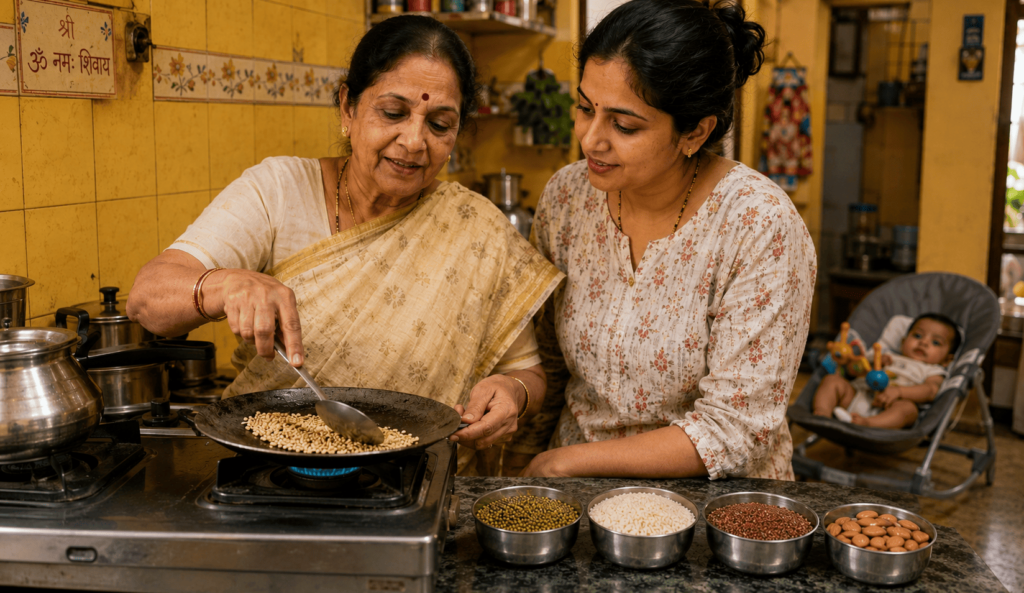
In an Indian kitchen, the best baby food for 6 months already exists in familiar ingredients. Well-cooked khichdi made from rice and moong dal, mashed with a little ghee and served without salt. Ragi porridge cooked with water and no added sugar, naturally smooth and genuinely nutritious. Mashed banana. Steamed and mashed sweet potato or carrot. Apple or pear steamed and blended. These are not complicated. They take minutes to prepare and they give the baby something a packaged cereal never can: real food flavors and the developmental experience of different textures.
For parents who want a homemade alternative that stores like Cerelac does, here is the recipe that Indian parents increasingly make at home. Wash and sun dry one cup of rice with two tablespoons each of moong dal, masoor dal, black urad dal, and horse gram. Dry roast each separately on a low flame. Blend with five almonds and two tablespoons of dalia into a fine powder. Sieve through a fine mesh and store in an airtight container. Cook a small amount with water when needed. Zero added sugar. Zero preservatives. Full nutritional control. And it costs a fraction of what a box of Cerelac costs.
Conclusion
Cerelac is not a dangerous product. Used occasionally during travel or when cooking is genuinely not possible, it is a perfectly acceptable option. But it is not the nutritional gold standard it has been marketed as, and Indian parents deserve to know that the version sold in India contains added sugar that the version sold in Europe does not.
Fresh food from an Indian kitchen, dal, khichdi, ragi porridge, mashed fruit, and homemade cereal powder, is always the better choice. Not because it requires more effort, though it does take a little more time. Because it is real food. Because it teaches a baby what food actually tastes like. Because it builds the healthy eating foundation that no packaged cereal, however fortified, can replicate.
Read the label. Use packaged food as the backup, not the base. And trust that an Indian kitchen, which has been feeding babies beautifully for generations, already has everything needed.
Starting solids with your baby and not sure where to begin? Book a consultation at Vivasvan Child Care Clinic, Mumbai. A personalized first-foods plan takes the guesswork out of weaning and gives your baby the strongest possible nutritional start.
Frequently Asked Questions
Cerelac is not considered unsafe, but it may not be the best option as a daily staple food. Some variants sold in India contain added sugar, which is unnecessary for infants. Occasional use during travel or emergencies is generally acceptable, but fresh home-cooked meals remain the healthier long term choice.
At 6 months, babies benefit most from real food textures and natural flavours. While Cerelac offers fortified nutrients, homemade foods like mashed khichdi, ragi porridge, dal, and fruit purees better support texture learning, chewing development, and long term eating habits.
Fresh homemade foods are usually the best starting point. Good options include:
Mashed khichdi with ghee
Ragi porridge without added sugar
Mashed banana
Steamed sweet potato or carrot
Homemade mixed cereal powder made from roasted grains and dals
These foods provide balanced nutrition without preservatives or added sugars.
Always read the ingredient list carefully. Watch for:
Added sugar or glucose syrup
Maltodextrin
Artificial additives
Excessively refined ingredients
Also check whether milk ingredients are present if the baby has lactose sensitivity or digestive issues.
Yes. Packaged baby cereals can be practical during travel when fresh homemade food is difficult to prepare safely. The key is using them as a temporary convenience rather than replacing regular fresh meals long term.

Vivasvan Parekh
As a pediatrician and child specialist based in Mumbai, I bring over 15 years of experience in delivering comprehensive child healthcare. I hold an MD in Pediatrics and practice in Ghatkopar East and Chembur, where I focus on preventive and evidence-based pediatric care. My areas of expertise include vaccinations, newborn care, growth and development monitoring, and the treatment of common and complex childhood illnesses. I am committed to supporting parents with practical, reliable guidance on child health, nutrition, and overall well-being. Through my blog, I share trusted insights on pediatric health, helping parents make informed decisions about their child’s care and development.