
Vomiting and diarrhea in children can feel frightening, especially in the middle of the night when everything suddenly feels urgent. This guide helps parents understand what actually matters: how to prevent dehydration, when ORS should be used, why antibiotics are usually unnecessary, and which warning signs need immediate medical attention. Written in a calm, practical, parent-friendly way, it explains how most stomach bugs are manageable at home with the right care and observation. Sometimes the biggest difference comes from knowing what not to panic about, and knowing exactly when it’s time to call the doctor.
It is two in the morning. The birthday party was wonderful, the cake, the return gifts, the excited children running everywhere. But now your four-year-old is awake and throwing up for the third time, and the panic that sets in at 2 am feels very different from the calm you manage during daylight hours.
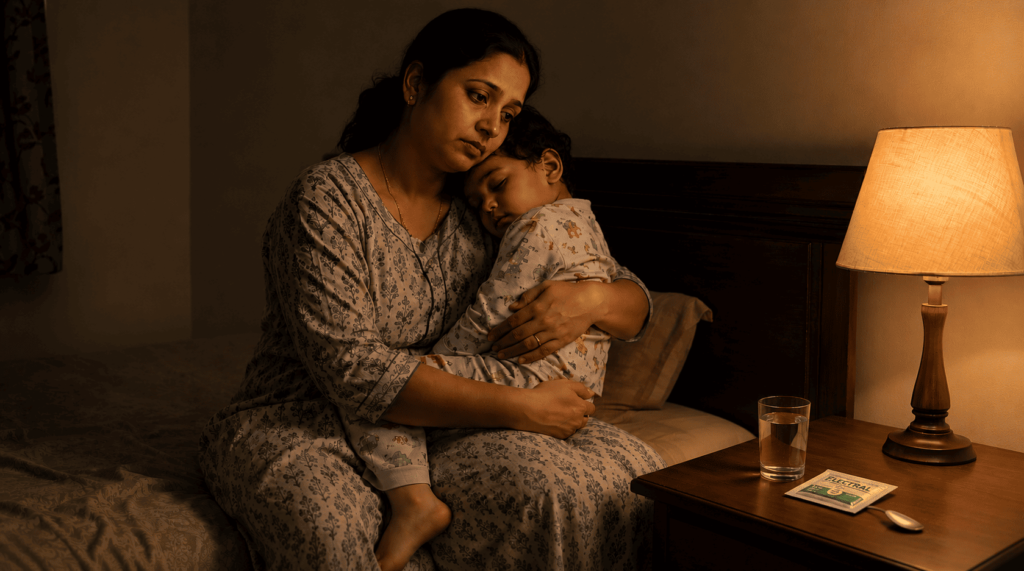
This scene plays out in homes across Mumbai every single day, and it spikes dramatically during monsoon season and summer, when stomach bugs travel fastest. Gastroenteritis, the medical name for what most people call a stomach bug, stomach flu, or simply “loose motions with vomiting”, is one of the most common reasons parents bring their children to a pediatric clinic in India. Rotavirus alone is responsible for a large share of severe diarrhea cases in Indian children under five, and it can hit suddenly and hard.
But here is the genuinely reassuring news: the overwhelming majority of vomiting and diarrhea cases in children are viral or food-related, resolve within a few days, and can be managed safely and effectively at home, if parents know exactly what to do.
There are three things every parent needs to know. The right medicine to give, the signals that tell you everything is okay, and the signs that mean it is time to go to the doctor right now. Everything else follows from those three points.
Want to know exactly what to do the next time your child has a stomach bug? Watch the reel below:
Point 1: The Right Medicine, And Why Antibiotics Are Not It
ORS Is the Real Treatment
When a child has vomiting and diarrhea, the body is losing fluids and essential salts faster than it can replace them. The danger is not the vomiting itself. The danger is dehydration. And the most powerful tool against dehydration is something that fits in a small sachet and costs almost nothing: Oral Rehydration Solution, or ORS.
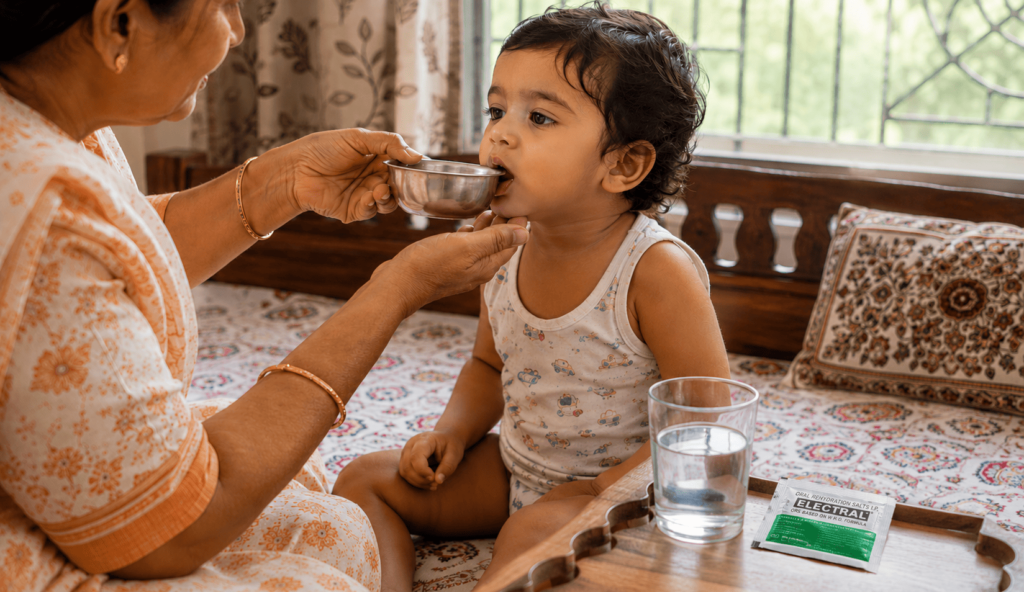
WHO-formula ORS, available as Electral, Pedialyte, or any pharmacy ORS sachet across India, is the single most important treatment for vomiting and diarrhea in children. Not a home-made glucose-and-salt drink. Not coconut water alone. Not lemon water. The WHO formula is precisely calibrated to replace what the body is losing, and it works.
The trick is how it is given. The instinct is to hand a child a full glass of water and say “drink this.” That approach almost always results in more vomiting. Instead, offer tiny amounts every few minutes. Five to ten millilitres, roughly one to two teaspoons, every five minutes. It feels painstakingly slow, but it works because small amounts do not trigger the vomiting reflex the way larger sips do. After two hours without vomiting, the amount can be gradually increased.
For breastfed babies, the guidance is simpler: keep nursing, but offer shorter and more frequent feeds. Breastmilk is both nourishment and hydration, and there is no reason to stop during a stomach bug. For formula-fed babies, switch to ORS by syringe or spoon during the vomiting phase, then return to formula once the vomiting has settled for four hours.
Zinc and Probiotics Can Help
Alongside ORS, zinc supplementation is recommended by the WHO for children with diarrhea, it helps reduce the duration and severity of the episode. Probiotics are a useful addition as well, particularly for restoring gut balance after the infection has passed or after any antibiotic use.
For vomiting specifically, an anti-vomiting medicine can be used to provide some comfort, but only on the advice of a doctor, not self-prescribed from the chemist.
The One Thing to Put Back on the Shelf
Here is something said clearly because it matters enormously: do not give antibiotics for vomiting and loose motions in children.
Most diarrhea in children is either caused by a virus or by food, and antibiotics do absolutely nothing against either. Giving antibiotics when they are not needed disrupts the gut, kills the helpful bacteria that the digestive system depends on, and contributes to the growing problem of antibiotic resistance. It is one of the most common mistakes made in home management across India, often driven by the best intentions, and it almost always makes things harder, not easier.
The same goes for medicines that stop diarrhea. More on that shortly.
Point 2: When to Relax, Reading the Signals Your Child is Sending
Parents often arrive at the clinic holding a detailed log of how many times the child vomited and how many loose stools they had that day. That information is useful. But the number on its own is not what tells the real story. What tells the real story is the child in front of you.
Three Green Flags That Mean Things Are Going Okay
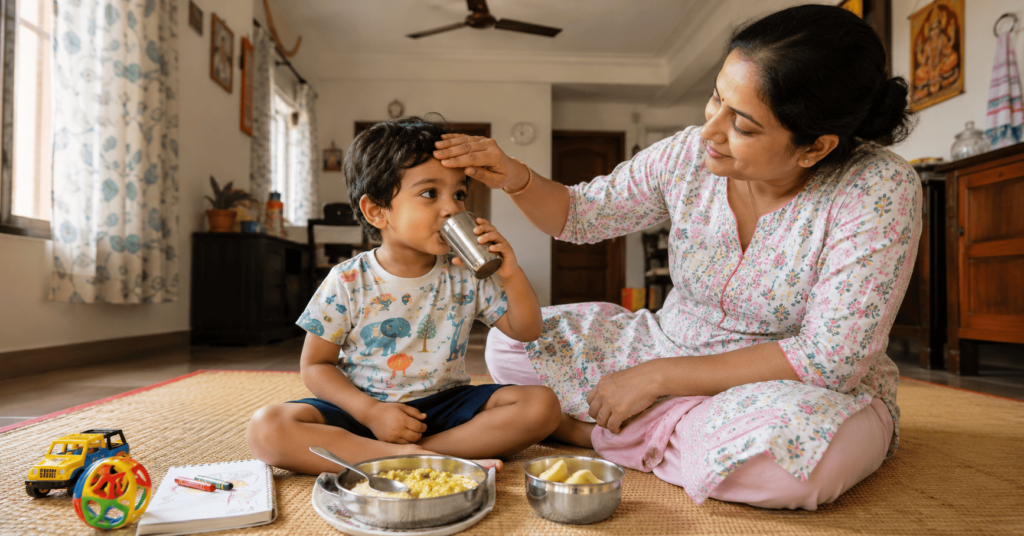
- The child is active and alert. A child who is playing, responding to their name, making eye contact, and showing interest in what is happening around them is not in serious danger. A child who is alert and even a little cranky is a very different picture from a child who is limp, glassy-eyed, and difficult to rouse.
- The child is urinating. This is the single most reliable home test for hydration. Wet diapers at regular intervals for babies. A trip to the bathroom every few hours for older children. As long as urine is coming, the body has enough fluid. Dark yellow or very little urine is the earliest warning sign of dehydration.
- The child is taking liquids, even if eating less. A child who refuses rice and dal but accepts small sips of ORS or water is doing far better than the situation may feel. Appetite comes back after vomiting stops. Fluids are what matter first.
What the Timeline Actually Looks Like
Vomiting almost always settles before the diarrhea does. Moderate vomiting typically stops within 12 to 24 hours. After that first difficult night, most children turn a corner.
Diarrhea, on the other hand, takes a few more days, sometimes up to five to seven days, and that is completely normal. The body is doing exactly what it is supposed to do: flushing out the infection. Trying to stop diarrhea with medicine interrupts that process and can actually prolong the illness. The right approach is to let it run its course while keeping the child hydrated.
Mild vomiting on and off, combined with loose stools, can continue for up to a week in some cases. As long as the green flags above are present, this is not a reason to panic.
From the clinic: A three-year-old comes in after four days of loose motions. The parents are exhausted and anxious. The child is running laps around the waiting room, sipping from a water bottle, and eyeing the toy basket in the corner. The reassurance: the activity level and urination output are far more meaningful than the number of loose stools. That child was going to be absolutely fine.
Point 3: When to Worry, Red Flags That Need Immediate Medical Attention
The guidance above is for the vast majority of cases, the stomach bugs and food reactions that are unpleasant but manageable. But there are specific signs that mean it is time to stop managing at home and get to a doctor or clinic right away.
- Go immediately if the child has blood in the stool. This is never normal and always needs evaluation without delay.
- Go immediately if the stool looks like water coming straight from a tap, not just loose or runny, but a forceful rush of liquid with each episode. This level of fluid loss can cause dehydration very quickly, especially in young children.
- Go immediately if the child is lethargic, unusually drowsy, or difficult to wake up. This is not the tired-after-a-bad-night kind of drowsy. It is unresponsive, floppy, not interested in anything around them, a sign the body is struggling.
- Go immediately if the child has not urinated in six to eight hours, or if a baby has had no wet diaper in that window. Combine that with dry lips, no tears when crying, or a sunken soft spot on a baby’s head and dehydration is already setting in.
- Go immediately if the child is not accepting any fluids at all, not even small sips of ORS.
- Go immediately if the vomit contains blood, is bright green, or looks like coffee grounds. Green or yellow vomit can indicate a bowel obstruction and needs urgent assessment.
- Go immediately if there is a fever above 40°C or 104°F, or any fever at all in a baby under 12 weeks old. Very young infants with any significant vomiting beyond normal spitting up need to be seen by a doctor, full stop.
- Go immediately if there is stomach pain that continues even when the child is not vomiting. Some cramping before a vomiting episode is expected. Pain that sits there persistently is a different concern entirely.
Keeping the Rest of the Family Safe
Stomach bugs spread quickly, and in Indian households where families live closely together, joint family setups, shared kitchens in chawls, cousins visiting on weekends, one sick child can become five sick children very fast if hygiene steps are not taken seriously.
Wash hands with soap and water after every diaper change, every trip to the bathroom, and before preparing any food. Keep the sick child’s utensils, towels, and water bottles separate from the rest of the family’s. Wash any soiled clothing or bedding on a hot cycle separately. The child should stay home from school or daycare until at least 48 hours after symptoms have completely stopped. Keeping vaccinations up to date is one of the most effective ways to reduce the severity of infections like rotavirus. Swimming pools and common play areas are off the table until full recovery. Children who fall sick repeatedly after every stomach bug are worth evaluating for weak immunity, as recurring infections are sometimes a signal worth discussing with a pediatrician.
Every Parent Can Handle This, With the Right Information
Vomiting and diarrhea in children is one of the most stressful experiences for any parent, especially at night, especially with a small child. But armed with three simple points, most parents can handle it calmly and confidently.
Give ORS in small sips, not antibiotics. Watch the child’s energy and urination, not just the number of episodes. And know exactly which signs mean it is time to stop waiting and go straight to the clinic.
Most stomach bugs in children are short, manageable, and leave no lasting harm. The body knows what it is doing. The job of a parent, and a pediatrician, is to support that process, not fight it.
Have questions about your child’s health? The team at Vivasvan Child Care Clinic in Mumbai is here to help, not to worry you, but to give you the clarity and confidence every parent deserves. Book a consultation today at childcareclinicmumbai.com.
Frequently Asked Questions
Medical attention is important if the child:
Has blood in vomit or stool
Has not urinated for 6 to 8 hours
Appears unusually sleepy or difficult to wake
Has a very high fever
Is younger than 12 weeks with repeated vomiting
A child who remains alert, urinates normally, and can tolerate small sips of fluids can often be managed safely at home with monitoring.
The most important treatment is proper hydration using WHO formula ORS given in small frequent sips. Breastfeeding should continue for infants. Once vomiting improves, bland foods like khichdi, banana, rice water, curd rice, or toast are usually easier to tolerate.
Vomiting commonly improves within 12 to 24 hours, while diarrhea may continue for 5 to 7 days. Mild loose stools can sometimes persist longer as the gut recovers, especially after viral infections.
Usually no. Most cases are caused by viruses and do not improve with antibiotics. Unnecessary antibiotics may disturb gut bacteria and can sometimes worsen diarrhea. Antibiotics should only be used when specifically advised by a doctor.
Concern increases if vomiting:
Happens very frequently
Continues beyond 24 hours
Contains blood or green bile
Is associated with severe stomach pain
Prevents the child from keeping fluids down
Hydration, urine output, and overall energy levels are often more important indicators than the number of vomiting episodes alone.

Vivasvan Parekh
As a pediatrician and child specialist based in Mumbai, I bring over 15 years of experience in delivering comprehensive child healthcare. I hold an MD in Pediatrics and practice in Ghatkopar East and Chembur, where I focus on preventive and evidence-based pediatric care. My areas of expertise include vaccinations, newborn care, growth and development monitoring, and the treatment of common and complex childhood illnesses. I am committed to supporting parents with practical, reliable guidance on child health, nutrition, and overall well-being. Through my blog, I share trusted insights on pediatric health, helping parents make informed decisions about their child’s care and development.