
Key takeaways
- If the crying ever feels unbearable, never shake the baby, place them safely in their crib and step away for a few minutes instead. Crying alone briefly is safe; shaking is not.
- Colic means more than 3 hours of crying a day, at least 3 days a week, for more than 3 weeks, in an otherwise healthy, weight-gaining baby.
- It starts around 3 weeks, peaks at 4–6 weeks, and resolves in almost all babies by 3–4 months.
- The cause is not fully known, research points to gut immaturity, sensory overload, and a documented genetic link to migraine.
- What helps most: dimming evening stimulation, slow rhythmic motion, white noise, and feeding adjustments, no single technique works for every baby.
- Colic is not caused by anything a parent did. It is not caused by the mother’s milk. It will not last forever.
It is 6pm in a Mumbai flat. The baby has been fed, changed, burped, and held. Nothing is visibly wrong. And yet the crying has been going on for two hours with no sign of stopping. The father is walking circles around the living room. The mother is trying everything she can remember from the hospital discharge sheet. The grandmother is suggesting hing water. The neighbour has knocked twice to check if everything is alright.
If a baby is crying for more than 3 hours a day, at least 3 days a week, for more than 3 weeks, and is otherwise healthy and gaining weight normally, this is colic. It affects up to 1 in 5 babies globally and up to 19% of infants by some estimates. It starts around 3 weeks of age, peaks between 4 and 6 weeks, and in almost all cases resolves completely by 3 to 4 months.
The crying is not caused by bad parenting. It is not caused by the mother’s milk. Nothing is permanently wrong with the baby. This guide explains what is actually known about why colic happens, what genuinely helps, and what every parent needs to hear before 6pm arrives again.
What Is Colic? The Clinical Definition Every Parent Should Know
Colic means an otherwise healthy baby cries excessively, inconsolably, and without any clear reason. The standard clinical criteria are more than 3 hours of crying per day, at least 3 days a week, for more than 3 weeks. When the baby is not crying, they behave completely normally. They feed well, gain weight, and are alert and responsive between episodes. This is the defining characteristic that separates colic from other conditions.
The daily pattern is usually predictable: crying typically begins suddenly, often at roughly the same time each afternoon or evening, and cannot be explained by hunger, a wet nappy, or any obvious discomfort. It does not follow feeding cues. It does not respond to the usual settling strategies. It simply happens.
One developmental fact that helps parents hold on: all babies have a normal crying peak between 5 and 6 weeks of life. Colic is an amplified version of this developmental pattern, not a separate disease in the traditional sense. It is the baby’s nervous system adjusting to the world. And by 12 weeks, most colicky babies are crying less than 1 hour per day. That milestone is real, and it is coming.
What Causes Colic in Babies? What the Research Actually Says
The honest answer is that the exact cause of colic is not fully known, and it may not have a single cause at all. Multiple theories exist, and more than one may be true at the same time for any given baby. Understanding this helps parents stop searching for the one thing they did wrong, because there almost certainly was not one.
The Digestive Theory: Gas, Reflux, and Gut Immaturity
The most commonly assumed explanation is digestive. An immature gut, gas from swallowed air during feeding or crying, reflux of stomach contents, or sensitivity to proteins in formula or breast milk all seem like plausible culprits, especially because colicky babies often pull up their legs, pass gas, and have a hard-looking belly during crying episodes.
But the research has not strongly supported this as a universal explanation. Clinical trials of simethicone, the gas-drop medication, showed no meaningful benefit over placebo for colic. Markers of dietary protein damage in the gut are not elevated in most colicky babies. And the evening crying pattern is genuinely difficult to explain from a feeding perspective, since babies feed around the clock, not just in the afternoon.
Cow’s milk protein allergy may play a role in a subset of formula-fed babies. And for breastfeeding mothers, certain foods can pass through breast milk and trigger sensitivity in susceptible babies. These are real contributing factors for some babies. They are not the universal explanation.
The Migraine Connection: An Emerging Theory That Changes Everything
This is the piece of colic science that most parents and many online resources completely miss, and it is worth understanding because it changes how to think about what helps.
Research published in peer-reviewed journals and now reflected in the International Classification of Headache Disorders has identified a significant, documented association between infant colic and migraine. The findings are striking:
Mothers with migraine are more than twice as likely to have a baby with colic. A major meta-analysis found the odds of developing migraine later in life were 5 to 6 times higher in people who had colic as infants. A large population-based prospective study found colic was associated with nearly triple the risk of developing migraine without aura by age 18.
The working theory is that babies with migraineous genetics may express those genes differently in early brain development through heightened sensitivity to stimulation, circadian patterns of distress, and sensory overload rather than headache. This is not proven, but it is taken seriously by researchers, and it is now listed in the International Headache Society’s classification system.
This theory explains three things that the digestive theory cannot. Why do the crying peaks in the evening? Why reducing stimulation specifically helps. And why colic resolves at around 3 months, precisely when the brain begins developing a diurnal melatonin rhythm that consolidates sleep.
If a baby with colic is not in gut pain but is overwhelmed by stimulation, that changes the entire soothing approach.
Sensory Overload and the Evening Environment
Some babies have nervous systems that are simply more reactive to the world around them. By late afternoon, after a full day of lights, sounds, activity, and the general noise of a busy Mumbai household, an immature nervous system may simply reach its limit. The crying that follows is not caused by anything that happened at 6pm. It is the accumulated sensory load of the entire day.
Parental Stress and the Baby’s Emotional Environment
Babies are remarkably attuned to the emotional state of the people around them. Research has noted that anxiety, worry, or depression in caregivers can contribute to infant distress. This is not a blame statement. It is an acknowledgement that new parenthood is hard, and that creating calm in the environment is one of the most useful things a parent can do, for their own sake as much as the baby’s.
What Colic Actually Looks Like: Signs That Help Confirm It
Colic has a recognisable presentation that is worth knowing clearly, because it helps parents distinguish it from crying that needs a medical review.
| Sign | Typical Colic | Needs Medical Review |
| Timing of crying | Predictable, usually in the late afternoon or evening | Random throughout the day with no clear pattern |
| Duration | More than 3 hours a day, at least 3 days a week | Crying is progressively worsening over several days |
| Baby between crying episodes | Completely normal, feeds well, and gains weight | Lethargic, feeding poorly, or losing weight |
| Physical signs during crying | Clenched fists, legs drawn up, hard belly, passing gas, red face | Fever, vomiting, blood in the stool, or rash |
| Response to soothing | May settle temporarily with rocking, motion, or white noise | Does not respond to any soothing measures |
| Weight gain | Tracks normally on the growth chart | Poor, plateauing, or declining weight gain |
How to Soothe a Colicky Baby: A Toolkit That Actually Works
No single technique works for every baby. What works one evening may not work the next. The goal is a range of strategies to try rather than one magic solution. And since colic may involve sensory sensitivity as much as digestive discomfort, the environment matters as much as what the parent does with their hands.
Start by Changing the Environment
Before trying any soothing technique, reduce stimulation in the room. Dim the lights. Mumbai evenings often involve bright overhead lighting, the television running, older children playing, and cooking smells from the kitchen at their strongest. For a baby who may already be at sensory capacity, all of this adds to the load.
Turn down or switch off the television and loud music. Ask older children or visitors to move to another room. Avoid strong smells near the baby, including cooking aromas, perfume, and cologne. If breastfeeding in the evening, consider doing so in a dimly lit, quieter room. There is some evidence that lower light in the evening may optimise melatonin levels in breast milk, which could help the baby settle.
Motion and Position Techniques
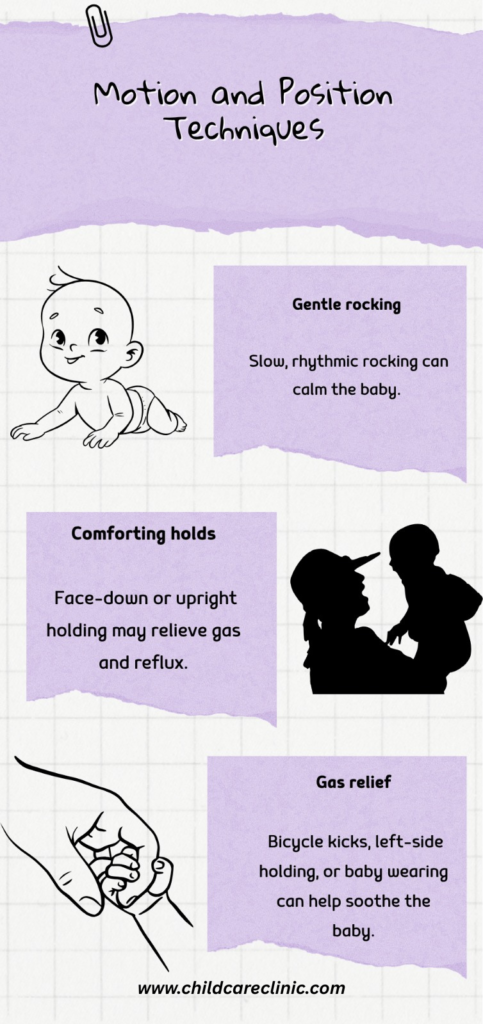
Gentle rocking in arms or a rocking chair is one of the most consistent soothers across all evidence. The motion should be slow and rhythmic, not vigorous. Jiggling or bouncing vigorously increases stimulation in a baby who is already overwhelmed.
The face-down hold is one of the most underused techniques. Hold the baby face-down along the forearm with the belly resting on the hand and the head at the elbow. The gentle pressure on the tummy helps relieve gas, and the position itself is often calming. Most parents instinctively cradle a crying baby face-up. Flipping them over changes everything for some babies.
The upright hold against the chest or shoulder uses gravity to help gas move through the gut and reduces reflux discomfort. Simply holding the baby more upright than flat can make a meaningful difference.
Left-side positioning while being held may aid digestion. Bicycle kicks, gently cycling the baby’s legs while they lie on their back, help move trapped gas through the digestive tract.
A baby wearing a sling or carrier keeps the baby close, warm, and exposed to the gentle rhythmic movement of the parent’s body. In many Indian households, carrying a baby against the body is already natural and instinctive. The carrier version simply makes it sustainable for longer stretches. Safety note: never cook, eat, or carry anything hot while the baby is in a carrier.
For babies at least 3 weeks old who can hold their head up, an infant swing can provide continuous rhythmic motion without exhausting the parent.
Sound Techniques
White noise recreates the constant whooshing sound environment of the womb. The options at home are numerous and free: a fan nearby, the washing machine or dishwasher running in the next room, the shower turned on, or a radio tuned between stations to produce static. The goal is a constant, low-level sound, not sharp or intermittent noise.
The “shh” technique involves making a sustained, loud shushing sound directly near the baby’s ear, loud enough that the baby can hear it over their own crying. This sounds counterintuitive. It works for many babies.
Singing quietly, talking calmly, and humming are all worth trying. The parent’s voice is one of the most familiar sounds in the baby’s world.
Sucking and Touch
A pacifier activates the sucking reflex, which releases natural endorphins with a measurable calming effect. There is an additional benefit worth knowing: studies link pacifier use to a reduced risk of SIDS.
- Baby massage using slow, firm strokes along the legs, arms, back, chest, and face has been shown in studies to reduce crying and improve sleep. For gas specifically, rub the tummy in a gentle clockwise direction. Always check with the paediatrician before using any oil or lotion on a young baby’s skin.
- Burping more effectively reduces the crying-swallowing air-more gas cycle that makes colic worse. When a baby cries, they swallow air, which causes more gas and discomfort, which causes more crying. Breaking this cycle with a good burp helps. Alternative to the over-the-shoulder position: lay the baby face-down across the lap and pat the back gently, or sit the baby up with the chest supported by one hand while patting with the other.
- Swaddling snugly, with arms held close so the baby cannot wriggle free, recreates the contained feeling of the womb. Always place a swaddled baby on their back. Stop swaddling as soon as the baby shows any sign of being able to roll independently.
A warm bath works for many babies. The sensation and the sound of running water are genuinely soothing. A warm towel placed gently on the baby’s tummy between baths can offer similar comfort.
Feeding Adjustments Worth Trying
For breastfeeding mothers, consider a two-week elimination of known dietary triggers: caffeine (including tea, which is a staple in most Indian households), dairy products, and chocolate. Foods like cabbage, onions, and beans are commonly blamed but the research on these is less conclusive. Eliminating them is optional.
The hind milk technique: allow the baby to fully empty one breast before offering the second. The richer, fattier hind milk at the end of each feed is often more satisfying and settling. If the baby seems to be getting too much foremilk, offer only one breast over a 2 to 3 hour period.
For formula-fed babies, bottle feeding should take approximately 20 minutes. If the baby finishes faster, switch to a teat with a smaller hole to slow the feed and reduce air swallowing. If colic is severe, discuss formula options with the paediatrician, as some babies respond to a change.
Smaller, more frequent feeds rather than larger volumes less often may reduce the amount of gas produced per feed.
For parents interested in how breastfeeding connects to overall comfort and supply, this guide on how to increase breast milk naturally has practical information that complements the colic management strategies above.

The Part Nobody Talks About Enough: Taking Care of the Parent
Colic is hard on babies. It is harder on parents. And it is important to say this clearly, without softening it.
Clinical data on colic and caregiver distress is sobering. An estimated 1% of parents of one-month-old babies admit to having shaken their baby at least once to try to stop the crying. By 6 months, 5.6% of parents have performed a dangerous physical manoeuvre. These numbers are not cited to alarm. They are cited to make clear that the distress parents feel during a colic episode is real, it is common, and it can reach a point where the baby is genuinely at risk.
Shaking a baby causes blindness, brain damage, and death. No matter how overwhelming the moment becomes, no matter how many hours the crying has gone on, the baby must never be shaken.
What to do instead: in a joint family household in Mumbai, there is usually someone else who can take over even for 20 minutes. Ask. Hand the baby to the grandmother, the sister-in-law, the partner, the neighbour who has offered. Step outside. Walk to the end of the building. Breathe. Come back.
If no one is available, the safest action is to place the baby on their back in a safe crib or bassinet and leave the room for a few minutes. The baby will cry. The baby will be safe. The parent will return calmer. A few minutes of crying alone in a crib does no harm. A shaken baby is harmed forever.
Colic has been linked to postpartum depression. If feelings of despair, anger, inability to cope, or thoughts of harming the baby are present, these need to be shared with a healthcare provider. This is a medical situation, not a personal failure.
And for families managing the pressure of extended family opinions on top of everything else, this resource on newborn visitor rules and managing the early weeks addresses the social side of those first intense months.
When Crying Is Not Colic: Red Flags That Need Medical Attention
After all the reassurance in this guide, this section is equally important. Most prolonged infant crying is colic. Some of it is not, and knowing the difference matters.
Contact the paediatrician if:
- The baby has a fever of any degree alongside the crying
- The crying pattern changes suddenly in character, timing, or intensity
- The baby is not gaining weight or has stopped gaining weight
- Vomiting is forceful, frequent, or contains green colour or blood
- Diarrhoea is present alongside the crying
- There is blood in the stool
- The baby is still showing colic symptoms at 3 months with no sign of improvement
- The baby cannot be settled at all and this represents a new change in behaviour
The paediatrician will check for and rule out oesophageal reflux, infection, hernia, intussusception (an intestinal blockage), milk protein allergy, and other medical causes. Keeping a simple crying diary before the appointment, noting when crying starts and stops, feeding times and amounts, sleep timings, and bowel movements, gives the clearest possible picture and saves significant time in the consultation.
For guidance on fever specifically and how to distinguish illness-related fever from other causes, this guide on child fever: when to see a doctor, warning signs, and safe medicines covers the full picture.
It Is Not Your Fault. And It Will Not Be Like This Forever.
Colic has been documented since 1954 and still puzzles researchers today. It is not caused by something the parent did or did not do. It is not a sign that the baby is unwell or unhappy in some deeper sense. It is a phase that the baby will move through, and every parent who has come out the other side knows that the 3-month mark arrives and the evenings change completely.
In a city like Mumbai, where families often live in close quarters, evenings are busy, and extended family members are nearby with opinions and suggestions and good intentions, colic can feel like a very public difficulty. Use the joint family structure as a resource. Let others take a shift. Accept help when it is offered. And call the clinic when anything feels uncertain, because certainty is one of the most useful things a paediatrician can offer in the middle of a colic episode.
The techniques in this guide are not guaranteed. But they are the most evidence-based, carefully considered strategies available. Try them. Keep a note of what helps. Come back to the ones that worked even a little.
And remember: it is not your fault. It will not be like this forever.
If the baby has been crying inconsolably and nothing seems to help, or if there is any concern that something beyond colic may be causing the distress, book a consultation with Dr. Vivasvan Parekh at Vivasvan Child Care Clinic in Mumbai. Bring notes on the crying pattern, feeding schedule, and anything that has helped or made things worse.
Book a Consultation with Dr. Vivasvan Parekh
Frequently Asked Questions About Colic in Babies
The exact cause of colic is still unknown and is likely multifactorial. Possible contributors include an immature digestive system, swallowed air during feeding or crying, sensitivity to proteins in formula or breast milk, sensory overload, and a genetic link to migraine. Research shows that mothers with migraine are more than twice as likely to have a baby with colic, and babies with colic are more likely to develop migraine later in childhood. In most cases, however, there is no single identifiable cause.
Colic usually begins around 3 weeks of age, peaks between 4 and 6 weeks, and resolves by 3 to 4 months in most babies. By 12 weeks, crying often reduces to less than an hour a day. The improvement can be surprisingly sudden, and colic does not cause any long-term health or developmental problems.
No single position works for every baby, but two are especially effective. The face-down hold places the baby across the parent’s forearm with gentle tummy pressure to help release gas. Holding the baby upright against the chest or shoulder can also reduce reflux discomfort and encourage gas to pass. Gentle bicycle leg movements may provide additional relief. Slow, calming motion is generally more helpful than vigorous bouncing.
Crying is unlikely to be colic if it is accompanied by fever, forceful or bloody vomiting, diarrhoea, blood in the stool, rash, poor weight gain, lethargy, or difficulty waking the baby. A sudden change in the crying pattern rather than the typical evening episodes also warrants medical review. If there is any doubt, consult a paediatrician rather than assuming it is colic.
Although commonly recommended in many Indian households, there is no strong clinical evidence that hing water or traditional gripe water reliably relieves colic. Some gripe water products may also contain ingredients unsuitable for young infants. Simethicone drops are safe but have not shown benefits over placebo in clinical trials for colic. Gentle soothing techniques, skin-to-skin contact, feeding adjustments, and reducing stimulation have more consistent evidence than supplements or herbal remedies.

Vivasvan Parekh
As a pediatrician and child specialist based in Mumbai, I bring over 15 years of experience in delivering comprehensive child healthcare. I hold an MD in Pediatrics and practice in Ghatkopar East and Chembur, where I focus on preventive and evidence-based pediatric care. My areas of expertise include vaccinations, newborn care, growth and development monitoring, and the treatment of common and complex childhood illnesses. I am committed to supporting parents with practical, reliable guidance on child health, nutrition, and overall well-being. Through my blog, I share trusted insights on pediatric health, helping parents make informed decisions about their child’s care and development.