Key takeaways
- Newborn jaundice affects up to 60% of full-term babies and nearly 80% of premature babies, in most cases it is normal and resolves on its own.
- There are three types: physiological (most common, resolves in 2 weeks), breastfeeding jaundice (linked to low milk intake), and breast milk jaundice (can last 4–6 weeks, generally benign).
- Jaundice appearing within the first 24 hours of birth is never normal and needs immediate medical attention.
- Pale, chalky stools with dark urine can signal a rare but serious liver condition, report this immediately, do not wait.
- Frequent feeding (8–12 times daily for breastfed babies) is the single most effective way to help clear bilirubin.
- Phototherapy, not sunlight, is the safe and effective medical treatment when bilirubin levels cross the treatment threshold.
Newborn jaundice is one of the most common conditions seen in babies during their first week of life, affecting up to 60% of full-term newborns and nearly 80% of premature babies. That yellow tint on your baby’s skin or in the whites of their eyes can feel alarming, especially when you have just brought your little one home. The reassuring truth is that in most cases, jaundice in newborns is completely normal, resolves on its own, and does not cause any lasting harm. But knowing when it needs medical attention is what every parent should understand clearly.
What Is Newborn Jaundice and Why Does It Happen?
Newborn jaundice is the yellowing of a baby’s skin and eyes caused by a build-up of bilirubin in the blood. Bilirubin is a yellow pigment naturally produced when red blood cells break down. In adults, the liver processes and clears bilirubin efficiently. In newborns, the liver is still maturing, and for many babies it simply takes a few days to catch up. During this catching-up period, bilirubin accumulates in the bloodstream, and the result is that familiar yellow tinge.
The medical term for this is hyperbilirubinemia, but parents do not need to worry about the terminology. What matters is understanding the type of jaundice the baby has and how closely it needs to be monitored.
The Three Types of Newborn Jaundice Parents Should Know
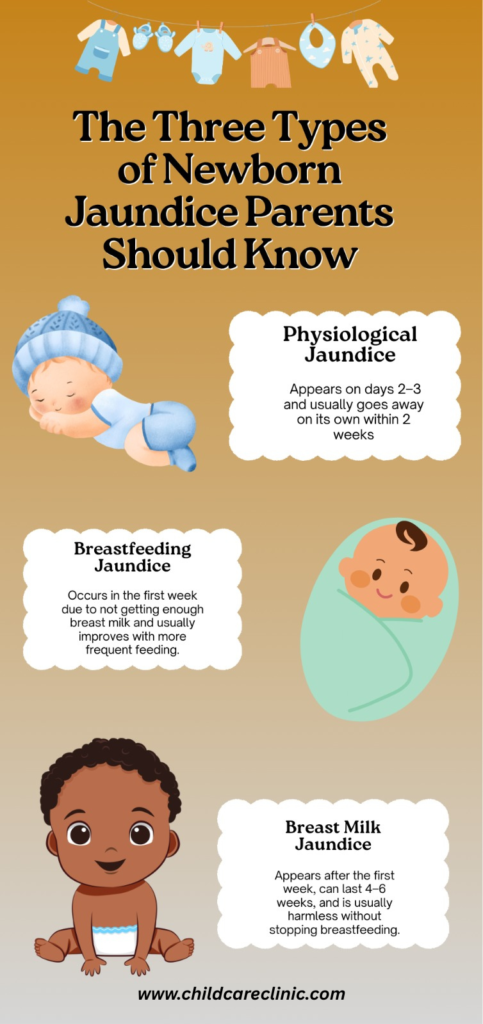
- Physiological Jaundice is the most common type by far. It appears on day 2 or day 3 of life, peaks between day 3 and day 5, and typically resolves within two weeks in formula-fed babies. This is the body doing exactly what it is supposed to do while the liver gets up to speed. No treatment is needed in mild cases.
- Breastfeeding Jaundice appears in the first week and is linked to the baby not getting enough breast milk, often because of latching difficulties, delayed milk let-down, or feeding less frequently than needed. This is especially common in the early days after a C-section when milk production takes a little longer to establish. Increasing feed frequency almost always helps. More on improving milk supply can be found in this guide on how to increase breast milk naturally.
- Breast Milk Jaundice is a different condition entirely and appears after the first week of life. Certain substances naturally present in breast milk can slow down the liver’s ability to process bilirubin. This type can last up to four to six weeks but is generally benign. It does not mean breastfeeding should be stopped. A paediatrician’s guidance will clarify whether any intervention is needed.
What Causes Bilirubin to Build Up? Understanding the Root Causes
Most newborns experience some level of jaundice because the situation is almost inevitable in the early days. The liver is immature, bilirubin production is high because newborns have more red blood cells per unit of blood than adults, and the gut is still learning to clear waste efficiently. That said, some babies are at higher risk than others.
- Premature birth is one of the most significant risk factors. Babies born before 37 weeks have livers that are even less developed, making bilirubin clearance slower and jaundice more pronounced.
- Blood type incompatibility between mother and baby, such as Rh incompatibility or ABO incompatibility, triggers the mother’s antibodies to attack the baby’s red blood cells. This accelerates red blood cell breakdown and floods the system with bilirubin far faster than the liver can handle.
- Birth trauma or significant bruising during a difficult delivery leads to the breakdown of more red blood cells under the skin, which raises bilirubin levels beyond what physiological jaundice alone would cause.
- G6PD deficiency, a genetic enzyme disorder, is worth a specific mention for Indian parents. It has a notably higher prevalence in certain communities across Maharashtra, Gujarat, and South India. Babies with G6PD deficiency can develop severe jaundice rapidly, sometimes without obvious triggers. If there is a family history of this condition, inform the paediatrician immediately after delivery.
- Other underlying causes including infection (sepsis), hypothyroidism, and liver conditions such as biliary atresia can also cause or worsen jaundice. These are rarer but important to rule out, particularly when jaundice is severe or persistent
How to Spot Newborn Jaundice at Home
The yellow colour of jaundice starts at the face and moves downward as bilirubin levels rise. To check at home, press the baby’s skin gently on the forehead or nose in natural light (near a window is ideal) and then release. If the skin looks yellow when you press, jaundice is likely present. This method works best in good natural light.
For darker-skinned Indian babies, the skin colour change may be subtle. In these cases, checking the whites of the eyes (sclera) and the underside of the tongue is far more reliable. Both will appear distinctly yellow if bilirubin levels are elevated.
Mild vs Severe Newborn Jaundice: A Quick Reference Table
| Sign | Mild Jaundice | Severe Jaundice |
| Skin Colour | Yellowing on the face and upper chest | Yellowing spreads to the belly, arms, and legs |
| Eyes | Slight yellowing of the whites | Deep yellow or orange tint to the whites |
| Feeding | Slightly sleepy but feeding well | Refusing feeds or very difficult to wake |
| Stools | Normal yellow or mustard colour | Pale, white, or chalk coloured |
| Urine | Normal pale yellow | Dark yellow or brown |
| Behaviour | Mild drowsiness | High-pitched cry, back arching, or floppy body |
| Recommended Action | Monitor at home and follow up with a paediatrician | Seek emergency medical care immediately |
When Should You Worry About Newborn Jaundice? Red Flags to Never Ignore
This is the most important section for every parent to read carefully. The majority of newborn jaundice is benign, but a small number of cases can escalate into a serious condition called kernicterus (bilirubin-induced brain damage) if not treated in time. Knowing exactly when to act can make all the difference.
Call Your Paediatrician If:
- Yellowing spreads below the belly button to the arms and legs
- Jaundice in a formula-fed baby lasts beyond two weeks
- Jaundice in a breastfed baby lasts beyond four weeks
- The baby is not gaining weight adequately or is feeding poorly
- The baby seems unusually fussy or difficult to settle
Go to the Emergency Room Immediately If:
- Jaundice appears within the first 24 hours of birth (this is never normal)
- The baby is extremely difficult to wake or appears limp or floppy
- The baby has a high-pitched or unusual cry
- The body is arching backward with the head and heels bending back
- The baby develops a fever
- Stools are pale, white, or chalky and urine is dark brown
That last point about pale stools and dark urine deserves special attention. This combination can be a warning sign of cholestatic liver disease, including a condition called biliary atresia, where the bile ducts are blocked or absent. Research shows that biliary atresia affects roughly 1 in every 2,500 births, and outcomes are dramatically better when surgery is performed before 60 days of age. This is precisely why any jaundice persisting beyond two weeks must be reviewed by a paediatrician, not observed at home. Early detection is genuinely life-changing in these rare but serious cases.
If the baby also has other symptoms such as unexplained fever, it is worth reviewing this detailed guide on child fever: when to see a doctor, warning signs, and safe medicines for kids.
How Is Newborn Jaundice Diagnosed?
Parents are sometimes surprised by how systematic the testing process is, and that is a good thing. Most NABH-accredited hospitals in Mumbai, including delivery centres in Bandra, Andheri, Chembur, and Powai, routinely screen bilirubin levels before the baby is discharged. Parents should always confirm this before leaving the hospital.
The diagnostic process typically follows two steps.
First, a non-invasive probe is placed on the baby’s forehead to measure the transcutaneous bilirubin (TcB) level. This gives an estimate without any blood draw.
If the TcB reading is elevated, a heel-prick blood test is ordered to measure the total serum bilirubin (TSB) level precisely. The American Academy of Pediatrics (AAP) uses a bilirubin-age chart to determine whether treatment is needed. The thresholds vary by the baby’s exact age in hours, which is why the timing of checks matters as much as the numbers themselves.
Bilirubin peaks between day 3 and day 5 of life, which is often after discharge. This is why a follow-up appointment within 48 to 72 hours of leaving the hospital is not optional. It is essential.
Newborn Jaundice Treatment: What Actually Works
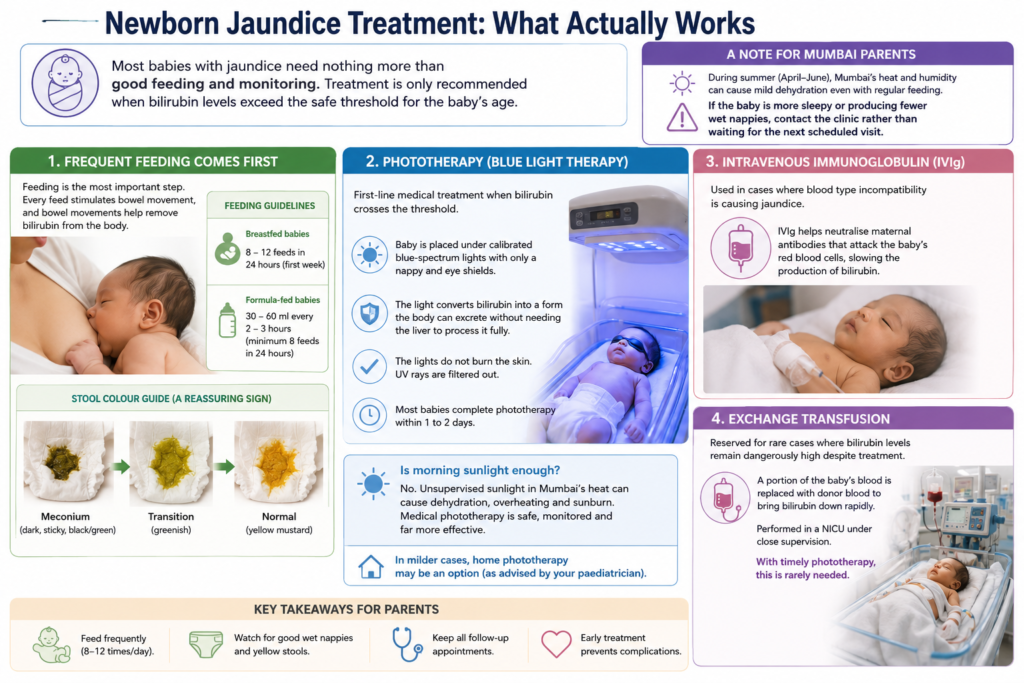
Most babies with jaundice need nothing more than good feeding and monitoring. Treatment is only recommended when bilirubin levels exceed the safe threshold for the baby’s age.
Frequent Feeding Comes First
Feeding is genuinely the most important thing parents can do. Every feed stimulates a bowel movement, and bowel movements are how bilirubin leaves the body. Stool colour shifting from dark meconium to yellow mustard is actually a reassuring sign that bilirubin is being cleared.
For breastfed babies, the target is 8 to 12 feeds in 24 hours during the first week. For formula-fed babies, 30 to 60 ml every 2 to 3 hours with a minimum of 8 feeds in 24 hours is the guideline.
A practical note for Mumbai parents: during the summer months from April through June, Mumbai’s heat and humidity can contribute to mild dehydration in newborns even with regular feeding. If the baby seems more sleepy or is producing fewer wet nappies than expected, contact the clinic rather than waiting for the next scheduled visit.
Phototherapy (Blue Light Therapy)
When bilirubin levels cross the treatment threshold, phototherapy is the first-line medical treatment. The baby is placed under calibrated blue-spectrum lights wearing only a nappy and small eye shields. The light converts bilirubin into a form the body can excrete without needing the liver to process it fully.
The lights do not burn the skin. UV rays are filtered out. Parents who have heard the instruction about morning sunlight exposure will often ask whether that is an alternative. The honest clinical answer is that it is not. Unsupervised sunlight in Mumbai’s heat carries real risks of dehydration, overheating, and sunburn in a newborn. Medical phototherapy is calibrated, monitored, and far more effective. Most babies complete phototherapy within one to two days.
In milder cases, home phototherapy may be an option the paediatrician can discuss.
Intravenous Immunoglobulin (IVIg)
In cases where blood type incompatibility is driving the jaundice, IVIg may be used alongside phototherapy. It works by neutralising the maternal antibodies that are attacking the baby’s red blood cells, slowing the rate of bilirubin production at the source.
Exchange Transfusion
This is reserved for the rare situation where phototherapy has not been effective and bilirubin levels continue to rise to dangerous levels. A portion of the baby’s blood is replaced with donor blood to bring bilirubin down rapidly. It is performed in a neonatal intensive care unit under close supervision. With timely phototherapy, exchange transfusion is rarely needed.
Can Newborn Jaundice Be Prevented?
Physiological jaundice is a normal part of the newborn period and usually cannot be prevented entirely. However, the severity can often be reduced with a few straightforward steps.
Start feeding within the first hour after birth. Colostrum, the early breast milk produced before the full milk comes in, acts as a natural laxative that helps clear meconium and bilirubin from the gut. Every early feed matters.
Request a bilirubin check before leaving the hospital and schedule a paediatric follow-up within 48 to 72 hours of discharge. Do not skip the day 3 to 5 check.
If the mother has Rh-negative blood, inform the paediatrician immediately after delivery so blood type incompatibility can be monitored from day one.
Parents who are bringing visitors home in those early days should also take care to manage the baby’s exposure to illness. Keeping a healthy environment for a newborn matters significantly. This guide on newborn visitor rules for friends and family visiting a baby is worth sharing with well-meaning relatives.
A Final Word for Parents
Discovering that a newborn has jaundice in those first fragile days can feel frightening, especially when parents are still finding their footing with feeding, sleep, and the enormous responsibility of a new life. The goal of everything written here is not to alarm anyone but to give parents the clarity and confidence to know what is normal, what to watch for, and exactly when to reach out for help.
Most babies with jaundice go home, feed well, and are perfectly healthy within a fortnight. A small number need phototherapy for a day or two. A very small number need further investigation. The difference between a good outcome and a complicated one almost always comes down to how quickly a parent noticed something was off and sought medical review.
Trust the instinct. When something feels wrong, pick up the phone.
If the baby is showing any signs of jaundice or parents have any concerns after hospital discharge, booking a consultation at Vivasvan Child Care Clinic in Mumbai is the right next step. Early review is always better than worrying at home.
Book a Consultation with Dr. Vivasvan Parekh
Frequently asked questions about newborn jaundice
Bilirubin levels in full-term babies typically peak between day 3 and day 5 of life. This window often falls after hospital discharge, which is exactly why a follow-up visit with the paediatrician within 48 to 72 hours of going home is so important. In premature babies, the peak may occur slightly later, around day 7. Parents should not assume the baby is out of the woods just because everything looked fine at discharge.
Yes, very much so. Up to 60% of full-term newborns and around 80% of premature babies develop some degree of jaundice in their first week of life. In the vast majority of cases, it is a normal physiological process as the baby’s liver matures and adjusts to life outside the womb. That said, all cases of jaundice should be evaluated by a paediatrician to confirm the type and severity and to rule out any underlying cause.
Jaundice that appears within the first 24 hours of birth always needs immediate attention. Similarly, if the yellowing spreads to the arms and legs, if the baby is very difficult to wake or is refusing to feed, if the cry sounds unusually high-pitched, or if the body is arching backward, these are emergency signs requiring an immediate visit to the hospital. For non-emergency concerns, contact the clinic if jaundice lasts beyond two weeks in formula-fed babies or four weeks in breastfed babies.
This question comes up in almost every consultation. Filtered morning sunlight has a very mild effect on bilirubin, but it is not a reliable or medically recommended treatment, especially in Mumbai’s climate. The heat and humidity can cause dehydration and overheating in a newborn very quickly, and the risk of sunburn on delicate newborn skin is real. Medical phototherapy using calibrated blue-spectrum lights is significantly more effective and completely safe. Always consult the paediatrician before trying any home remedy for jaundice.
In formula-fed babies, jaundice typically resolves within two weeks. In breastfed babies, particularly those with breast milk jaundice, it can persist for four to six weeks and this can be completely normal. If jaundice extends beyond these timelines, a paediatric consultation is necessary to investigate whether an underlying condition such as cholestatic liver disease is contributing. Duration alone is not cause for panic, but it should always prompt a professional review.

Vivasvan Parekh
As a pediatrician and child specialist based in Mumbai, I bring over 15 years of experience in delivering comprehensive child healthcare. I hold an MD in Pediatrics and practice in Ghatkopar East and Chembur, where I focus on preventive and evidence-based pediatric care. My areas of expertise include vaccinations, newborn care, growth and development monitoring, and the treatment of common and complex childhood illnesses. I am committed to supporting parents with practical, reliable guidance on child health, nutrition, and overall well-being. Through my blog, I share trusted insights on pediatric health, helping parents make informed decisions about their child’s care and development.